
Stone cladding is one of the fastest ways to give a villa character, and it is also one of the line items that quietly inflates a budget. Full-thickness natural stone is heavy, brittle in transit, and impossible to wrap around an arched opening without cutting, kerfing or a very patient fixer. That is exactly the gap our flexible rock stone panel fills: a bendable mineral sheet with a rugged natural-rock surface that can be rolled into a carton and pressed onto curved walls. This article explains how we specify it on villa projects, which details to confirm before ordering, and where it fits alongside the rest of the wall finishes.
What the Panel Actually Is
The flexible rock stone panel is a thin mineral decorative cladding with a moulded surface that reproduces the rough, uneven relief of quarried rock. The face carries the stone texture; the carrier layer behind it is what makes the sheet flexible, so the panel can be rolled for packing and unrolled on site. Because it is thin and light, it adds far less load to a substrate than solid stone or thick rigid panels, which matters when you are cladding an existing partition, a lightweight steel-frame wall or an upper-level surface.
On site the sheet is worked with ordinary hand tools: cut to size, drilled for services and fixings, and bent onto a curved form. Joint treatment stays simple because the panels are thin, so installers do not need the heavy lifting gear, diamond saws or structural supports that thick stone slabs demand. Colour options are available as stocked finishes, and surface painting can be customised when a project needs a specific tone to match an existing facade or an interior palette.
Why Villas Choose a Flexible Panel Over Solid Stone
| Factor | Flexible rock stone panel | Full-thickness natural stone |
|---|---|---|
| Wall load | Thin mineral sheet, adds little weight to the substrate | Heavy; may need a stronger background wall or a structural ledge |
| Packaging and freight | Rolled for packing and transport, so cartons are compact and easier to consolidate with other fit-out goods | Crated slabs, fragile in transit, breakage risk on long hauls |
| Curved work | Bends onto arches, columns and special-shaped surfaces | Rigid; needs cutting and kerfing, or the curve is abandoned |
| On-site tools | Cut, drilled and bent with simple hand tools | Heavy lifting gear and stone saws typically required |
| Fire and moisture | Fireproof, waterproof and mould-resistant as specified for the product | Naturally non-combustible; performance depends on the stone and fixing system |
None of this means solid stone is the wrong choice — a quarried slab has a depth of break that no moulded face copies exactly. It means that for curved geometry, upper levels, renovation over an existing wall and long-haul freight, the flexible panel reaches the same visual result with far fewer constraints.
Where It Earns Its Place in a Villa
The panel is used on both interior feature walls and exterior facades, and the applications that suit it best are the ones where rigid stone struggles:
- Arched openings and curved walls. Entry arches, curved bay walls, rounded columns and cylindrical features can be clad in one continuous wrap rather than pieced together from cut segments.
- Villa renovation. Existing render or blockwork facades can be re-skinned without demolishing the background wall or adding significant weight.
- Feature walls in living areas and lobbies. Fireplaces, media walls, stair voids and reception backdrops gain depth from the relief texture, which reads well under directional lighting.
- Outdoor and semi-outdoor surfaces. Garden walls, pergola piers, pool surrounds and terrace parapets, where a water-resistant, mould-resistant finish is preferred over timber.
- Guest annexes, wine rooms and landscape structures. Smaller outbuildings where the stone look is wanted but the scale does not justify a full masonry package.
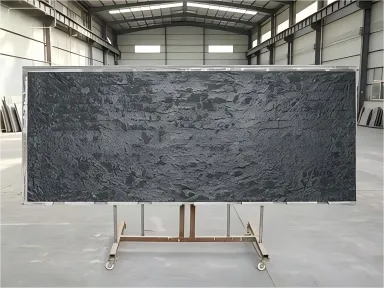
Rugged rock relief on a flexible mineral sheet, used where solid stone would be too heavy or impossible to bend.
How We select It on a Project
1. Fix the exposure first
Interior feature walls and exterior facades are different specifications. For external use, the panel itself is water-resistant and weather-tolerant, but the joints, edges and adhesive line are what usually fail if they are not detailed properly. Tell us whether the surface faces rain, splash, sun or a heated interior; we match the finish and advise on detailing accordingly.
2. Decide how much relief you want
Rock-look surfaces range from shallow, almost flat strata to deep, broken relief. Deep relief looks dramatic in a double-height stair void but is harder to keep clean in a kitchen splash zone and catches dust in a low-level hallway. In guest rooms and corridors we usually steer clients toward a shallower texture and let the lighting do the work.
3. Confirm colour and finish against a physical sample
Stocked colours cover the common stone tones, and custom surface painting is available for projects that need to match an existing facade or a designer's palette. Always approve a physical sample under the actual on-site lighting before confirming volume; photographs flatten the relief and shift the tone.
4. Measure the curves properly
For arched and curved work, send us the radius or a sketch of the geometry along with the heights and openings. The panel bends, but every curve has a practical limit depending on thickness and texture depth, and knowing the radius in advance lets us confirm feasibility and plan the panel layout so joints land where they are least visible.
5. Order as part of the wall package
Wall finishes rarely arrive alone. Grouping the cladding with the other surfaces it meets — flooring, ceiling, joinery and lighting — avoids the awkward gaps where two suppliers' tolerances collide.
Related Wall Finishes in the Same Range
If rock texture is not right for a particular room, the same flexible mineral format comes in other surfaces, so a villa can carry one consistent construction method across different looks:
| Finish | Surface character | Typical villa use |
|---|---|---|
| Flexible rock stone panel | Rugged, uneven natural-rock relief | Facades, garden walls, fireplaces, arched openings |
| MCM flexible travertine stone veneer | Thin sheet replicating the pitted texture of travertine, with weather-resistant properties for outdoor use | Hotel-style villa lobbies, external facades, curved surfaces |
| MCM flexible rammed earth panel | Soft ceramic sheet reproducing traditional rammed-earth strata, in white and earth-brown tones | Feature walls, landscape terraces, courtyard walls |
| Flexible wood grain cement wall panel | Cement-based sheet moulded with a realistic timber grain, non-combustible, supplied in a white raw surface for on-site painting | Curved ceilings, soffits, feature walls where timber is not wanted near heat or moisture |
| Wall panels and wall cladding range | Decorative, 3D and moulded panel options beyond the flexible mineral sheets | Interior feature walls and panelling |
Procurement, Delivery and Installation
Because the panels roll rather than pack as rigid slabs, they ship in a much smaller volume than an equivalent area of natural stone — which is where a large part of the real saving on a villa project sits. Freight, not the sheet itself, usually dominates the landed cost of stone cladding, and a rolled carton is easier to consolidate with the rest of a fit-out order.
As a China-based manufacturer of furniture and building materials, we supply this panel as part of a wider villa package rather than as an isolated line item. Under our turnkey villa solution, wall cladding is coordinated together with furniture, building materials and interior fixtures, so one team handles the specification, production and delivery. Our custom and OEM service covers bespoke colours, textures and finishes when a design calls for something outside the stocked range, and our logistics and door-to-door delivery service handles freight arrangements and documentation through to site. For installation questions on curved or exterior work, our team provides site guidance before the panels are laid.
We have delivered villa fit-outs in Australian projects including Willoughby, Perth, North Turramurra, Melbourne and Sydney — see project cases for the work we have published.
Ordering Checklist Before You Confirm Quantities
- Interior or exterior exposure, and whether the surface sees splash, direct rain or heat from a fireplace.
- Substrate type and its condition — render, board or masonry — and who is preparing it.
- Panel layout drawing for curved elements, with radii and opening dimensions marked.
- Approved physical sample under on-site lighting, including the chosen colour or custom paint finish.
- Order quantity with a cutting allowance for curves, openings and pattern matching, plus spare sheets held on site.
- Delivery address, packaging format and how the cartons will reach the level of use.