
A swim spa usually arrives on site long before the paperwork around it is finished. On a villa or resort build, the Outdoor Swim Spa WS-SP600-MS touches the architect, the structural and MEP engineers, the pool contractor, the electrical contractor, the client's representative and the procurement or asset manager. That is a lot of signatures for one item, and each one asks a slightly different question. This guide sets out who needs to approve what, in which order, so the approvals run alongside production instead of holding up the delivery.
Start with an approval map, not a product datasheet
Most approval delays on swim spa packages come from sending one document to everyone. The architect reads dimensions, the electrical contractor reads power, the commercial manager reads price and delivery, and all four people end up waiting on each other's comments. Build a short register first: for every party, name the decision they own, the information they need to make it, and the date by which you need their signature.
For a configurable product such as the WS-SP600-MS, keep the register tied to a single configuration reference. The catalogue lists options including control systems, UV sterilisation, water pumps, heat pumps, sand filtration, insulation and steps, and availability varies by model. If one consultant approves an early draft while another sees a later revision with different options, you will re-run approvals from the start.
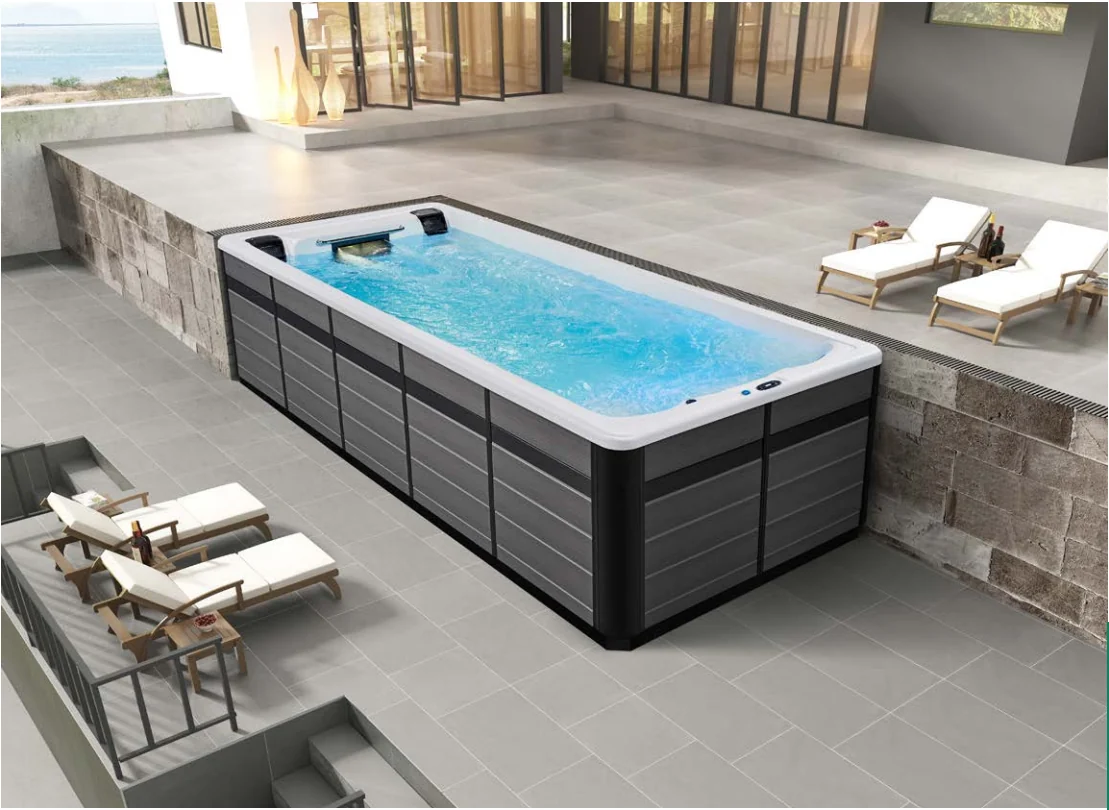
Catalogue image of the Outdoor Swim Spa WS-SP600-MS as published on the SANTERSON product page.
Who signs off, and what each party is looking for
| Party | Decision they own | Evidence they will ask for |
|---|---|---|
| Client or asset owner | Final configuration, finish and budget | Configuration list with options included or excluded; product page and imagery; total project package price |
| Architect or interior designer | Placement, clearances, surrounding finishes | Footprint and height, access route to the position, details for coping, decking and steps |
| Structural engineer | Slab, plinth or deck support, and site access for installation | Delivery method, shell dimensions, whether the unit is set into a recess or stood on a prepared base |
| MEP or electrical consultant | Power supply, protection and earthing arrangement | Total power figure for the selected configuration, control system scope, routing for supply and controls cabling |
| Pool, landscape or civil contractor | Base preparation, drainage, plant location | Filter pump and equipment layout, insulation scope, drainage falls around the installation position |
| Procurement or main contractor | Purchase order, delivery window, installation sequence | Confirmed configuration and quantity, packaging and container plan, delivery terms, on-site installation support |
Local authority or body corporate approvals sit with the client's team in most projects. Flag them early as a separate line in the register; they follow local rules that neither the manufacturer nor the designer can sign off on your behalf.
Read the catalogue figures as a starting point, not as the final spec
The published record for this model gives a footprint of 5900 × 2500 × 1600 mm, one control system, one swim training system, one water pump, one filter pump, 29 jets, four LED lights and a total power figure of 11.55 kW, with water jets, LED lighting, ozone and a swim training system shown as features. Those numbers are enough for space planning and early electrical discussions.
Treat them as catalogue values for the standard listing. The same shell is also listed in a variant with a different jet count and a lower total power figure, which tells you plainly that the electrical load follows the selected equipment rather than the model name alone. Ask for the specification sheet of your exact configuration before any consultant signs an electrical design or a builder fixes a cable schedule.
Sequence the approvals so they overlap production
A workable order on a project we would typically see for Swimming Pools and Swim Spas:
- Stage 1 — scope freeze. Client confirms the configuration, options in or out, and the installation position. Nothing else can be signed until this is fixed.
- Stage 2 — technical review. Architect, structural engineer and MEP consultant comment in parallel on the same issue pack: dimensions, base requirement, power figure, controls routing.
- Stage 3 — commercial sign-off. Procurement issues the purchase order against the frozen configuration, with the delivery window agreed against the site programme rather than an assumed one.
- Stage 4 — pre-delivery confirmation. Final drawings or specification sheets are countersigned by the site contractor before shipping, so base works and first fix match what will arrive.
- Stage 5 — handover sign-off. Commissioning is witnessed, a snag list is raised on the day, and warranty terms plus spare-parts contact are recorded with the owner's documentation.
Stages 1 and 2 can start while other packages are still in design. Stages 3 and 4 must be closed before production releases, otherwise a late change to options or position becomes a variation on both the spa and the civil works.
Where approvals usually break down
- Options quoted loosely. A heat pump, sand filtration or extra steps mentioned in an email but absent from the approved list. Put every option on one line with "included" or "not included".
- Electrical design done off a marketing figure. The load depends on the equipment selected for the configuration; get the confirmed value before cables are ordered.
- No named approver. Comments arrive from three consultants and nobody consolidates them. Nominate one person to close each comment.
- Access not checked. A 5900 mm shell has to reach the position. Confirm the route, lifting or crane needs, and any overhead obstruction with the builder before delivery is booked.
- Handover undocumented. Without a signed commissioning record and warranty file, later service requests have no baseline.
How a single supplier simplifies the sign-off chain
When the spa is bought separately from the rest of the outdoor package, the client's team becomes the interface between several vendors, and every clarification costs a round of email. Sourcing it inside Turnkey Interior Project Solutions means the swim spa, surrounding outdoor furniture and finishes for the same terrace come from one production and coordination team, so one set of drawings and one contact covers the whole area.
The commercial side also narrows down. Furniture Logistics and Door-to-door Delivery covers freight, packaging and customs paperwork through to the site, so delivery terms are fixed in one contract rather than negotiated between a spa vendor and a furniture forwarder. After installation, Furniture Installation and After-sales Support is where snags, warranty records and spare parts are logged, which is exactly the documentation your handover sign-off needs.
For projects where the terrace shape or the option set does not suit a standard shell, the range includes a Customizable Shape Outdoor Spa - Personalized Hydrotherapy Pool, so an approval can be resolved by changing the specification rather than switching suppliers mid-programme.
Send your drawings, the intended installation position and your required delivery window to our project team, and we will return a configuration specification for your consultants to review in one round.