
An outdoor dining programme rarely fails on the furniture itself. It fails when the people who have to sign it off are asked to approve too much at once, or approve things that cannot be changed later without cost. The Extendable Aluminum Slat Dining Table, Matching Wicker Dining Set & Bar Table Stool Set is a good test case for that discipline: one rope-woven chair design covering three layouts — an extendable slat-top dining table, a square terrace dining set and a high bar set — which means the approval chain has to cover capacity, finish consistency and zone mixing at the same time.
Why this product family creates extra approval work
The series is described as a unified rope-woven outdoor family covering three layouts that recur in hospitality projects. The extendable slat-top dining table is the anchor: it can be stretched to seat more diners when occupancy peaks. The square dining set covers small terrace corners, and the high bar set with stools suits pool bars and café front areas. Chairs are woven rope on aluminium frames, and metal surfaces are powder coated.
That single design language is exactly what makes approvals awkward. Operations want the extendable table because it protects peak-season covers. Food and beverage want the bar set because it turns a pool deck into revenue after dark. Design wants one visual identity across both. Procurement wants fewer line items. If those four conversations happen separately, you end up with three sets of drawings, three finish schedules and nobody owning the conflict between them.
Map the approvers before the first sample is made
For a project of this type, we have found it fastest to name one decision-maker per question rather than one per department. In practice that means:
- Capacity and layout — the operator or F&B lead signs off on how many extendable tables go into which zone, and what seat count each table carries closed versus open.
- Finish consistency — the interior designer or architect confirms rope colour, frame tone and tabletop option once, for all three layouts, so the dining terrace and the pool bar do not drift apart.
- Specification changes — whoever holds the budget signs off on dimensional changes, since table dimensions, frame tones and rope colours can be adjusted to match project design schemes, and each change resets production.
- Site readiness — the builder or site manager confirms level substrates, clearances around the bar set and storage for stools, before delivery is scheduled.
Write these four names into one document. It sounds obvious, but the delay we most often see on outdoor furniture for villas and resorts is a finish being re-decided after production has started because two people both believed they owned that decision.
Split the approvals into three decisions, not one
Bundling everything into a single "approve the furniture" milestone is how projects lose weeks. Ask for approval in this order instead.
| Decision gate | What is approved | Who signs | What must not be reopened afterwards |
|---|---|---|---|
| 1. Layout and quantity | Which of the three layouts appear in which zone; seat counts; number of extendable tables | Operator / F&B lead | Table dimensions and quantities |
| 2. Finish package | Rope colour, frame tone, tabletop choice — applied across all three layouts together | Designer / architect | Colour and finish references |
| 3. Commercial terms | Order split, delivery sequence, site access for installation | Procurement / project manager | Delivery windows and container mix |
The point of the table is the last column. Once a finish package is signed, changing rope colour on one layout only — for example switching the bar stools but not the dining chairs — breaks the unified look the family was chosen for. Make that consequence visible at gate 2, not at delivery.
Use samples as evidence, not as decoration
For custom and OEM work, design and prototyping, bespoke finishes and material choices are confirmed with the client before bulk production. For this product family that gives you a practical approval artefact: a chair corner showing the rope weave at real scale, the powder-coated frame tone under your own site lighting, and the tabletop edge detail.
Two habits make samples useful rather than expensive:
- Approve against a written reference — record the rope colour, frame tone and tabletop option in words and codes on the sample itself. A sample without a written reference is a rumour.
- Photograph the sign-off — a dated photo of the approved sample, initialled by the named approver, settles later disputes faster than any email thread.
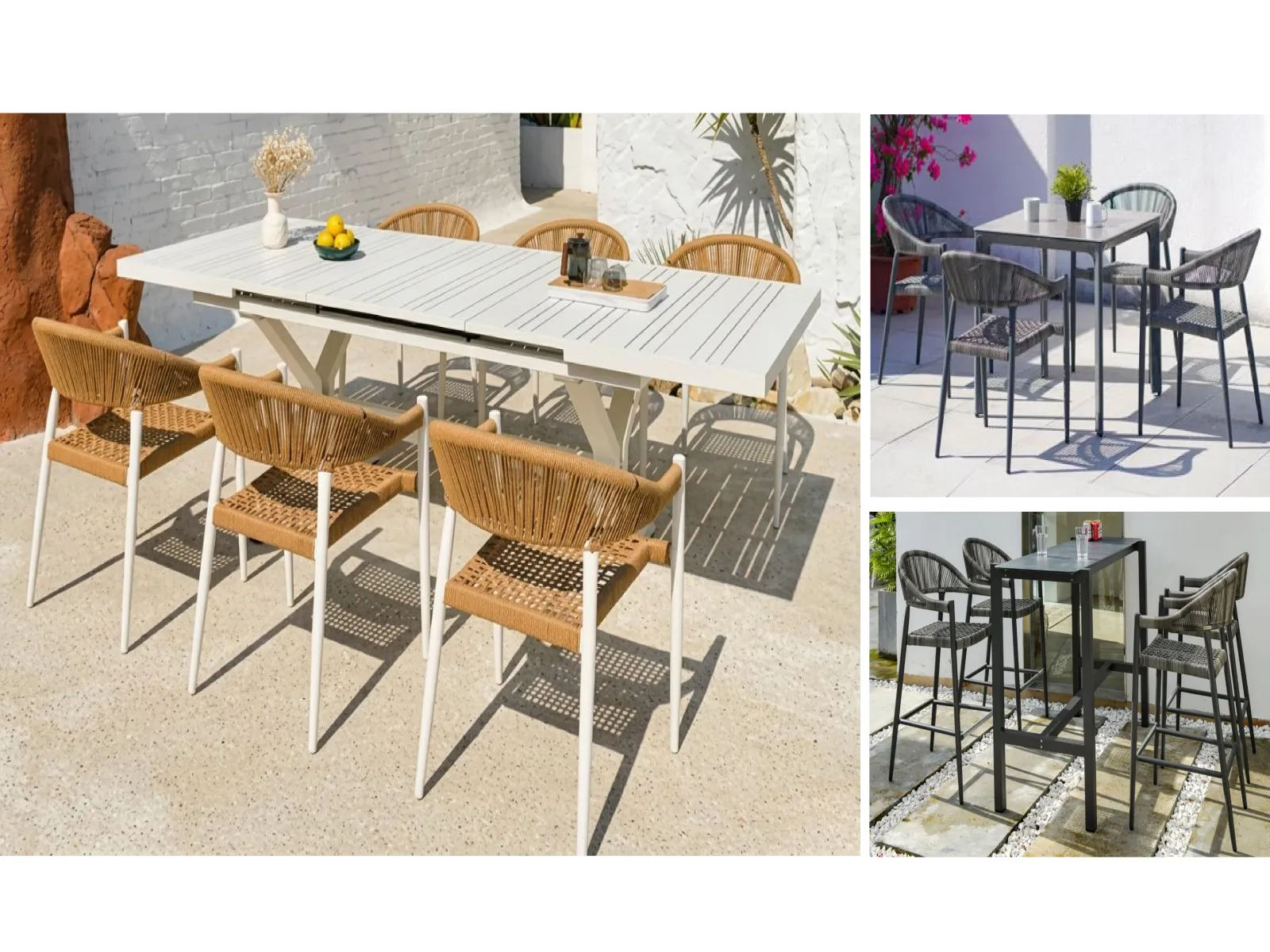
One chair design, three layouts: the extendable slat-top table, square dining set and high bar set are specified together so finishes stay consistent across zones.
Run a single sign-off sheet for all three layouts
Because the family is meant to work as one programme — resort outdoor restaurant, holiday villa, coastal café, mixed leisure zone — keep one approval sheet covering all of it. Our recommendation for what belongs on that sheet:
- Zone plan showing where each layout sits, with measured clearances
- Seat count per table, closed and extended, signed by the operator
- Finish block: rope colour, frame tone, tabletop option — one entry, applied to all three layouts
- Any dimensional deviation from standard, flagged as a change with its cost and schedule impact
- Named approver and date against every line
If you are coordinating this alongside interior fit-out — cabinetry, flooring, wall finishes, lighting — the same sheet structure works, which is why a one-stop furniture and building materials supplier arrangement saves time: one document set, one specification owner, one production coordination point instead of several vendors each holding their own version of the truth.
Common approval failures and how to close them
- Approving the dining set first, the bar set later. The bar stools are where finish drift shows up fastest. Approve all three layouts in one gate.
- Deciding "extendable" after production starts. Extension mechanism and table length affect the top, base and packing. Lock seat counts before the layout gate closes.
- Letting the rope colour be chosen from a screen. Confirm the colour on a physical sample under site lighting; screen rendering of woven texture is unreliable.
- No named owner for site readiness. A delivered bar set on an unprepared deck becomes a storage cost. Name the site contact on the same sheet.
Sign-off checklist — what must be closed before production is released
- Zone plan with clearances, signed by operator and site manager
- Quantities: extendable dining sets, square dining sets, high bar sets
- One finish package covering rope colour, frame tone and tabletop for all layouts
- Approved physical sample, referenced in writing and photographed
- Delivery sequence and site access confirmed with the builder
Related products in the same approval family
If your project needs a second outdoor dining language — for example a warmer timber-look palette on one deck and a cleaner line on another — these matching sets follow the same rope-and-aluminium logic and can be approved on the same sheet:
- Aluminum Outdoor Dining Set & Bar Table Stool Set with Teak Accents — sled-base aluminium frames with teak details, for beach terraces and pool bars.
- Rope Weave Outdoor Dining Set & Bar Table Stool Set with Teak Armrest — oval dining set plus high bar set in the same rope weave.
- Thick Rope Woven Outdoor Dining Set with Multi Tabletop Options — one chunky braided chair matched with sintered stone or teak-look slat tops in round or square.
Browse the full range in Outdoor Furniture for Villas and Resorts.
Send your zone plan and target seat counts, and a specification sheet covering all three layouts — extendable slat dining table, square dining set and high bar set — can be returned with the finish package and dimensional options marked up for approval before anything enters production. Enquiries are handled through our contact page.