
A wall-hung basin looks simple on a specification sheet. Four numbers, a shape, a colour. The problems never show up in the showroom either — they appear six months after handover, when a fixings bracket pulls away from a partition, when two guest bathrooms in the same hotel read as mismatched because they were ordered from different series, or when the tap hole sits where the chosen faucet cannot reach. If you are sourcing a wall hung ceramic basin for apartments, boutique hotels or villa bathrooms, the supplier conversation is where most of that risk is removed. Here is what a serious buyer should be asking, and why.
Start with the fixing method, not the shape
Every wall-hung basin in this category carries its own weight plus the load of a person leaning on it. What matters is how that load reaches the wall. The Model 1051B fixes to the wall through its back panel, so the basin bears against a solid bearing surface rather than hanging from a single bracket. That is the first question to put to any supplier: is the unit back-panel mounted, and what wall construction does it assume? A back-panel-fixed basin behaves very differently on a fully built masonry wall than on a timber stud partition with a reinforcement frame behind the plasterboard.
Ask for the fixing detail in writing before you order. A supplier who can describe the bracket arrangement, the required substrate and the rough-in position is a supplier who has produced this item before. One who answers only with a photograph has not.
Check the dimensions against your actual shaft, not a typical one
The 1051B measures 400 mm wide by 380 mm deep by 450 mm high — a compact footprint that suits guest powder rooms, ensuite bathrooms and hotel rooms where a vanity cabinet would crowd the plan. Those figures come from the product listing and should still be checked against the technical data sheet for the batch you intend to buy, along with the waste and water connection positions, because those are what your plumber sets out before tiles go on.
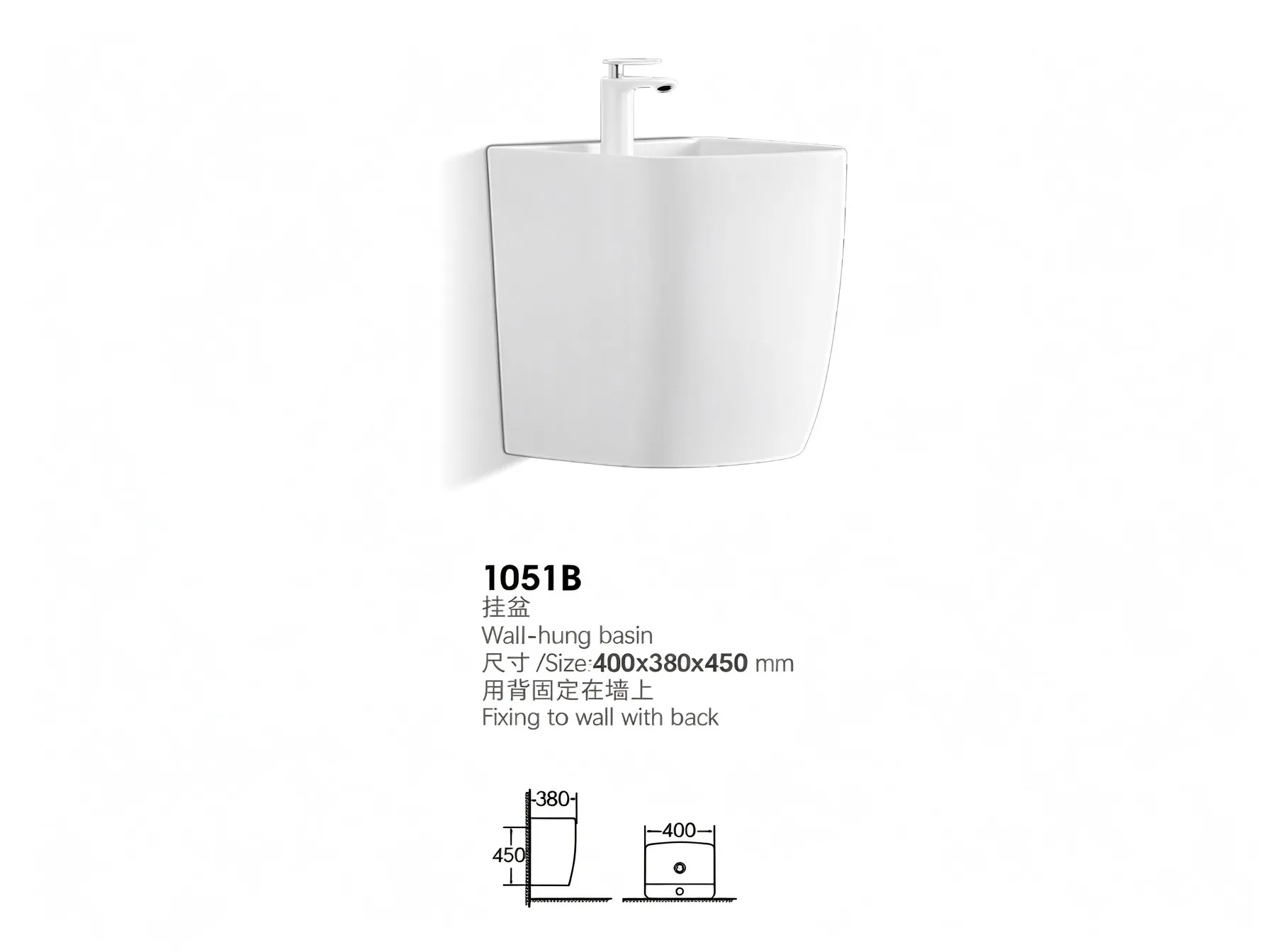
Model 1051B wall-hung ceramic basin with back-panel wall fixing and a single tap hole.
A practical test for any supplier: send them your bathroom elevation drawing and ask them to confirm the rough-in height, the outlet position and the tap set they would recommend. If they cannot work from a drawing, treat that as a capability signal, not a service detail.
Ceramics age differently — ask what the glaze is doing
In contract use, a basin is wiped hundreds of times a year with whatever cleaning chemical the housekeeping team has on the trolley. Vitreous ceramic with a dense, high-gloss glaze resists water marks, limescale and staining far better than a porous or thinly glazed body, and it is the difference between a washbasin that still looks new at year five and one that has gone dull around the splash zone. The 1051B is made from vitreous ceramic with a dense glossy glaze, which is the specification you want for high-frequency use.
What to ask for: the body material, the glaze description, and how the supplier handles breakage in transit. Ceramic travels badly when it is packed carelessly, so packaging method and container loading practice are part of the product quality conversation, not a separate logistics topic.
Buy the suite, not the basin
This is where project buyers save the most rework. The 1051B belongs to the 1051 sanitary suite, which also covers the wall-hung WC and a freestanding pedestal basin in the same soft, rounded profile. When guest bathrooms, ensuites and public restrooms all draw from one series, the curves, glaze tone and hardware match across the building without anyone having to police it on site.
| Where it is used | What to specify alongside it |
|---|---|
| Guest powder room, compact ensuite | 1051B wall-hung basin; single-lever faucet to the reserved tap hole; no cabinet required, floor left clear underneath |
| Hotel guest bathroom with a wall drain | 1051W wall-hung WC (P-trap rough-in) sharing the same design language and glaze |
| Larger bathroom where floor-standing is preferred | 1051S freestanding pedestal basin in the same 1051 collection, for consistent styling across room types |
| Villa or serviced-apartment fit-out | Basins, WCs and vanities coordinated through one supplier so finishes arrive together |
One caution: the 1051W wall-hung WC uses a P-trap wall drain with a concealed cistern. That is a different plumbing arrangement from a floor-drain S-trap layout, and it has to be decided before the wall is closed up. Confirm which drainage arrangement your building actually has before you commit to a wall-hung WC anywhere in the suite.
Judge the supplier on what happens after the proforma invoice
Anyone can quote a unit price. The value of a manufacturer sits in four things that are easy to test during the enquiry stage:
- Specification support. Can they read your drawings, flag a clash between your rough-in and their product, and propose an alternative from the same series rather than simply selling what you asked for?
- Custom and OEM scope. For bathroom fit-outs it is rarely the basin alone — custom and OEM service covers bespoke finishes, materials and branding across vanities, cabinetry and matching fixtures, so one specification can carry through the whole floor.
- Logistics you can plan around. Freight forwarding by sea, air and rail, customs paperwork, packaging and container loading, shipment tracking and door-to-door delivery all affect your site programme. Get the Incoterms, packing list and insurance arrangement in writing for each shipment; do not assume a marketing promise is a service level.
- Handover support. Installation guidance, snag inspection, spare parts and warranty terms should be defined before order confirmation, because replacement ceramic matched to a glaze colour is difficult to source once the series changes.
What a complete enquiry should contain
To get a comparable quotation from two or three manufacturers, send the same package to each: room-by-room bathroom schedule with quantities; the elevation drawing showing drainage type and position; your chosen faucet model so tap-hole spacing can be checked; the target delivery port and preferred Incoterm; and the installation sequence your contractor is working to. With that, a manufacturer such as SANTERSON — operating since 2008 as a China-based maker of furniture and building materials for villa, hospitality and office projects — can confirm the model, flag anything that does not fit, and price the basins together with the vanities, cabinetry, lighting and finishes around them through one coordinated package instead of five separate purchase orders.
Sourcing a wall-hung basin is not really about the basin. It is about whether the supplier can tell you, before you pay, exactly how it attaches to your wall, what has to be behind that wall, and what happens if one unit arrives cracked. Ask those three questions of every manufacturer on your list; the answers will shorten it faster than any price comparison.