
A rope weave outdoor dining set paired with a matching high bar table and stools solves a problem that project buyers meet on almost every coastal or resort job: two different seating zones, one design language, and a single procurement line to manage. The question is not whether the look works in renders. It is when a custom version of this kind of suite makes commercial sense, and when it quietly adds cost, risk and lead time to a programme.
This article sets out the points we see on villa, resort and food-and-beverage projects, what can actually be changed on a made-to-order suite, and what a buyer should have settled before a custom order is placed. It uses our Rope Weave Outdoor Dining Set & Bar Table Stool Set with Teak Armrest as the reference example, because it is a coordinated suite rather than a single item.
What the suite actually contains
The reference product combines two zones in one series: an oval dining set and a high bar table with bar stools. Both share the same chair design, so the vertical rope weave and the teak arm details repeat across dining chairs and bar stools. On site that matters more than it sounds. A pool bar close to the restaurant terrace reads as part of the same scheme when the seat profile, rope pitch and timber tone match, and reads as two separate purchases when they do not.
The chair frame is solid aluminium with an anti-rust powder coating, and the cushions use outdoor-grade fabric. The weave itself is a vertical rope pattern, which suits seaside terraces and beach cafes: the open structure lets air move through the seat back, and it does not hold water the way a tightly upholstered back does. Those are descriptions from our own product page rather than independent test results, so check them against a physical sample before you specify.
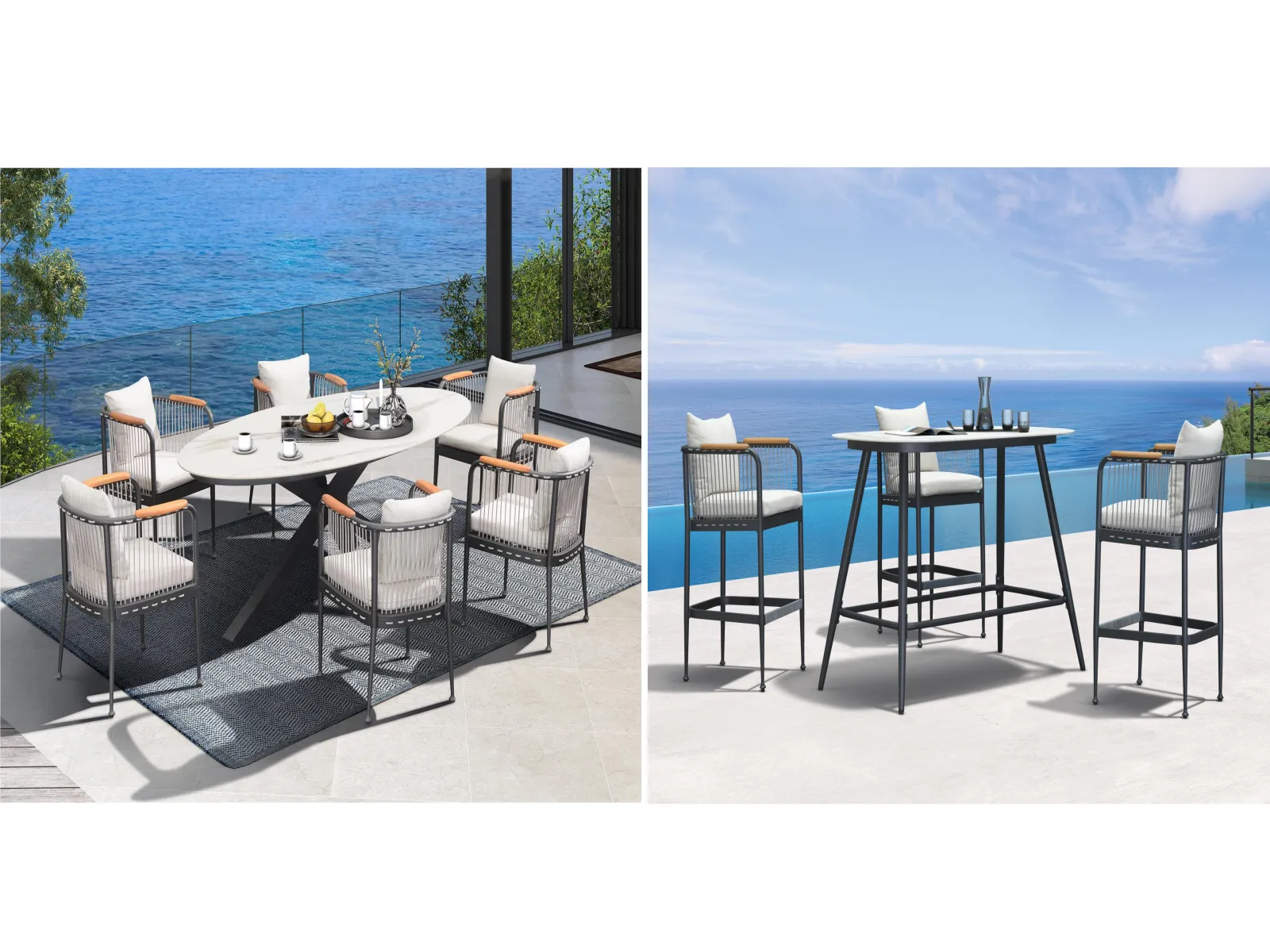
Coordinated rope weave dining and bar suite with teak arm details, as shown on the SANTERSON product page.
What customising actually changes on site
Custom work is only worth the extra cost when a standard catalogue dimension or finish would force a compromise elsewhere in the design. The compromises we see most often cluster in six places.
- The terrace footprint does not match the catalogue table. A standard oval table suits an open villa deck but can clash with a restaurant setback line or a column grid. Where column spacing, balustrade offsets or service routes fix the plan, changing table dimensions at drawing stage is cheaper than re-laying pavers later.
- Dining and bar zones must read as one scheme. Buying seating for two zones from two ranges means matching rope colour, weave tension and teak tone across suppliers. One production line handles it, with one finish approval to sign off.
- Seat count is a revenue question, not a preference. Cover targets in an F&B operation drive the number of place settings. A made-to-order suite lets you set that quantity instead of accepting whatever a stock set offers.
- Upholstery has to survive housekeeping. Commercial cleaning regimes, chlorine exposure and daily stacking wear out a domestic-grade cover quickly. Choosing the fabric and the removal method at order stage avoids a replacement cycle well inside the life of the frame.
- Teak is the visible wear surface. Arm caps take the most handling on any outdoor chair. Settle the timber specification and how it will be cared for, then record both in the project maintenance documentation from day one.
- The project needs matching pieces beyond the dining set. If lounge seating, loungers or a swing bench appear in the same outdoor areas, ordering within one series keeps the styling consistent across zones.
When customising is not worth it
Where none of those conditions apply — a small patio, standard dimensions and no bar zone — a catalogue configuration is usually the better buy. The same applies when the terrace has no fixed seating requirement at all: relocatable stock sets are easier to re-plan during a fit-out than made-to-order pieces. Customisation should be justified by a constraint you can point to on a drawing, not by a preference for a slightly different silhouette.
What can be changed, and what stays fixed
For this suite the adjustable items are upholstery, frame finish and table dimensions for hospitality project orders. Our Custom & OEM service covers bespoke material finishes and textures, prototyping, flexible minimum order quantities and branding such as engraving or logos on components.
| Element | Typical custom option | What to confirm before approval |
|---|---|---|
| Rope weave | Rope colour and weave density on the seat back | Sample for UV and salt-air exposure in your location; check tension and repair method |
| Aluminium frame | Powder-coat colour from a stated RAL range | Coating specification and thickness, edge treatment, touch-up provision |
| Teak arm caps and tops | Timber grade, profile, oiling or unfinished supply | Maintenance routine, spare-part availability, replacement supply |
| Cushions | Outdoor fabric, colour, foam density, cover closure | Cleaning regime, storage routine, whether covers are removable in the field |
| Table dimensions | Diameter or length adjusted to the layout | Base and leg position against chair spacing; still enough clearance for service routes |
| Quantity mix | Dining chairs and bar stools ordered in project quantities | Whether both zones are on one production batch, so finishes match |
The parts that generally stay fixed are the structural logic: the chair construction, the frame geometry and the way the weave is anchored. Those are what make the piece durable, and changing them turns a product into an engineering exercise with prototyping time attached.
Where project buyers get this wrong
The most common failure is not aesthetic. It is specifying an outdoor suite from a photograph and discovering at handover that nobody agreed who maintains the rope and the teak once the operator runs the terrace itself.
- No sample sign-off. Rope colour under showroom lighting and rope colour on a west-facing terrace in full summer sun are not the same material. Approve a physical sample against the actual finish palette.
- Cushion fabric chosen by look alone. Specify cleanability and storage before colour, then match colour to the approved scheme.
- Bar stool height assumed rather than measured. Bar height and seat height must be set together; a mismatch shows up only when the stools arrive.
- Spare parts forgotten. Teak arm caps and rope sections are the wear items on this kind of chair. Order spares with the main batch, while the batch is running.
- Two zones, two suppliers. Splitting dining and bar seating across ranges produces near-matches in timber tone and rope colour that read as an error as soon as both zones are in use.
Freight, handover and site readiness
A custom suite is a scheduled item, not a stocked one. The practical sequence on our side runs through design and specification confirmation, quotation and detail confirmation, then production, shipment and follow-up. Our logistics and door-to-door delivery service handles freight forwarding by sea, air and rail, customs paperwork including commercial invoices, packing lists and certificates of origin, container loading and shipment tracking.
Two points are worth pinning down in the contract rather than in correspondence: which Incoterms apply to your delivery, and who carries risk once goods land. Transit times, duties and import terms vary by consignment, so we settle them case by case instead of quoting a figure that may not hold. Equally, an outdoor area needs its substrate complete — pavers laid, drainage falls set and any balustrade fixed — before furniture arrives, otherwise crates sit in storage and the opening date slips.
Related outdoor collections
If the same terrace also needs lounge seating, matching rope weave pieces keep the scheme coherent: the Rope Weave Outdoor Sofa Set with Teak Armrest & Nesting Coffee Tables carries the identical seat profile into lounge zones. For a more architectural line, the Aluminium Outdoor Dining Set & Bar Table Stool Set with Teak Accents uses an aluminium sled-base chair with teak detailing, which suits infinity pool bars and beachfront restaurants. The full Outdoor Furniture range covers loungers, daybeds, pergolas, gazebos and swing benches for resort gardens and villa terraces.
As a hospitality furniture and building materials supplier, SANTERSON has manufactured furniture and building materials since 2008 and supplies outdoor collections alongside interior fixtures, cabinetry, lighting and finishes for villa, hotel and office projects. Ordering dining, bar and lounge zones from one turnkey programme means one specification sheet, one finish approval and one delivery window.
Send us the terrace layout
If you are pricing outdoor dining and bar zones for a villa, resort or F&B project, send the plan with target seat counts and your location. We will confirm which dimensions, rope colours, frame finishes and cushion fabrics can be produced for that site, and quote the suite as one line. Contact PHILLIP on WhatsApp +86-13928214007 or email santerson@qq.com.