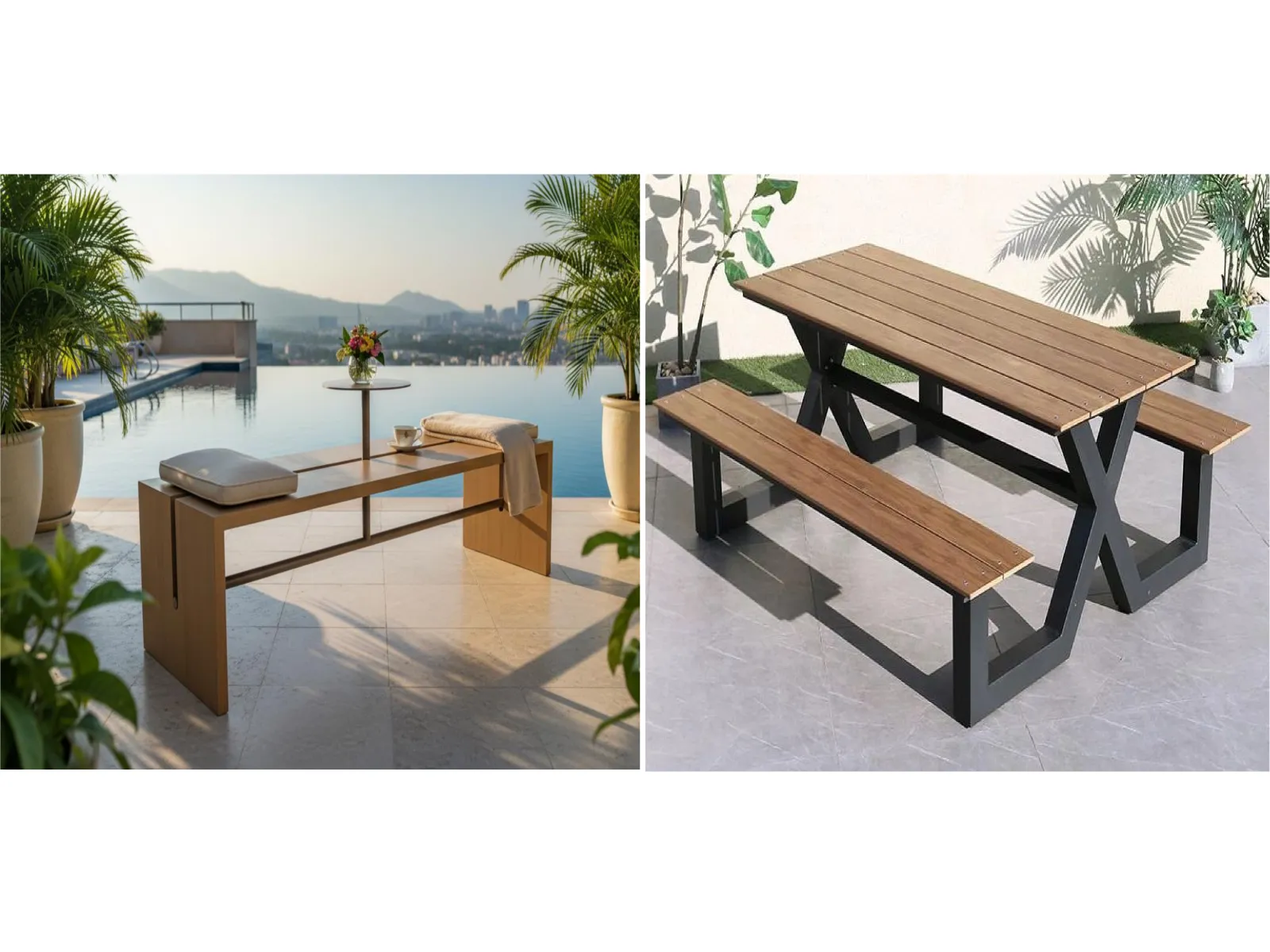
A procurement brief is the document that decides whether an outdoor item arrives as specified or as a compromise. For shared exterior seating, the Teak-Look Aluminum Outdoor Bench & Integrated Picnic Table Set is a useful test case: it looks like timber, behaves like metal, and comes in two very different configurations that are easy to confuse on a purchase order. This guide sets out what a buyer, specifier or contractor should write down before the quotation stage, so the bench, the picnic table and everything around them land on site as intended.
Start With the Two Configurations, Not One Line Item
This product group covers two separate items that share the same teak-effect aluminium slat look. They are not interchangeable, and a brief that names only the collection invites substitutions.
| Configuration | What it is | Where it belongs in a scheme |
|---|---|---|
| Minimalist bench with side tray | A two-person bench paired with a small integrated side surface for drinks, towels or a book. | Rooftop relaxation corners, poolside edges, terrace landings where people sit briefly rather than dine. |
| Integrated picnic table with fixed benches | A table with attached benches on an X frame, built for group meals and shared seating. | Resort terraces, clubhouse courtyards, communal gardens, staff or guest dining lawns. |
Write each one as its own line item with its own dimensions, finish code and quantity. If the design intent is a continuous seating run along a fence line, say so — fixed-bench picnic units cannot be reconfigured the way loose chairs can, and that limitation should be resolved on paper before production.
State the Material Logic in the Brief
The commercial argument for aluminium slats with a teak-effect finish is maintenance. Solid timber outdoors demands regular cleaning, oiling or resealing, and it moves, splits and weathers. Aluminium does not rot, is not eaten by insects, and tolerates salt spray, which is why coastal resorts and pool decks tend to specify it. The trade-off belongs in the brief too: a teak-effect finish is a surface treatment, so the brief should name the finish system, the colour tone and the expected wear pattern for the location rather than simply writing "teak".
Where a project genuinely requires solid timber — a heritage context, a specified species, a client preference — that decision should be recorded as an exception and priced separately, not quietly swapped into an aluminium line item.
Dimensions, Clearances and Site Conditions
Outdoor furniture fails on site more often through clearance than through material. Before the brief is signed off, capture:
- The overall footprint of each unit, plus the usable clear zone around it for access, cleaning and service routes.
- The supporting surface: pavers, timber decking, compacted gravel, concrete slab or a raised roof deck. Fixed-bench picnic units need a level, load-bearing base.
- Whether the installation sits under an aluminium pergola, a hardtop gazebo or an open sky. Overhead cover changes both the finish exposure and the drainage detail underneath.
- Fixing or ballast requirements for rooftop and elevated decks, including any restriction on drilling into waterproofing.
- Proximity to pools, spas and irrigation spray, which affects slip resistance expectations and cleaning frequency.
SANTERSON's product page states that dimensions and colour tones can be adjusted to match project design requirements, so a non-standard length or tone is a specification conversation, not a rejection. Record the required change in writing on the brief with the reason attached.
Coordinate With the Rest of the Outdoor Package
A bench specified in isolation rarely reads well once installed. Slats, tones and frame profiles should be consistent across the terrace. If the same teak-effect aluminium language is already used for dining and lounging, matching items from the wider outdoor furniture range keeps the palette coherent and reduces the number of finish samples to approve. Where a scheme mixes materials — rope weave, wicker, powder-coated frames — the brief should state which items anchor the design and which are accents.
Practical rule: specify one anchor collection for each outdoor zone, then allow at most one deliberate contrast material per zone. That keeps procurement simple and the finished terrace legible.
What the Brief Should Explicitly Cover
Pre-quotation checklist
- Item name, configuration (bench with side tray or integrated picnic table) and quantity per location.
- Overall dimensions, seat height and required clearances for each position on the layout drawing.
- Frame material, slat profile and named finish tone, with a physical sample reference.
- Base condition and fixing method for each installation point.
- Any custom dimension or colour change, with the design reason stated.
- Packaging, container loading and delivery address, including access constraints for larger fixed units.
- Inspection and snag process on handover, and who signs it off.
Working With a Manufacturer Who Handles Custom Runs
Because these sets are usually produced to order rather than held as stock, the specification stage is where cost is controlled. Custom & OEM service covers bespoke dimensions, finishes and branding, and a clear brief reduces revision rounds. SANTERSON works as a one-stop furniture and building materials supplier, so the same coordination that covers seating can also cover pergolas, screens, lighting and paving-adjacent finishes on one project file — which is where outdoor packages usually go wrong when they are split across several vendors.
For Australian villa and hospitality work, freight, customs paperwork and site delivery should be defined in the same brief as the furniture itself. Confirm Incoterms, delivery point and who is responsible for the last leg to an elevated or restricted-access terrace before production starts.
Approvals Before Production
Two approvals prevent most disputes: a signed finish sample showing the teak-effect tone against the actual paving or decking, and a dimensioned layout drawing showing every unit in position. Once both are countersigned, changes become variations with a price and a lead time attached; before that point they are free.
Send the brief with the checklist above completed. A supplier can quote faster, flag conflicts early and propose an equivalent configuration where the original would not work — which is exactly what a procurement brief is meant to achieve.