
A rug rarely decides a project on its own, but it is one of the last items to arrive and one of the first things a guest or owner notices. When the schedule is already tight, an under-specified rug line becomes an expensive problem: re-dyeing, re-weaving, or a lobby that does not match the design intent. The way to avoid that is to write the rug line the same way you write any other FF&E line — with enough detail that the factory can quote and build it without guessing. Below is how we fill in that line for the Modern Abstract Art Texture Polyester Area Rug, and the same structure works for any other rug or carpet in a villa, hotel or office package.
Start With the Room, Not the Pattern
Before discussing colours or designs, record where the rug is going. Traffic level and use pattern drive fibre choice, pile height, backing, pad specification and cleaning method far more than aesthetics do. For this product family, the site positions it for living rooms, bedrooms, villa lobbies, hotel interiors and office space — a wide range, and each of those settings asks something different of the same construction.
Write the room first: room name, floor finish underneath, door clearances, expected traffic, and whether spills are likely. Everything below that line follows from it.
The Six Fields a Rug Line Needs in the Brief
| Field | What to record | Why the factory needs it |
|---|---|---|
| Location and traffic | Room, floor type, daily traffic level, spill exposure | Sets fibre, pile density, backing and whether a pad is required |
| Size and shape | Overall size, cut-to-size tolerance, orientation of the pattern | Standard sizes quote directly; non-standard sizes change lead time and packaging |
| Fibre and construction | Polyester face yarn, weave type, pile height where stated | Determines wear behaviour, sheen, and how the design reads at distance |
| Colour reference | Named palette plus a physical sample or dye lot instruction | Neutral beige, blue and brown tones shift noticeably between batches |
| Edge and finish | Binding, serged edge, or custom edge detail | Affects cost, thickness at door thresholds and long-term fraying |
| Quantity and phasing | Total pieces, split by room, delivery sequence | Determines whether one dye lot is possible or batches must be matched |
Reading the Material Specification Correctly
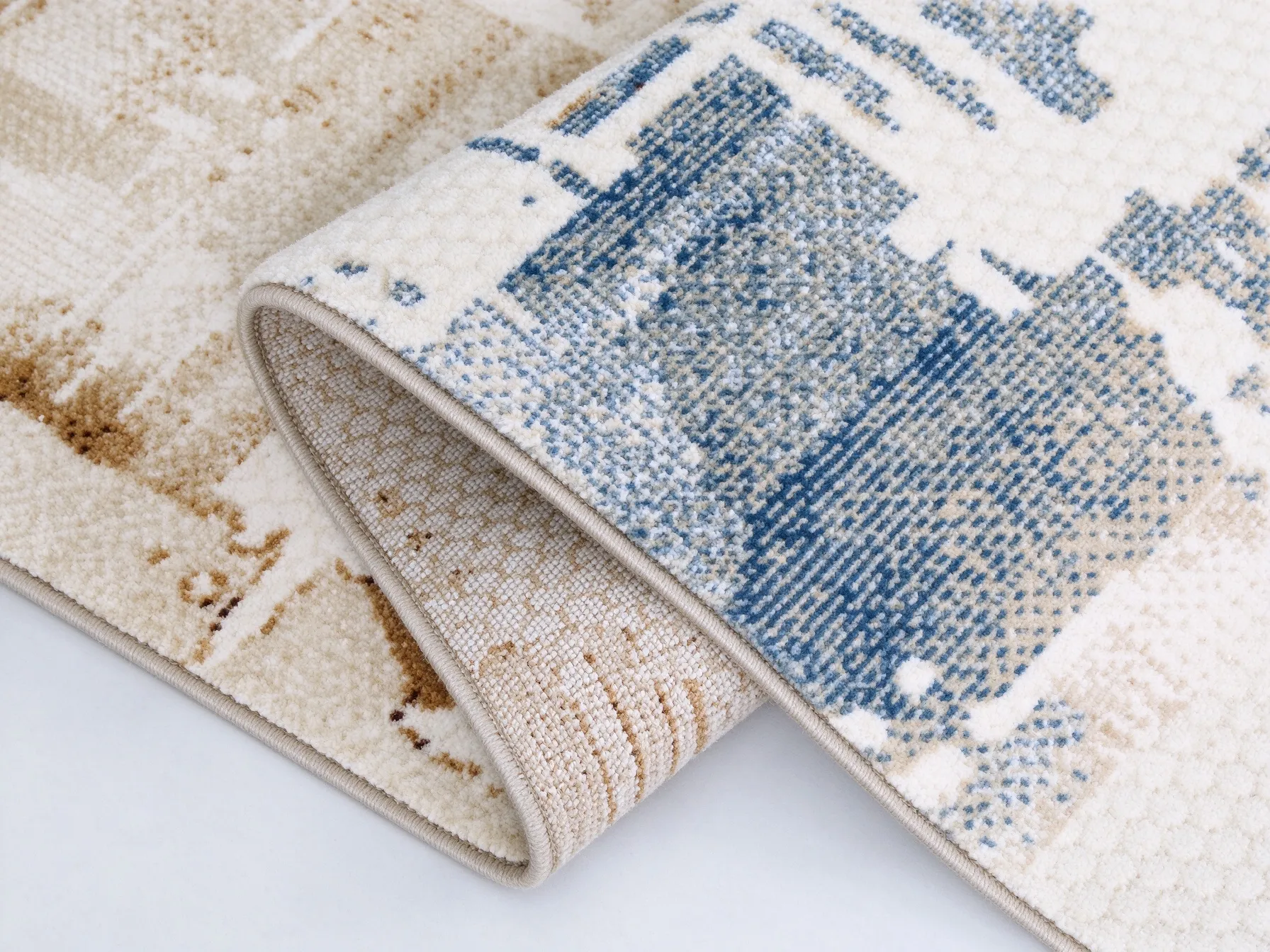
This rug is specified as a polyester face yarn with an artistic brushstroke texture in beige, blue and earth-brown tones. The catalogue copy describes it as soft underfoot, wear resistant and stain resistant, with a fine weave intended to hold its structure without shedding or fading. Treat those as supplier-stated characteristics of the product line, and confirm the exact construction — pile height, total thickness, face weight, backing type — against the sample you approve, not against the brochure.
Polyester earns its place in project work because it tolerates routine cleaning well, holds colour consistently, and costs less than wool at comparable density. Where a specification calls for fibre content to be proven on paper, ask for the mill's own test documentation and check it against your project's requirements rather than assuming a generic claim covers them.
Where a project needs more body underfoot or a visible sheen, compare the line with the Modern Luxury Abstract Polyester Shiny Silk Area Rug, which is built from polyester bright silk and polyester shrink yarn at a stated 12 mm total thickness. Same design language, different hand and light response — useful in a suite or reception where the rug should catch the light, less obvious in a corridor.
Sizes: Standard Stock Versus Cut-to-Size
Multiple standard sizes are held in stock for this design, and larger custom sizes are supported. That distinction belongs in the brief as two separate line items, because a stock size and a made-to-size rug behave differently on price, lead time and packaging. A practical approach:
- List every standard size you can use as-is; take the schedule win.
- Flag only the rooms where the design genuinely requires an oversized piece — typically a living room or lobby seating group where furniture legs must sit on the rug.
- State the tolerance for cut-to-size pieces and who measures on site.
- Confirm how a large piece is packaged and carried, especially up stairs or through narrow service doors.
Colour Approval: Sample Before Order
Neutral palettes are the hardest to approve from a photograph. Beige shifts warm or cool depending on the light source, and a blue that reads grey in daylight can turn obvious under warm 2700 K lobby lighting. Two rules that keep approvals clean:
- Request a physical sample and review it in the actual room, at the room's own lighting, before signing off.
- For multi-piece orders, state whether all pieces must come from one dye lot, and record the approved sample reference on the purchase order so later batches can be matched.
Specifying Rugs Inside a Larger Package
Rug lines are easier to manage when they are not ordered alone. In a villa or hotel fit-out, the same supplier is usually handling kitchen cabinetry, sanitaryware, lighting, wall finishes and flooring — items that share delivery windows, storage space and installation crews. Grouping them under one turnkey furniture and building materials package means one coordination point for the whole interior schedule, so the rug arrives when the room is actually ready for it rather than sitting in a corridor.
Where the brief calls for wall-to-wall carpet instead of an area rug — guest rooms, ballrooms, banquet halls — that is a different product route with its own specification fields: fibre blend, tufting or jacquard construction, pile weight and roll width. See the Customizable Commercial Carpet for Hotel, Banquet Hall & Villa Projects page for that route, and keep it as a separate line item so area rugs and wall-to-wall carpeting are not quoted against the same assumption.
Coordination Fields That Prevent Site Problems
- Delivery sequence: which rooms must be finished first, and where later pieces are stored in the meantime.
- Thresholds and door clearances: total rug thickness plus pad against the undercut of each door.
- Floor protection during handover: cover laid rugs before trades finish adjacent work.
- Cleaning brief at handover: what the operations team should use, and what they must not use.
- Punch-list responsibility: who inspects edges, and who replaces a damaged piece.
A Short Procurement-Brief Template
Copy this into the FF&E schedule and fill one line per room:
| Item | Entry format |
|---|---|
| Product | Modern Abstract Art Texture Polyester Area Rug, ref. 2239 |
| Room / qty | Level 01 Living Room — 1 pc; Level 02 Master Bedroom — 1 pc |
| Size | Standard size __ / Cut to __ x __ mm, tolerance +/- __ mm |
| Colour | Beige–blue–brown brushstroke, approved sample ref. ______ |
| Edge | Bound edge, colour ______ |
| Substrate / pad | Existing timber floor, pad required: yes / no |
| Delivery | Required on site by ____, storage location ____ |
| Approval | Sample approved by ______ on ______ |
Send us the schedule. Share your room list, sizes and reference images, and we will quote the rug line against a physical sample before production — with the same coordination we already run for the rest of the interior package.
Contact: PHILLIP | Phone / WhatsApp: +86-13928214007 | Email: santerson@qq.com
Enquiries receive a response within 24 hours, Monday to Saturday, 8:00 AM – 6:00 PM (GMT+8).