
A dark brown European oak engineered board can carry an entire interior palette — but only if the brief states what the buyer actually needs. This guide sets out the fields to define, the wording to avoid and the questions worth asking a supplier before you lock the floor schedule.
Why this finish keeps appearing in project schedules
Dark brown oak sits in an unusual position. It is warm enough for a residential living room, restrained enough for a hotel guest room, and dark enough to anchor pale stone, bouclé upholstery and brushed metal without competing with them. In villa and hospitality fit-outs we regularly see it specified as the single material that ties joinery, wall panelling and loose furniture together.
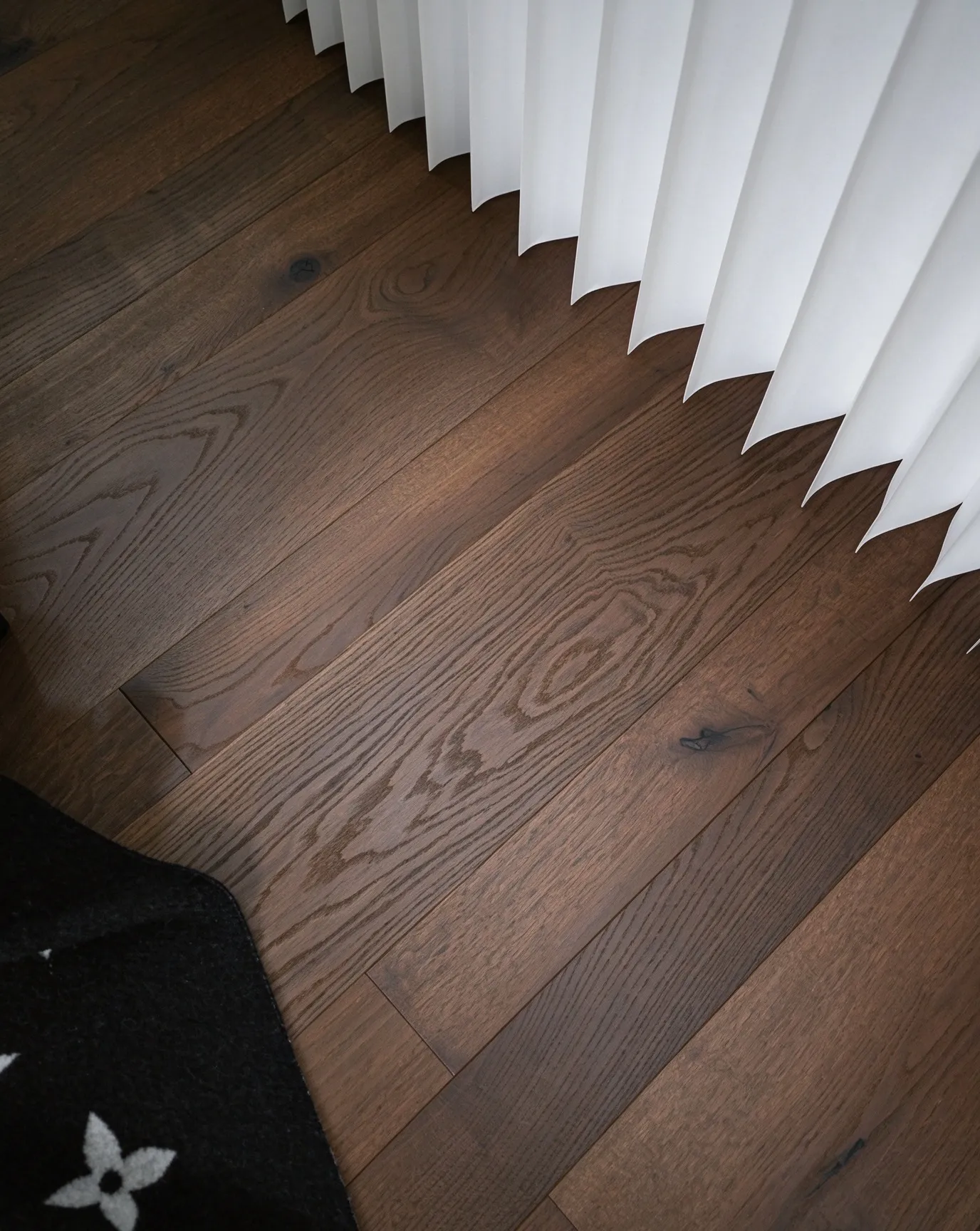
The engineered construction is what makes it practical at project scale. Dark Brown European Oak Engineered Wood Flooring, for example, is built with a 3 mm solid oak top layer over a multilayer base, and that cross-layered structure is what limits the movement you would otherwise expect from a deep-toned board in a conditioned building. The grain stays honest — knots, figure and colour variation remain visible, which is exactly why samples matter.
The short version: specify construction, top-layer thickness, finish system, board format, grade tolerance, subfloor conditions and sample approval in writing. Anything you leave as "dark oak, as shown" will come back at the shop-drawing stage.
Section 1 — Product identification
Start the brief with a single line that removes ambiguity. A supplier quoting from "oak flooring, dark brown" will send you whatever they have in stock; a supplier quoting from a defined construction and finish will send what you asked for.
- Species and origin of the wear layer — European oak, solid sawn veneer rather than printed transfer foil
- Construction type — multilayer engineered board, with the core described by material, not just "stable"
- Top-layer thickness as a measured figure, since this governs whether the board can ever be refinished
- Total board thickness and board format (plank width and length), which drive layout and wastage
- Reference sample or product code, with the date of that sample noted
Section 2 — Finish system and colour tolerance
"Dark brown" is not a specification. Two boards can both be called dark brown and sit a full step apart once one has been smoked and the other stained. State how the colour is achieved:
- Smoked or fumed finish — colour driven by a reaction with the tannins in the oak, which keeps the grain three-dimensional
- Stained finish — pigment applied over the wood, easier to match across batches but flatter in appearance
- Topcoat — matte, satin or gloss lacquer / oil, and how many coats, because sheen changes how dark a floor reads under lighting
Then define the acceptable range. Oak is a natural material; sapwood, mineral streaks, sound knots and colour drift between boards are part of what you are buying. The brief should say how much variation the design team will accept, and which features must be excluded. A useful test sentence: "Samples A, B and C are approved as the range; boards outside this range are to be sorted on site."
Section 3 — Application scope and performance context
State where the floor is going, because a guest-room floor and a lobby behave very differently. Cover:
- Room-by-room schedule with expected traffic level for each area
- Whether underfloor heating is present — engineered boards are commonly used over heated screeds, but the exact compatibility of the board and adhesive system must be confirmed against the current technical sheet, not assumed
- Substrate type, residual moisture reading and levelling tolerance at handover
- Acoustic requirements between floors, and whether an underlay or decoupling layer is required
- Wet areas and entry zones adjacent to the floor, where standing water and grit are the real failure modes
Where a project mixes formats, say so early. A corridor in straight plank meeting a lounge in European Oak Herringbone Engineered Wood Flooring needs a set-out drawing, a transition detail and one agreed board thickness across both products.
Section 4 — Quantity, packaging and delivery
Flooring claims are where procurement briefs get loose. Rather than quoting an industry-wide wastage percentage, ask the supplier to price against your set-out drawing and state their own allowance:
| Field | What the brief must record |
|---|---|
| Measured area | Net area per room from the drawing, with openings listed separately |
| Cut allowance | The wastage figure applied, and whether it accounts for the layout pattern and board lengths |
| Packing list | Square metres per carton, boards per carton, gross and net weight per pallet |
| Batch control | Whether the full quantity ships from one dye batch, and how spares for later phases are matched |
| Consolidation | Whether flooring shares a container with joinery, cabinetry or loose furniture — relevant when one supplier covers several trades |
| Site access | Delivery window, lift dimensions and storage conditions on site before installation |
Order the full quantity in one shipment wherever the schedule allows it. Matching a dark brown finish to a later top-up order is a colour problem you cannot solve with a sample tile.
Section 5 — Sample approval and acceptance criteria
Make sample sign-off a formal gate, not a courtesy. Before production starts, the brief should already fix:
- A physical board approved by the design lead, signed and dated, held on site and at the factory
- The lighting condition it was viewed under — daylight, warm LED or a mix — because dark floors shift noticeably between them
- Written acceptance criteria for colour range, grain character and permitted defects
- A mock-up area, typically one room or one bay, signed off before the remainder is released
- The inspection and snag process at handover, plus what happens to boards rejected during laying
Section 6 — Coordination with the rest of the fit-out
A floor rarely fails on its own; it fails where it meets something. If your flooring, cabinetry and wall finishes come from separate suppliers, you inherit the coordination work yourself. Ordering them through a one-stop furniture and building materials supplier means one party holds the board thicknesses, the transition details and the delivery sequence for all of it — which is how the flooring scope stays linked to joinery, wardrobes and loose furniture on a villa or hotel package rather than arriving as an afterthought.
For projects outside the country of manufacture, this also affects logistics: freight consolidation, customs paperwork and staged delivery are handled once instead of per trade. Our team works with buyers on furniture sourcing for Australian projects, where flooring typically ships alongside cabinetry and furniture for the same villa or hospitality site.
Related finishes in the same range
If the dark brown tone is being tested against alternatives, these are the boards we most often see evaluated alongside it:
- Charcoal European Oak Engineered Wood Flooring — cooler and greyer, for schemes where brown reads too warm
- European Oak Parquet Engineered Wood Flooring — classic parquet blocks in a deep brown grain
- European Oak Engineered Wood Flooring (2207) — the lighter honey end of the same construction, useful for continuity across rooms with different light levels
Send us your floor schedule. Share the room list, board format and target finish, and we will quote against your drawing — including packing detail, batch control and consolidated delivery with the rest of the package.
Contact: PHILLIP | Phone / WhatsApp: +86-13928214007 | Email: santerson@qq.com