
A curio cabinet in a hotel lobby, a guest-suite dressing area or a resort retail corner is a small item with an unusually long service life. It sits in the most visible part of the building, it is specified once and replaced rarely, and it has to survive daily handling by guests who are not careful with other people's furniture. That combination is why display cabinetry tends to arrive late in a hospitality package and then cause rework: the dimensions no longer match the wall, the lighting detail was never agreed, or the finish does not sit with the joinery already ordered. The following procurement sequence keeps Santerson Curio Cabinets inside the normal fit-out programme instead of outside it.
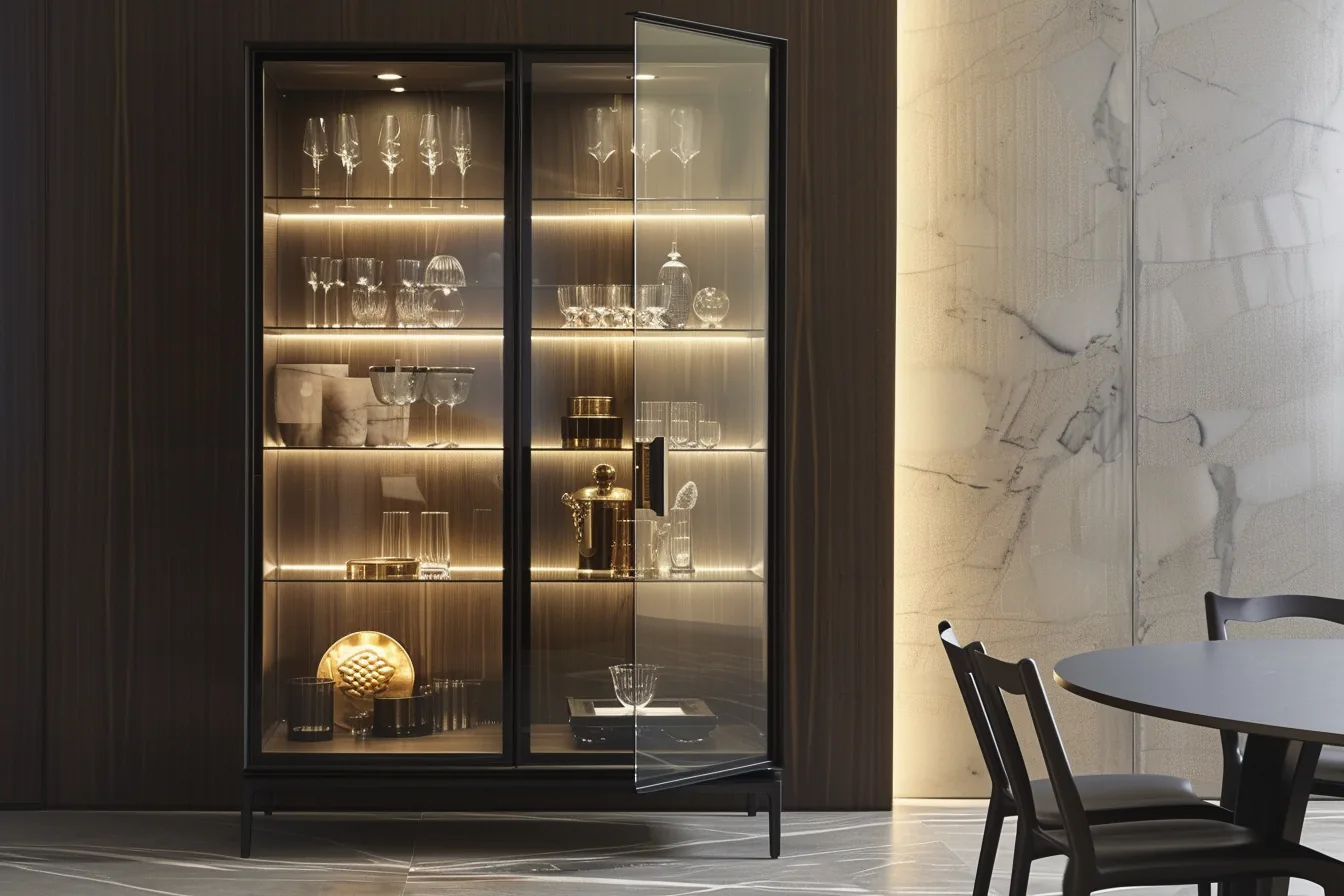
Santerson Curio Cabinets are configurable display cabinets supplied to project-specific dimensions and finishes.
What Santerson Curio Cabinets Actually Are
The Santerson Curio Cabinets range sits inside the Display Cabinets collection, alongside glass-front, illuminated, open and wall-mounted variants. Each unit is made to measure rather than offered in fixed sizes: dimensions, layout, materials and finish are specified for the individual space, which is what makes the range usable in a hotel where no two alcoves are identical.
That configurability is the reason the item needs an early place in your procurement schedule. A made-to-measure cabinet cannot be swapped in from stock when a site dimension changes by 120 mm, so the specification has to close before cabinetry production starts. The same applies to the internal layout — shelf heights, glass or solid doors, and whether the unit will hold glassware, artwork, porcelain or branded merchandise all change what the carcass needs.
Step 1: Decide What Each Cabinet Has to Do Before You Choose a Finish
Hospitality projects usually mix three different jobs under one line item. Write them separately in your schedule of accommodation:
- Lobby and public-area display. The cabinet is part of the arrival experience, so sightlines, lighting and proportion to the wall matter more than storage volume. Santerson Illuminated Display Cabinet and Glass Front Display Cabinets are the variants typically specified here.
- Guest suite and villa living areas. The cabinet supports the room's joinery language and has to store guest items as well as show pieces. Made-to-measure sizing lets it fill a recess flush with adjacent panelling.
- Retail, spa or F&B back-of-house display. Higher handling frequency, so door hardware, glass thickness and shelf loading need attention.
Grouping all three into one schedule line is the most common cause of variation orders later. One line per location type, with a room-by-room dimension list behind it, gives you a quotation you can actually compare.
Step 2: Lock Dimensions and Openings from Site Survey, Not Drawings
For built-in display work, order from a site survey taken after the wall build-up, floor finish and skirting are fixed. Record finished-face dimensions, not structural ones, and note the position of sockets, switches and any services running behind the recess. Curio cabinets are frequently placed against walls that also carry lighting circuits, and a cabinet that blocks an access point becomes a snag at handover.
If the unit is wall-hung rather than floor-standing, use the Santerson Wall Mounted Display Cabinets configuration and confirm the substrate behind the finish with your local contractor before production. Load-bearing requirements for glass shelving and the weight of the displayed items should be settled at this stage.
Step 3: Specify Lighting as Part of the Cabinet, Not After It
A curio cabinet without considered lighting reads as a dark box in photographs and in person. Because SANTERSON also supplies Santerson Integrated Cabinet Lighting, Santerson Wall Sconces and other decorative fixtures, the interior lighting can be coordinated with the carcass in one package instead of being retrofitted by a local electrician. Electrical specification, driver location, switching and any dimming control should be agreed with the cabinet design before the carcass is cut, since concealed wiring has to be routed during manufacture.
Confirm the electrical ratings and installation requirements for each lighting configuration with your supplier, and check what applies locally in the project country before ordering. Specification sheets should be reviewed by the local installing contractor rather than assumed from export documentation.
Step 4: Match Finish to the Wider Joinery Package
A display cabinet that does not match the millwork around it is visible in every guest photograph. Where curio cabinets sit next to kitchen, wardrobe or media-wall cabinetry, order them inside the same package so veneers, lacquers and glass tints come from one production run. The Interior Fixtures range covers built-in cabinetry, storage walls and shelving systems that normally share a finish schedule with display units.
SANTERSON's Custom & OEM service covers bespoke finishes, textures and materials — wood, metals, engineered stone and laminates — which is useful when a designer has a specific veneer or metal frame to reproduce across several cabinet types. Ask for a physical finish sample against your joinery schedule rather than relying on a digital image.
Step 5: Order Through One Package and Sequence the Delivery
Display cabinets are small enough to ship as part of a consolidated container, which is why they should not be procured separately. As a one-stop furniture and building materials supplier, SANTERSON handles freight forwarding by sea, air and rail, along with commercial invoices, packing lists and certificates of origin, and offers door-to-door delivery. Cabinet crates should be marked per room number against your schedule of accommodation so the site team can place each unit where it belongs instead of storing them and losing the mapping.
Practical sequencing that has worked on villa and hospitality fit-outs:
- Site survey and dimension sign-off before cabinetry production is released.
- Finish samples approved against the joinery schedule, in writing.
- Electrical and lighting details frozen with the carcass drawings.
- Cabinets consolidated into the joinery shipment, not a separate later one.
- Inspection on arrival, then installation after wet trades and floor finishes are complete, followed by snagging before handover.
SANTERSON's stated service scope includes installation and after-sales support alongside production and logistics. Confirm the current warranty terms, response times, spare-parts availability and which items are excluded for your specific project in writing before the order is placed; do not treat published marketing figures as contractual commitments.
Step 6: Build a Comparison Sheet Before You Request a Quotation
A quotation request that arrives without a defined internal layout produces a price you cannot compare. Send each of the following:
- Room-by-room schedule with finished-face width, height and depth, and floor-standing or wall-hung.
- Glass type for doors and shelves, plus door operation (hinged, sliding, open).
- Shelf count, spacing and expected load per shelf.
- Interior lighting specification with switching and dimming intent.
- Finish reference matched to the joinery package, with sample approval status.
- Delivery address, Incoterms and the installation scope you expect from the supplier versus your local contractor.
The same sheet lets you compare a made-to-measure display cabinet against an off-the-shelf alternative honestly: if the recess is standard and the finish schedule is forgiving, stock units may be cheaper. If the unit is built into a wall next to other millwork, custom cabinetry normally wins on the total package cost once site corrections are counted.
Common Procurement Mistakes With Display Cabinets
- Specifying one size for all locations. Made-to-measure work only pays off if each opening is measured individually.
- Leaving lighting to the electrical contractor. Concealed wiring cannot be added after the carcass is manufactured.
- Choosing glass without stating the load. Shelf depth and glass thickness follow from what will actually be displayed.
- Ordering cabinets after the joinery package closes. Finish matching then depends on a second production run.
- No room marking on crates. Unmapped delivery of many similar units creates avoidable installation errors.
Frequently Asked Questions
How early in a hospitality project should curio cabinets be specified?
At the same time as the rest of the built-in cabinetry, because dimensions, finishes and electrical routes are shared decisions. The detailed dimension sign-off can follow the wall survey, but the product family and lighting approach should be fixed earlier.
Can display cabinets match existing joinery on a renovation?
Yes, through made-to-measure sizing and bespoke finish options. Provide a physical sample or exact reference of the existing finish, and expect a sample approval step before production.
Are illuminated and non-illuminated cabinets supplied together?
The Display Cabinets collection includes both illuminated and glass-front configurations, and integrated cabinet lighting is available as a separate accessory category. Specifying them in one enquiry keeps the electrical detail consistent across the package.
What supports warranty and spare parts after handover?
SANTERSON lists installation, inspection, warranty coverage, spare parts and ongoing maintenance within its service scope. The exact terms for your project should be agreed and documented before ordering, including what is covered in the destination country.
Send your room schedule and get a made-to-measure display cabinet quotation
Share your schedule of accommodation, target finishes and lighting intent, and the SANTERSON team will confirm configuration options and pricing for your project. Contact PHILLIP on WhatsApp +86-13928214007, or send your enquiry through the contact page — enquiries receive a response within 24 hours.