
Why a Finish Sample Review Comes Before the Production Order
On a guest-room fit-out, the water closet is rarely specified alone. Basins, bidets, vanities, mirrors and wall finishes are issued together, and each supplier confirms colour, glaze and hardware at a different moment. That is where sample programmes go wrong: the toilet is approved against a brochure photograph while the tiles and joinery are approved from physical boards, so nobody sees the combination until the first mock-up room is assembled.
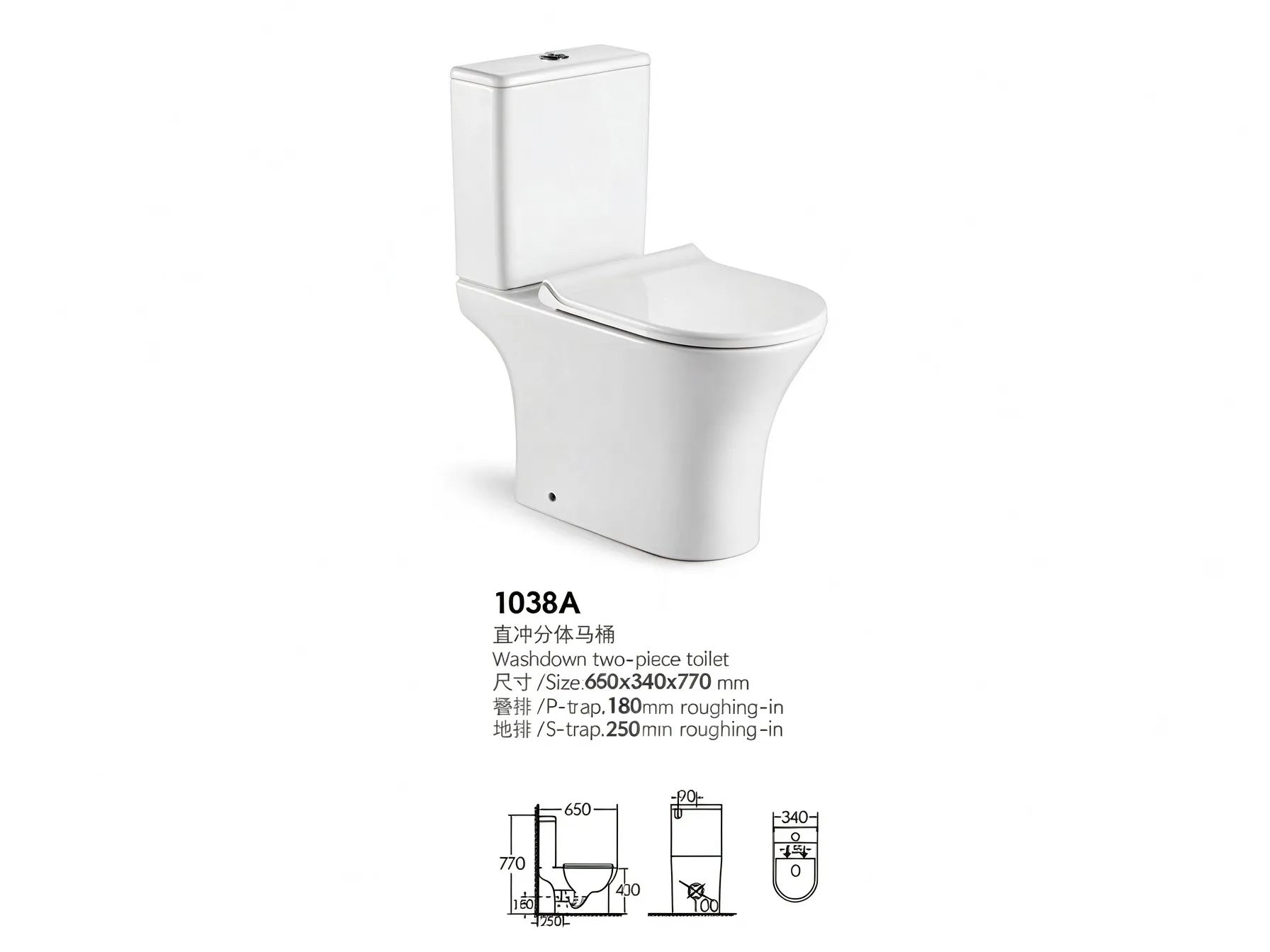
A finish sample review, the step carried out on a physical unit before the production order is released, settles those questions for the Two Piece Washdown Toilet 1038A, Dual S Trap & P Trap Ceramic WC Toilet for Hotel Bathroom while changes are still cheap. It is a two-piece vitreous china water closet offered with a wall outlet and a floor outlet option, intended for guest rooms, apartments and commercial washrooms. The review below follows the order a procurement team actually works in: what arrives, what you measure, what you compare, and what you sign off before bulk production begins.
What the Sample Package Should Contain
Before anything is inspected, confirm that the sample represents what will be manufactured in quantity. Ask the supplier to state, on the packing list and on the sample itself:
- the model reference and which outlet variant the sample carries, wall outlet or floor outlet;
- the glaze colour name and batch used for the sample, so later cartons can be matched to it;
- the seat, cover and fixing set supplied with it, including whether soft-close hardware is included;
- the tank-to-bowl connection method and the seal or gasket used between the two pieces;
- the flushing arrangement fitted, and the water inlet connection type and size.
For bathroom sanitary fixtures ordered across several room types, keep one approved sample physically sealed in the site office. Every shipment is then judged against that reference rather than against a memory of the first one.
Glaze and Colour: What to Check on the Sample Surface
Ceramic defects are easy to miss under warehouse lighting and impossible to hide once two hundred rooms are occupied. Inspect the sample in daylight or a neutral 4000K light, at arm's length and then close up:
- Colour consistency. Compare the bowl, the tank lid and the seat against one another. A cool-white bowl beside a warm-white tank reads as carelessness even when both are within tolerance individually.
- Pinholes and fish-eyes. Small craters in the glaze collect stain and are the first thing housekeeping complains about. Run a fingernail over the inside of the bowl and behind the rim area.
- Glaze coverage on hidden faces. The rear and underside should be fully glazed; unglazed patches absorb moisture and chip during handling.
- Shade match against adjacent finishes. Hold the sample against the wall tile, the vanity countertop and the painted wall. Ceramic white is not one colour, and a warm-white closet against a cool-white counter will look mismatched in photographs.
Outlet Type and Rough-In: Confirming the Dual Trap Arrangement
The distinguishing feature of this model is that it covers two plumbing conditions. The product data lists a wall outlet with an 180 mm rough-in and a floor outlet with a 250 mm rough-in, which lets one closet specification serve both older buildings with floor drains and newer stacks with wall returns.
| Check | What to do with the sample |
|---|---|
| Outlet type on the delivered sample | Look at the back and underside of the bowl. Confirm which outlet is fitted, since the two variants are not interchangeable once the waste pipe is set. |
| Rough-in dimension | Measure from the finished wall face to the centre of the outlet on the sample, then compare with the setting-out drawing for each room type. Record the figure rather than trusting the label. |
| Floor clearance | Stand the sample on a mock finished floor with the intended tile thickness underneath. A floor-outlet closet sits on the finished level, not the structural slab. |
| Waste connection parts | Ask which connector, seal or offset cuff is supplied for each outlet type, and confirm it suits the waste material used on site. |
| Isolation valve position | Check that the inlet connection clears the wall finish, the vanity carcass and any concealed cistern furniture shown on the joinery drawing. |
Flushing and Water Performance to Test Before Production
This model uses a washdown flushing design, which the product description presents as strong cleaning performance with efficient water use. A sample review is where that claim becomes an observation you can record:
- Flush completeness. Dry-fit the sample to a water supply in the factory or mock-up room and fire the flush. Watch whether the bowl clears in one cycle or needs a second.
- Rim and washback coverage. Look for dry patches on the rear interior wall after a flush; those are where residue accumulates over years of guest use.
- Refill time and tank stability. Time the refill. A slow or noisy refill in a sample is a warning sign in rooms with thin partition walls.
- Inlet pressure range. Ask for the working pressure range the flushing mechanism is rated for, then compare it with the measured pressure on the guest-room riser, especially on upper floors.
- Fill valve noise. In a hotel room the closet shares a wall with the bed. Fill-valve noise is a snag item guests report, and it is only audible when you test a sample connected to water.
Record each of these as pass or fail in the sample sheet. Where a mock-up room exists, photograph the result and attach it to the sign-off.
Two-Piece Construction: The Joints That Cause Later Snags
A two-piece closet is easier to ship, cheaper to replace and simpler for maintenance than a one-piece unit, but it introduces joints that a one-piece design does not have. Inspect the sample with those in mind:
- Tank-to-bowl seal. Ask what seals the joint and how it is clamped. A poorly seated gasket weeps onto the floor and shows up as a recurring housekeeping report rather than a single failure.
- Bolt torque and access. Confirm the fixing bolts are reachable with standard tools, because housekeeping and engineering will remove the tank lid for internal parts during service.
- Seat fixing type. Top-fixing seats are far quicker to clean and replace than bottom-fixing ones in a room where the closet sits between vanities.
- Lid and seat fit. Check that the seat does not shift sideways under load and that the lid closes without striking the tank.
- Spare-parts availability. Ask which internal flush parts are stocked for this model, since a discontinued fill valve strands an operator with working closets it cannot service.
Where a project mixes room types, it is worth comparing the two-piece option against the Washdown One Piece Toilet 1004A, Modern Ceramic Bathroom Toilet and the wall-mounted Wall Hung Toilet 1038W, Rimless Ceramic Wall Mounted WC for Modern Bathroom in the same review session. One-piece units remove the tank-to-bowl joint; wall-hung units clear the floor for cleaning but need a supporting frame and concealed cistern. Deciding between them at sample stage keeps the specification honest per room type instead of forcing one answer across the whole building.
Compatibility With Adjacent Fixtures and Finishes
A closet is approved in a room, not on a table. Lay the sample against the setting-out drawing and check:
- Clearance to the vanity or wall. Confirm elbow and paper-holder clearance from the bowl centreline as drawn.
- Tank depth. The tank projects behind the bowl; make sure it does not collide with a niche, a mirror cabinet or a grab rail.
- Accessibility fittings. Where an accessible room is required, verify that grab-rail positions in the drawing suit the actual bowl height and projection measured on the sample.
- Cleaning access. Check the gap behind and beside the base, since a tight gap becomes a permanent cleaning problem.
Where the guest room also includes a bidet, confirm it comes from the same series. The Floor Standing Bidet 1038F, Ceramic Bidet Basin for Bathroom Hygiene is described as matching the 1038 series toilet, so reviewing it in the same session keeps shape, glaze and height consistent.
Documentation to Collect During the Review
The sample review is also a documentation checkpoint. Ask for and file:
- the technical drawing with outlet positions and dimensions, signed and dated;
- the glaze colour reference used on the approved sample;
- the flushing mechanism data sheet, including working pressure range;
- packing details: carton size, units per carton and pallet configuration, which drive container loading;
- the spare-parts list for fill valve, flush valve and seat;
- a written confirmation of what is included in the price: seat, fixings, outlet connector, inlet hose.
For a multi-room order, ask for one sealed reference sample to be retained on site plus a signed sample record from the supplier. When cartons arrive months later, that pair settles any dispute about glaze shade or hardware without opening every crate.
Sign-Off Checklist Before Production Release
- Outlet variant and measured rough-in match the setting-out drawing for each room type.
- Glaze colour matches the approved reference and adjacent finishes under site lighting.
- No pinholes, fish-eyes or unglazed patches on visible or hidden faces.
- Single-flush clearance, refill time and fill-valve noise tested with water, not just inspected.
- Tank-to-bowl seal method confirmed and service access verified.
- Seat type, fixings and spare-parts supply confirmed in writing.
- Clearances to vanity, mirror cabinet and grab rails checked against the drawing.
- Packing and pallet data received so container loading can be planned.
Ordering Samples Through a Project Supplier
SANTERSON manufactures and supplies bathroom sanitary fixtures alongside the furniture, cabinetry, flooring, lighting and wall finishes that surround them on the same project. Because those items come from one order, samples can be reviewed together: closet glaze against vanity worktop against wall panel, instead of being judged separately by different trades. Sample requests for this model, or for a mixed bathroom package across guest-room types, can be raised through the contact page with the room schedule and setting-out drawings attached.
Before you release production: send the room schedule, the outlet conditions for each room type and the finish schedule, and request a physical sample of the 1038A in the intended outlet variant with its technical drawing and glaze reference.
Enquiries: SANTERSON contact