
A two tone matte kitchen scheme looks straightforward on a rendering and quietly difficult on site. Two flat, low-sheen surfaces meet along a long run of doors, and every difference in colour depth, panel edge or light reflection becomes visible the moment the job is handed over. For a project buyer, the decision is therefore not which shade to specify but which supplier can hold that finish consistent across an entire order, deliver it on schedule and stand behind it after installation.
Why two tone matte puts more pressure on the supplier than a single colour does
Matte surfaces hide fingerprints and soften reflections, which is exactly why they are specified in family kitchens, villa kitchens and guest-unit fit-outs. They also expose three risks that a gloss or single-colour scheme forgives:
- Colour drift between the two zones. Upper cabinets in one tone and base units in another are frequently produced in separate batches, dried at different times and packed separately. A slight variance that is invisible on a sample board becomes obvious once both runs sit under the same under-cabinet lighting.
- Edge and surface mismatch. The door face and the edge banding can come from different processes. On a matte finish, a slightly glossier edge catches light differently and reads as a fault even when the colour matches.
- Cut-outs and site modifications. Hinge bores, handle grooves, appliance cut-outs and scribed panels break the surface film. How a supplier seals and finishes those areas determines whether the kitchen still looks uniform after installation.
A capable supplier does not ask you to accept these as normal tolerances. They show you how they are controlled before the order is placed.
Seven checks worth making before you place a cabinetry order
| Check | What to ask for | Why it matters |
|---|---|---|
| Finish consistency across the order | Confirmation that both tones are produced for one project in a coordinated run, with approved physical samples retained on file | Protects against tone differences between uppers and bases, or between units delivered in different containers |
| Panel construction and edge treatment | Written panel specification, edge material and adhesive method for the selected matte surface | Determines how the doors age near sinks, dishwashers and oven housings |
| Made-to-measure capability | Whether dimensions, layout and finish are set per project rather than chosen from fixed modules | Villa and apartment kitchens rarely follow standard module widths; site tolerances need absorbing in the factory, not on site |
| Hardware and integration | Hinge and runner brands, handleless or profile options, allowance for integrated appliances | Failing hardware is the complaint most often raised against project kitchens after handover |
| Documentation pack | Shop drawings, packing schedule keyed to room and unit number, installation sequence | A site team that can identify each crate installs faster and damages less |
| Packaging and freight protection | Panel separation, corner protection, container loading plan, moisture protection for sea freight | Matte doors show transport damage more readily than gloss |
| After-sales support | Named contact, replacement-part route, response commitment in writing | A missing door panel on a handed-over project becomes an emergency if there is no restocking path |
Ask for a project reference kitchen, not a showroom sample
A single sample door tells you about colour. It does not tell you whether the supplier can repeat that colour across a whole apartment block or villa scheme. Useful questions include:
- Which recent projects used this exact matte tone, and how many kitchens were produced in it?
- Were those units shipped to a single destination or split across consignments?
- Can you see the approved sample that was signed off on those orders?
- What defects were reported after installation, and how were they resolved?
Suppliers who work on repeat residential and villa programmes can usually answer all four. Suppliers who only sell showroom units often cannot.
A practical specification line to include in your enquiry: "Please confirm that both tones for this project are produced in one coordinated production run, that approved physical samples of each tone are retained against the order, and that edge banding is matched to the door surface sheen. State the tolerance you will hold."
How SANTERSON approaches two tone matte cabinetry for projects
SANTERSON is a China-based manufacturer of furniture and building materials, operating since 2008 and supplying project customers across residential, villa and hospitality work. The Two Tone Matte Cabinets range sits within the company's matte finish kitchen cabinet collection, and each order is specified to the project rather than selected from fixed modules: sizing is made to measure, material and finish options are chosen per project, and the layout is drawn to suit the space.
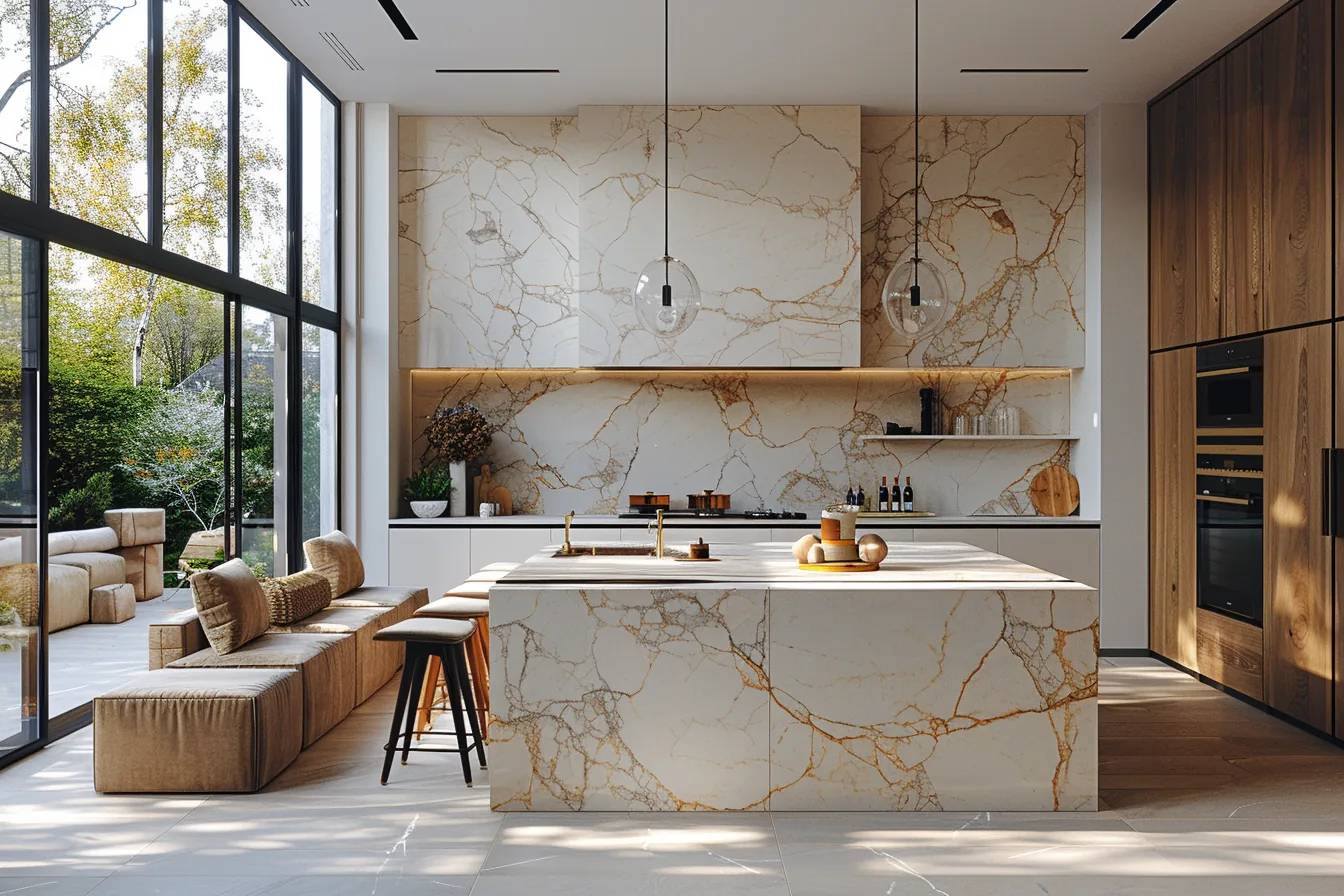
Two Tone Matte Cabinets, part of the matte finish kitchen cabinet collection. Dimensions and selected specifications are confirmed per project.
Where a scheme needs more than one matte tone in the same building, related finishes in the same family help keep the palette coherent across rooms: Grey Matte Cabinets, Handleless Matte Cabinets where a clean edge profile is required, and Wood Tone Matte Cabinets when the second tone is a timber look rather than a solid colour. Each is likewise made to measure with material and finish options set per project. Confirm the exact finish name and reference against physical samples for each order, since finish naming on product pages can vary between collections.
What one-stop supply changes for the buyer
Kitchen cabinetry rarely arrives alone on a fit-out. Flooring, wall panelling, doors, vanities and lighting are usually specified at the same time, and split suppliers mean split schedules and disputes over where one trade's responsibility ends. SANTERSON's service scope covers design consultation and space planning, material selection and product specification, manufacturing with quality control, project management and site coordination, then final installation and handover, supported by custom and OEM work and door-to-door logistics including freight forwarding, customs paperwork and container loading plans.
For a buyer this reduces interface risk: the cabinetry drawing can be checked against the appliance schedule, the flooring threshold heights and the wall finish in one coordination cycle rather than three. The project cases published on the site include villa work at Willoughby, Perth and North Turramurra and villas in Melbourne and Sydney, so they are worth reading before you assess whether a supplier has handled Australian residential delivery at that scale.
Red flags in a two tone matte cabinets quotation
- A price given before shop drawings exist, with no stated basis for the measurement.
- Finish described only by a marketing name, with no sample reference or physical sample offered.
- No mention of how the two tones are scheduled — which units carry which colour, and how they are packed.
- Hardware quoted as "standard" without brand or model.
- Freight quoted as a single line with no loading plan or packaging description.
- Warranty terms that exist only in an email thread rather than on the order confirmation.
None of these make a supplier unusable, but each one should be closed out in writing before the deposit is paid. The cost of clarifying them at quotation stage is trivial next to re-producing a run of matte doors after installation.
Specifying cabinetry for an upcoming kitchen or villa fit-out? Send SANTERSON your drawings, appliance schedule and preferred tones. The team confirms dimensions, finish options and hardware per project and returns a quotation with the production detail above stated on it.
Contact: PHILLIP | Phone / WhatsApp: +86-13928214007 | Email: santerson@qq.com | Enquiry form