
A gold mirror stainless steel screen with rose gold decorative accents can carry an entire lobby or feature wall. It is also one of the easiest items in a fit-out package to get wrong, because the specification sheet rarely says what happens at the edges, behind the panels, or months after handover. This guide sets out the comparison criteria we apply on our own projects, and where each option sits.
Start With the Job the Screen Has to Do
Before comparing finishes, decide which of three roles the screen is playing. A partition that separates a reception desk from a lounge is a spatial element: sightlines, panel widths and access behind it matter more than pattern complexity. A feature wall with integrated lighting is a lighting detail first and a metalwork item second. A decorative insert set into joinery is a trim item, and its value depends on how cleanly it meets the surrounding material.
Specifiers who treat all three as the same product tend to receive a beautiful sample and an awkward site problem. Our custom gold mirror stainless steel screen with rose gold decorative accents is normally specified in the first two roles, which is why pattern, panel size and fixing detail are confirmed together rather than sequentially.
The Comparison Criteria That Actually Decide Value
| Criterion | What to check on the quotation | Why it decides value |
|---|---|---|
| Finish system | Whether the gold and rose gold tones come from a PVD coating, a film/laminate, or a polished bare surface — stated by name, not just "gold" | Tone, fingerprint behaviour, cleanability and repairability all differ between systems; identical sample photos can hide very different products |
| Panel construction | Solid sheet versus folded-edge panel, and how cut edges are finished | Mirror-finish surfaces show every edge imperfection; folded or returned edges protect the visible face |
| Pattern fabrication | Laser-cut, waterjet, etched or applied relief accents | Determines achievable detail, burr control behind the panel and cost per square metre |
| Rose gold accent method | Whether accents are cut from the same sheet with a second finish, or separately applied elements fixed to the base panel | Applied elements introduce fixings, shadow lines and a cleaning edge that through-cut patterns do not |
| Panelisation and module size | Module width and height, joint positions, total number of joints across the run | Drives transport feasibility, on-site handling and whether the finished wall reads as one surface or a grid |
| Fixing and substrate | Cleat, frame or direct-fix system; who prepares the substrate and to what tolerance | Mirror panels telegraph any flatness problem in the wall behind them |
| Site sequence | Where the screen sits in the programme relative to wet trades, lighting and joinery | Late delivery protects the finish; early delivery invites protection costs and damage claims |
Comparing the Options You Will Actually Be Quoted
Most enquiries for a warm metallic screen land on one of four briefs. They look similar in a mood board and behave differently on site.
1. Full mirror gold with applied rose gold accents
This is the gold mirror screen with rose gold floral accents configuration: a reflective gold base with a decorative motif in a second, softer tone. It gives the strongest visual result in low-light hospitality settings because the surface multiplies whatever lighting is nearby. The trade-off is that any dent, warp or substrate unevenness is visible. Reserve it for walls that can be prepared properly and areas that are not a heavy traffic corridor.
2. Laser-cut gold screen with open pattern
A custom gold stainless steel laser cut decorative screen partition in a brushed or satin gold, rather than mirror, reads as pattern rather than reflection. It tolerates substrate movement and unevenness far better, and it earns its keep where the design brief wants light and shadow on the floor beyond the screen. Where the brief is "this wall should glow", choose option 1; where the brief is "this space needs separation without closing it off", choose this one.
3. Bronze or antique-tone screen for wide runs
For long feature walls, a custom bronze stainless steel laser cut decorative screen partition in a multi-panel configuration is usually the calmer answer. Antique bronze hides handling marks and joint lines better than mirror gold, and larger modules become practical because the eye is not tracking reflections across each joint. Where a project needs gold tones across a lobby width of several metres, we frequently quote a bronze or champagne base with gold accents held for close-up zones.
4. Screen plus sliding system
If the partition has to open, the hardware becomes the specification risk, not the metal. Our acoustic sliding panels and partition sliding systems are the route when a decorative screen also has to divide a banquet or meeting space on demand. A fixed decorative screen specified as if it were operable is one of the more expensive mistakes on this list. Ask for the operating cycle rating and the panel stacking width before comparing any two systems, because both consume floor space that the plan rarely budgets for.
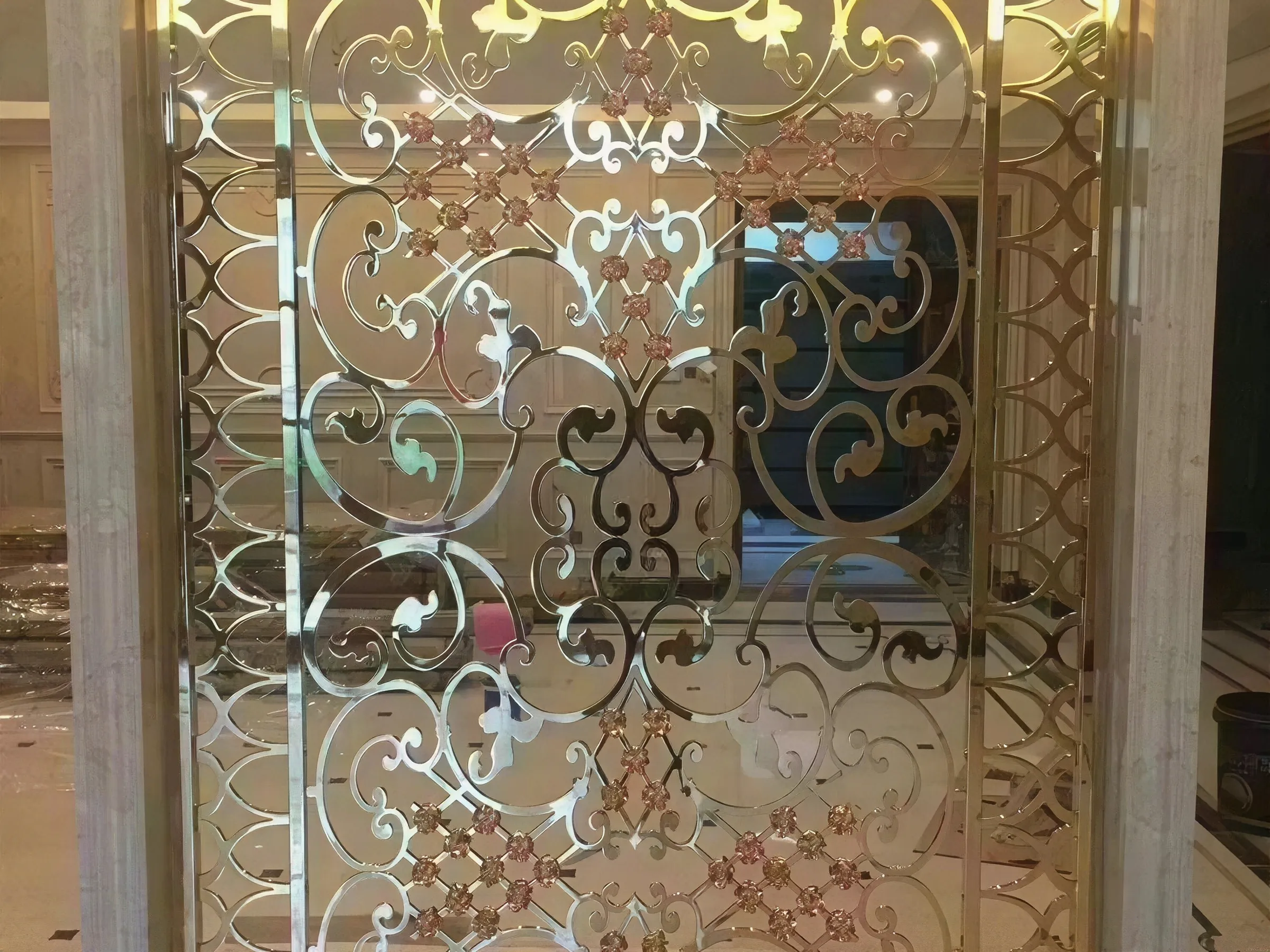
Gold mirror base with rose gold floral accents, fabricated to project dimensions.
How to Test the Alternatives Before You Commit
- Order a panel, not a coupon. A 100 mm sample tells you the colour. A full-height module tells you how the pattern scales, how the edge is finished and how stiff the panel is in your hand.
- Photograph the sample under the actual room lighting. Warm 2700 K light and cool accent light shift gold and rose gold in opposite directions. Compare photos taken on site against the design intent rendering.
- Ask for the fixing drawing at quotation stage. A supplier who can produce a cleat or frame detail with substrate tolerances stated is a supplier who has installed the product before.
- Confirm what is fixed and what is applied. For rose gold accents, ask whether the motif is through-cut with a second finish or a bonded element, and how each is cleaned.
- Check the joint strategy across the whole run. Ask where the vertical joints will fall on your dimensioned elevation, not just the module size.
Where the Cost Actually Sits
Comparing quotations per square metre is misleading. Two screens with the same finish can differ materially because of pattern density — a fine floral cut takes longer than an open geometric one — and because of panel count, which drives transport, handling and joint labour. A screen with applied accents carries a second fabrication step and a second tolerance chain.
For project teams coordinating several trades, the more useful comparison is total installed outcome: metalwork, substrate preparation, lighting coordination and protection all sit in one package. As a one-stop furniture and building materials supplier, we handle screens alongside the joinery, wall panelling, lighting and flooring they meet, which removes the interface arguments that inflate a decorative partition budget after award.
Specification note. Material grade, panel thickness, coating system and maximum module size for this product are set per project. Send drawings, photographs or a reference image and we fabricate to your exact dimensions — pattern, finish, size and decorative elements are all customisable.
A Short Decision Rule
Choose gold mirror with rose gold accents where the wall is a designed focal point viewed from a few metres, and the substrate can be properly prepared. Move to brushed or satin gold laser-cut where the screen must separate space and carry light through it. Move to bronze or antique tones where the run is long, the traffic is heavy, or maintenance access is limited. Choose an operable sliding system wherever the partition has to open at any point in the operating life of the room.
Send us your drawing, photo or reference. We fabricate decorative metal screens, partitions and matching interior fixtures for hotels, villas, clubs and high-end residential projects, with door-to-door delivery and installation support. Contact PHILLIP — Phone/WhatsApp +86-13928214007, Email santerson@qq.com, or use the contact page.