
Why One Fixture Name Can Cover Several Different Lights
Ask three suppliers for a quote on a "minimalist LED ring flush mount" and you will often receive three different products. That is the first thing to understand when you are comparing modern metal ring ceiling light options for a hotel, serviced apartment or villa development: the phrase describes a family of fixtures, not a single specification. A polished circular frame with an integrated LED strip is one version; an open ring with a slim metal rim is another; a flat round or square panel with no visible ring at all is a third. All three can appear under similar headings.
SANTERSON's own catalogue makes this clear. The Modern Metal Ring Ceiling Light pairs a polished metal circular frame with a black central structure and integrated LED strip lighting, positioned for living rooms, bedrooms, studies and lobbies. Alongside it sit the Modern Ring Ceiling Light, described as an open circular frame with a polished metal rim and soft LED strip lighting, and the Modern Ultra-Flush LED Ceiling Light, an ultra-flat round or square panel in a slim frame. Comparing suppliers properly means comparing fixtures against each other, not headings against headings.
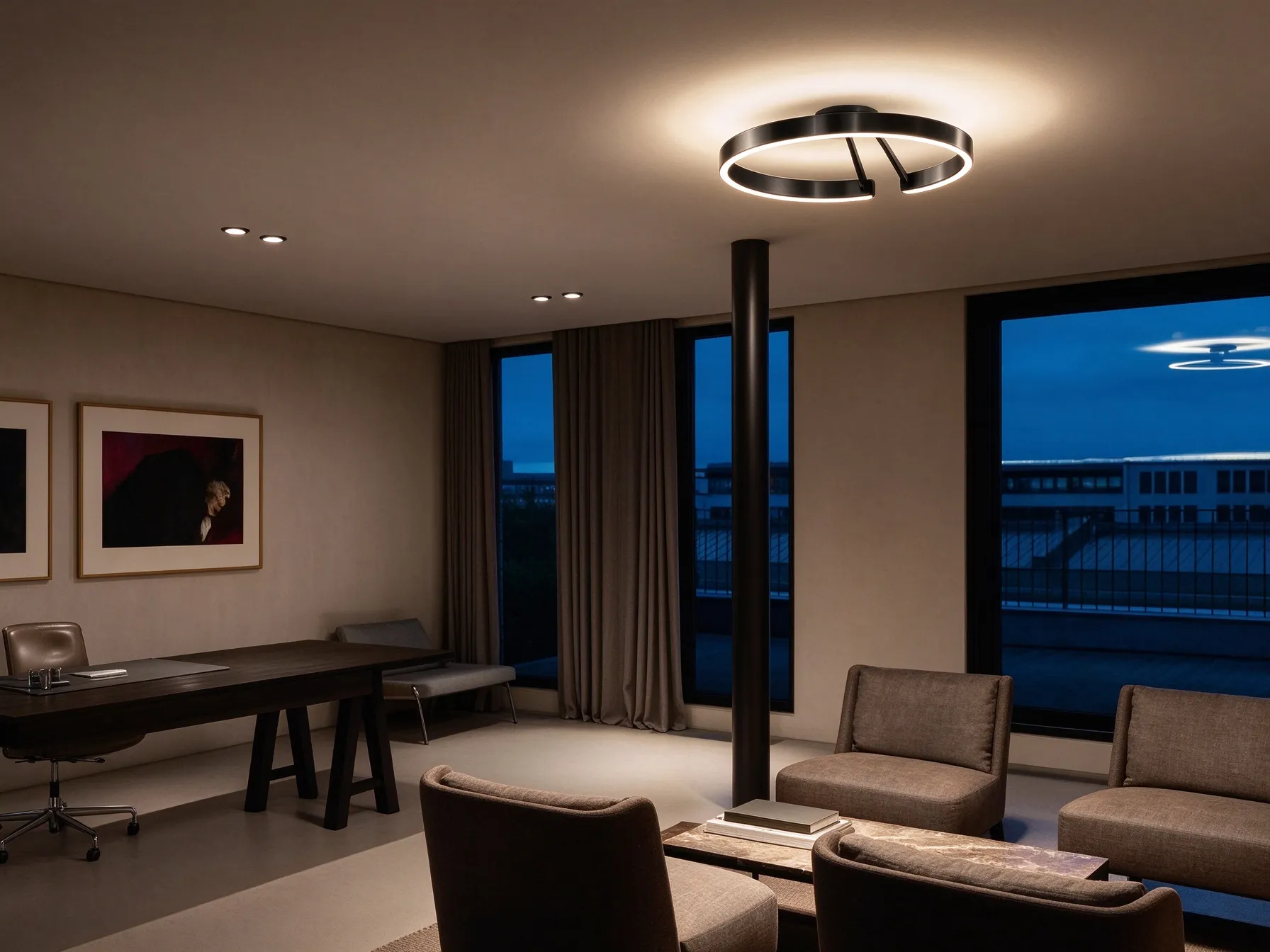
Polished circular frame, black central structure and integrated LED strip — the reference form used in this comparison.
Compare Suppliers on Six Points, Not On Price Per Unit
Once you have fixed which fixture each supplier is actually quoting, the comparison becomes practical. Work through these six points with every quotation side by side.
1. Physical form and how it reads in the room
A ring fixture with an open centre behaves differently from a closed flush panel. The open ring is a visible object on the ceiling — it carries design weight, which is why this type is specified for lobbies and living areas where the ceiling is part of the composition. A low-profile panel disappears, which suits corridors, bedrooms with modest ceiling heights, and rooms where wall sconces or floor lamps carry the decorative load. Decide which role you need before you compare anything else.
2. Finish and material
Ask what the frame is actually made of and how the finish is applied. Polished metal rims show fingerprints during installation and are easy to wipe down, which matters in high-traffic common areas. Confirm whether the finish can be changed for your project — SANTERSON's Custom & OEM Service covers bespoke material finishes and textures, prototyping and brand customisation, so matching a fixture to a brass or black hardware scheme elsewhere in the building is normally a conversation rather than a compromise. Get the finish confirmed on a sample before volume production.
3. Light quality and control
Integrated LED strip lighting produces soft, indirect illumination around the ring; a diffused panel gives even, flat light across its face. Neither is better in absolute terms — they answer different briefs. What you should pin down with every supplier is what the fixture looks like switched on in a room of your own ceiling height and paint colour, and whether the version quoted supports the switching or dimming arrangement in your design. Do not assume that the photo on a datasheet reflects output; request an illuminated sample.
4. Technical documentation
This is where suppliers separate themselves fastest. Product pages and catalogue listings are marketing material. For a commercial project you need written technical data for the exact item quoted: mounting method, driver information, electrical ratings, and any certification relevant to the destination market. The site copy itself notes that product standards and technical specifications should be validated against current documentation, so treat every figure as unconfirmed until it appears in a specification sheet bearing your project reference.
A practical rule
If a supplier answers "yes" to a technical question without sending a document, the answer is not an answer. Ask for the specification sheet, and ask for it in writing with your project name on it.
5. Consistency across the whole ceiling schedule
A single ring light is easy. Forty guest rooms, two lobbies and a restaurant are not. Fixtures from different batches or different factories can vary in colour temperature and finish sheen, and that variation only becomes visible once everything is installed side by side. Ask how many ceiling fixtures the supplier produces in-house and whether the matching pieces in your schedule — ring flush mounts, pendants over the bar, wall sconces, vanity lighting and integrated cabinet lighting — come from one production line under one project order. SANTERSON manufactures across furniture and building materials in the same programme, which is why turnkey hospitality and villa projects are usually coordinated as a single package rather than sourced item by item.
6. Delivery, installation and what happens afterwards
Lighting arrives early in a fit-out and gets damaged late in it, so packaging, container loading and sequencing matter as much as the fixture. Confirm freight mode, customs paperwork and who receives the goods on site. Then confirm who installs, who inspects for snags, and what happens if units fail or need replacing after handover. SANTERSON's stated service scope covers logistics and door-to-door delivery and installation and after-sales support, including inspection and spare parts. Response times, warranty terms and installer availability in your country should be confirmed for your specific project rather than taken from a webpage.
A Shortlist You Can Actually Send To Three Suppliers
Send the same request to every bidder and the answers become comparable within a day or two:
- Photograph and drawing of the exact fixture, with dimensions and mounting detail.
- Frame material and finish specification, plus whether a custom finish is available and at what cost.
- LED module and driver details, and the dimming or switching options offered.
- Minimum order quantity and lead time for that item, not for the range in general.
- Written technical documentation valid for your destination market.
- Packaging specification, freight options, and named responsibility for installation and snagging.
- Warranty terms and spare-part availability after handover.
Two of those seven lines will usually eliminate a bidder on their own: the technical documentation request and the lead time for that specific item. Suppliers who manufacture rather than resell answer both quickly.
Buying Ceiling Lights As Part Of A Wider Package
For villa and hospitality developments, ceiling fixtures rarely need their own procurement process. They are one line in a schedule that also covers joinery, wardrobes, flooring, wall panels, carpets and loose furniture. Coordinating all of it through one supplier removes the hardest part of lighting procurement — matching finishes and colour temperature across trades that would otherwise be ordered separately.
SANTERSON is a China-based furniture and building materials manufacturer operating since 2008, with project work spanning villas, hospitality and offices. Published project references include villa and housing projects in Willoughby, Perth, North Turramurra, Melbourne and Sydney. The company describes its workflow as consultation, design and planning, production, logistics, installation and after-sales.
Frequently Asked Questions
What is the difference between a ring flush mount and an ultra-flush panel?
A ring flush mount has a visible circular frame, often with an open centre, and reads as a design object on the ceiling. An ultra-flush panel sits close to the surface with a slim frame and gives even, diffuse light without a decorative silhouette. Both are LED and both mount flat; they differ in visual presence and in how much of the room's character they carry.
Can I order a ring ceiling light in a finish that matches my other hardware?
Ask the supplier directly. Custom finishes fall under bespoke manufacturing, which SANTERSON lists among its custom and OEM services alongside material and texture choices. Confirm feasibility, sample cost and any minimum order quantity before committing to volume.
Should I compare suppliers by fixture price or by project package?
Compare both, separately. Fixture price tells you whether a unit is competitive; package pricing tells you what consistency, coordination and after-sales cover actually cost. A low unit price paired with separate freight, separate installation and no spare-part route is usually the more expensive option by handover.
To compare ring flush mounts and other ceiling fixtures against your own room schedule, send drawings and quantities to SANTERSON — contact PHILLIP, +86-13928214007 (phone/WhatsApp), santerson@qq.com — and the technical questions above get answered in writing before any order is placed.