
A standing lamp rarely decides whether a villa or hotel project succeeds. But when the item is a Modern Glass Column Floor Lamp, LED Ring Standing Lamp for Living Room & Lobby, it sits in one of the most visible positions in the building — the arrival space, the lounge corner, the reception axis. Buyers who treat it as a small accessory line item are the ones who end up with lamps that arrive cracked, sit at the wrong height for the ceiling, or do not switch on correctly on site.
The risk in ordering this type of piece is not taste. It is specification, transport and coordination. Below is the checklist our project teams work through before a purchase order goes out for glass column floor lamps and LED ring standing lamps in living rooms and lobbies.
Why This Category Carries More Procurement Risk Than an Ordinary Floor Lamp
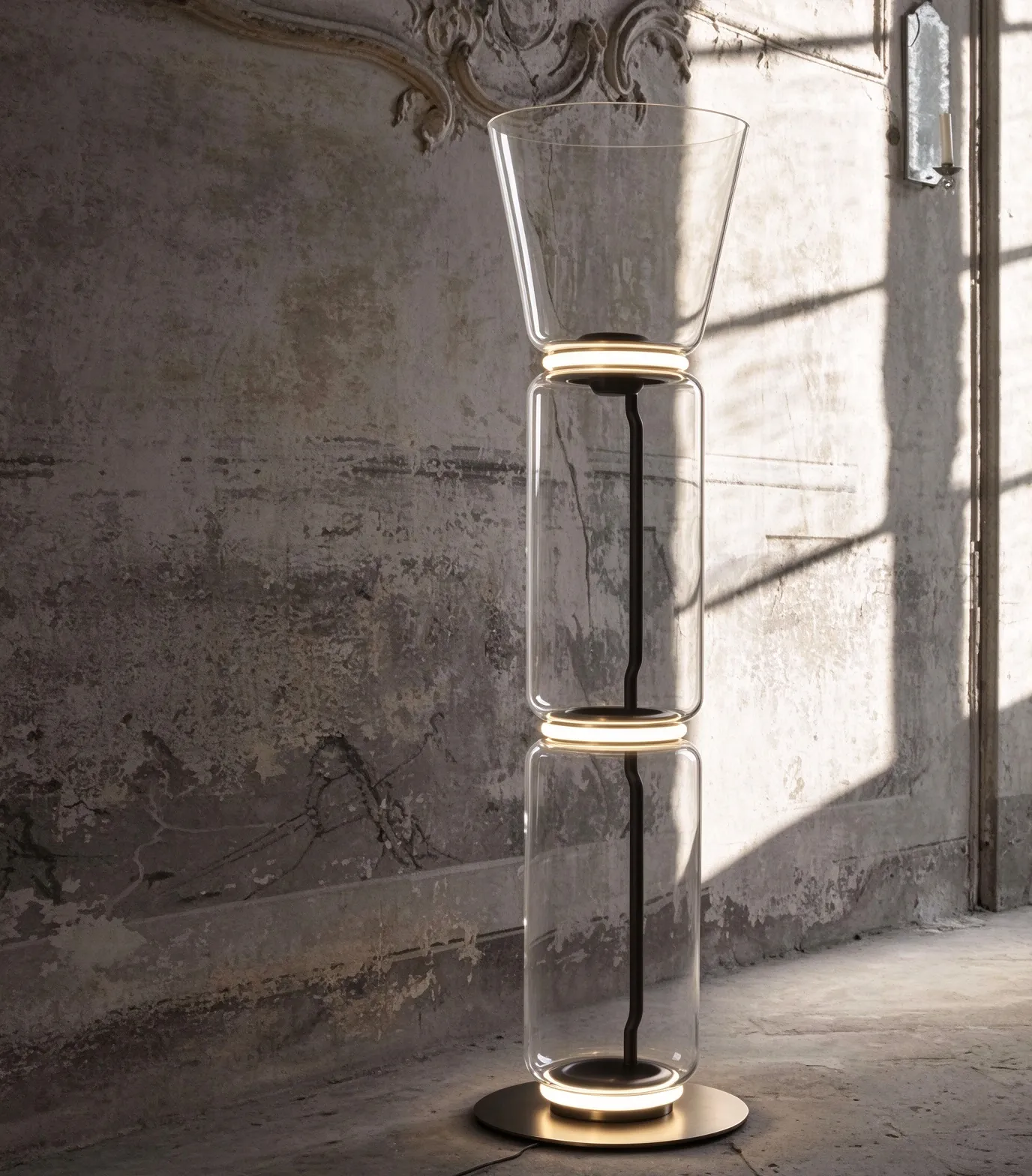
The product itself is straightforward to describe: transparent glass columns stacked into a vertical structure, with illuminated LED rings between them, producing soft ambient light and a sculptural silhouette. What makes it harder to buy is the combination of materials. Glass is brittle and heavy. LED rings are electrical assemblies with drivers, wiring and heat to manage. Metal joints hold the whole column in compression. Each of those three elements has its own failure mode, and a purchase order that only names a model number and a quantity does not control any of them.
In a lobby, the same lamp is also doing a second job. It anchors a sightline from the entrance, and it will be seen by every guest. A replacement ordered after handover means a visible gap in the scheme for weeks while a new batch is produced and shipped. That is why we recommend specifying these pieces during the furniture schedule stage rather than at the end of a project.
Risk 1: The Specification Sheet Is Thinner Than the Drawing Assumed
Interior drawings show a lamp as an outline. Procurement needs numbers. For glass column and LED ring lamps, the fields we ask suppliers to confirm in writing before production are:
- Overall height and base diameter, so the piece reads correctly against lobby ceiling height and next to the sofa group it stands beside.
- Glass column diameter, wall thickness and how the columns are joined and supported at the base.
- Light source type, driver location and whether the driver is accessible without dismantling the column.
- Switch or dimming method, and whether the control is compatible with the building's existing switching.
- Input voltage for the destination country, plus plug, hardwiring or floor-plate arrangement.
- Certification marks required by the project's electrical inspector or consultant.
If a supplier cannot confirm these fields, they are not quoting a product — they are quoting a photograph. On our own catalogue pages for lighting, some technical fields still need confirmation before publication, and we say so plainly rather than guessing. We would rather answer the same question twice in a design meeting than once during a claim.
Risk 2: Electrical Standards Are Not Interchangeable Between Markets
A lamp built for one market's voltage and wiring rules cannot simply be shipped to another. For Australian, Middle Eastern, Southeast Asian and African projects the requirements differ on input voltage range, plug or hardwiring method, earthing, driver approval marks and, in some cases, emergency or switching arrangements. This is where a low quote becomes expensive: the lamps arrive, the electrical contractor refuses to connect them, and the project buys again under time pressure.
Two practical habits prevent this. First, put the destination country's electrical requirement on the purchase order itself, not in an email thread. Second, ask for a sample unit with the full driver and wiring assembly before the production batch, so the electrician can inspect it rather than read about it.
Risk 3: Glass Travels Badly Unless Packaging Is Specified
Breakage in transit is the single most common issue with glass column lamps, and it is almost always a packaging decision rather than a shipping accident. Before a container is loaded we confirm:
- Moulded foam or timber crate cradles sized to the columns, not generic filler.
- Separate packing for glass elements and metal frames so weight never rests on glass during handling.
- Marked orientation and fragile labelling on each carton, with a packing list that matches the crate count exactly.
- Photographs of the packed crates before the container door closes.
Those photographs matter. If damage does occur, images of intact packing at load time are what allow a claim against cargo insurance to move quickly. Our Logistics & Door-to-Door Delivery service covers freight forwarding by sea, air and rail together with customs paperwork, packing lists, certificates of origin and container loading — but insurance terms, duties and transit time are agreed per project, because they depend on the route and the destination's import rules.
Risk 4: One Lamp Is Easy; a Lobby Scheme Is a Schedule Problem
Lobbies rarely take one lamp. They take a run of them, alternating with seating, planters and reception joinery. Once quantities rise, three new questions appear:
- Batch consistency. Glass tone, metal finish and LED colour appearance can shift between production runs. Order the full lobby quantity in one run, and keep a documented spare set for post-handover replacement.
- Delivery sequence. Lamps installed late are handled roughly through a finished space. Installed early they sit unprotected for months. We schedule them with the loose furniture delivery, after wet trades and flooring are complete.
- Site access. A tall column lamp needs a lift, a clear route and a door width that fits the crate. Confirm this with the builder before shipping, not at the loading dock.
Risk 5: Lighting Is Bought Alone When It Should Be Bought With the Scheme
The most avoidable cost in this category is coordination. A standing lamp's finish needs to match the wall sconces, the pendant over the reception desk, the joinery lighting in the cabinetry and the metal tones of screens and handrails. When these are bought from different suppliers, small differences in brass tone or black powder coat become visible under lobby lighting, and no single supplier is responsible for fixing it.
This is one reason our customers group lighting with the rest of the fit-out. Alongside free-standing pieces such as the Modern Arc Floor Lamp - Curved LED Standing Lamp for Living Room & Bedroom, the Modern Black Arc Floor Lamp - Minimalist Cylinder Reading Lamp for Living Room & Hotel and the Modern Globe Floor Lamp - Gold Reflective Standing Lamp for Living Room & Hotel Room, we supply wall lights, pendants, decorative fixtures and integrated cabinet lighting from the same production base, so finishes are specified once and applied across the project. Our wider Lighting Products range sits inside the same One-stop Furniture and Building Materials Supplier scope as flooring, wall panels, ceilings, carpets, cabinetry and outdoor furniture.
Risk 6: Custom Dimensions Are Quoted but Not Confirmed
Lobby ceilings vary. A standard height that works in a villa living room can look small against a double-height arrival hall, and buyers often ask for a taller column or a different number of rings. That is normally within reach — our Custom & OEM Service covers bespoke finishes, dimensions and prototyping with flexible minimum order quantities — but custom work moves the risk, it does not remove it. A changed height changes the centre of gravity, the base plate, the driver position and sometimes the electrical approval path.
For any modified dimension we ask for a signed shop drawing showing overall height, base diameter, ring positions and driver location, and we produce a prototype for approval before batch production. That single step prevents most custom-item disputes.
A Pre-Order Checklist You Can Paste Into Your Purchase Order
- Model name, finish code and glass type stated exactly as they appear on the approved sample.
- Overall height, base diameter and weight per unit, confirmed for floor protection and load.
- Input voltage, driver specification and switching or dimming method for the destination country.
- Required certification marks named by the project's electrical consultant, in writing.
- Packaging method described on the order, with pre-shipment packing photographs.
- Full lobby quantity ordered in one production run, plus a spare set held for handover.
- Crate dimensions checked against site lifts, doors and access route.
- Delivery window agreed with the builder, after flooring and wet trades are complete.
- Warranty scope, spare-parts availability and replacement lead time recorded on the order.
How This Fits Into a Turnkey Project Scope
For projects that include several lighting types plus flooring, wall finishes, joinery and loose furniture, running each category as its own purchase creates the coordination gaps described above. Under Turnkey Interior Project Solutions, a single project team handles design consultation and space planning, material selection and product specification, manufacturing and quality control, then logistics, site coordination and handover. Lighting is specified together with the finishes it will sit against, which is where most finish-mismatch problems disappear.
Our work on residential and hospitality projects in Melbourne, Sydney, Perth, Willoughby and North Turramurra, alongside hotel and office projects in China and the Middle East, follows that sequence. Project scopes and details are documented per case; we share them on request rather than summarising them here.
Frequently Asked Questions
Can a glass column floor lamp be used in a hotel lobby with heavy foot traffic?
Yes, provided it is placed where it will not be brushed by luggage trolleys or service carts, and the base is stable enough for the location. We position these lamps as decorative ambient pieces at the edge of a seating group or beside a reception axis rather than in a circulation path.
What lead time should I plan for?
Lead time depends on quantity, whether dimensions are standard or modified, and the packaging required for glass. A custom height with prototype approval takes longer than an order from the standard specification. Tell us the site installation date and we will confirm what is achievable against it.
Do you supply the electrical connection as well as the lamp?
We supply the lamp with its driver and wiring prepared to the agreed specification for the destination market. On-site connection, floor plates and final circuit work are carried out by the project's electrical contractor; we coordinate with them on drawings and installation guidance.
What happens if a unit arrives damaged?
Report it with photographs of the crate and the item as received. Because packing photographs are taken before loading, replacement of the affected glass elements can be arranged quickly, and insurance claims are supported by the shipping and packing documentation. Replacement parts and on-site support fall under our Furniture Installation and After-sales Support scope.
Send us your lighting schedule
Share the model reference, quantity, ceiling or floor conditions and destination country, and our project team will confirm specification, packaging and delivery scope for your living room or lobby scheme.
Contact: PHILLIP | Phone / WhatsApp: +86-13928214007 | Email: santerson@qq.com | Contact Us
Technical fields such as lumens, wattage, colour temperature, IP rating and certification marks for this lighting category are confirmed per order and per destination market before production; they are not stated here because they vary by configuration.