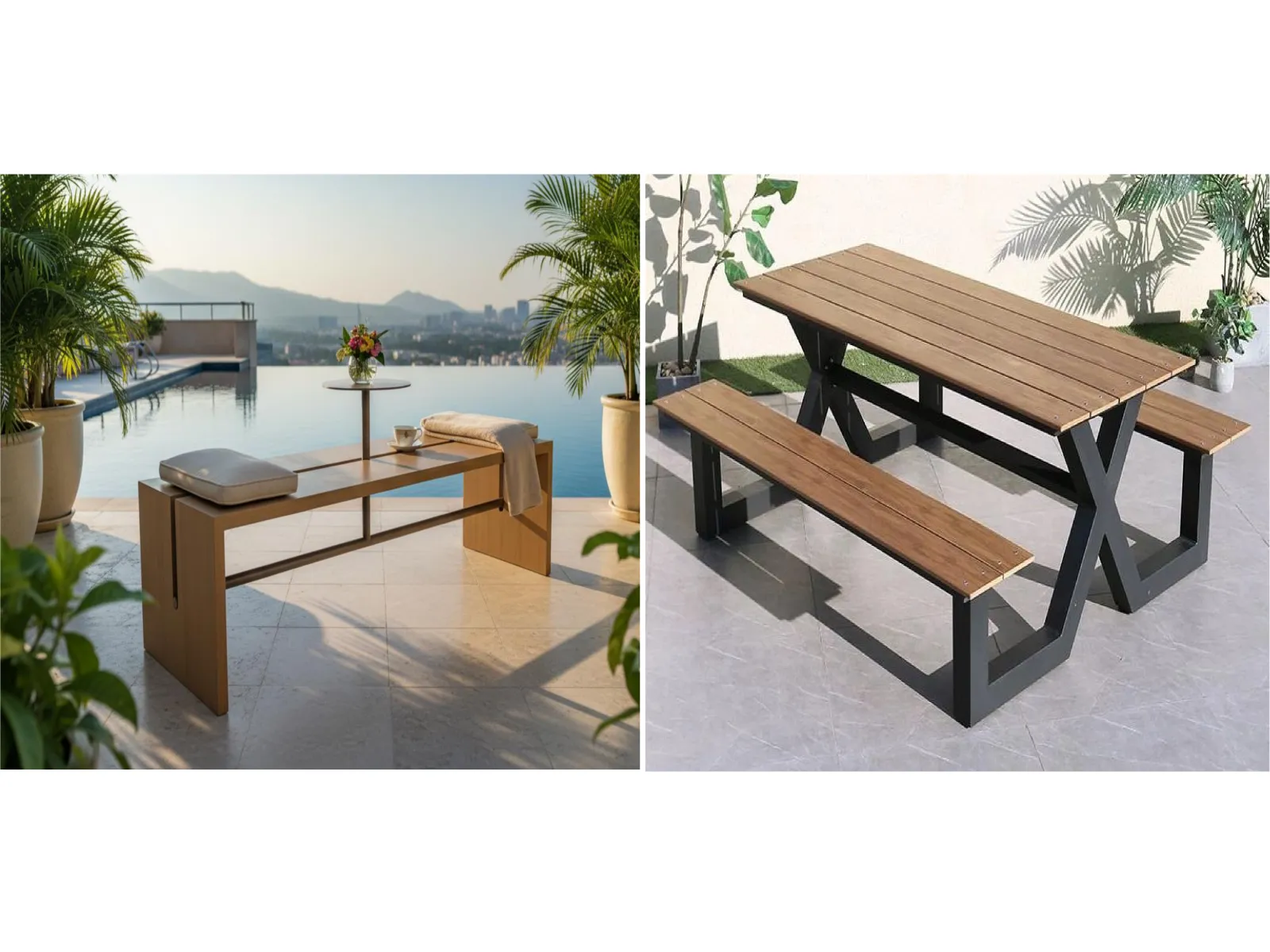
A teak-look aluminium outdoor bench with an integrated picnic table is one of those products that looks simple on a specification sheet and becomes complicated at the purchasing stage. Two configurations share one slatted aesthetic; one is a bench with a side tray for poolside and rooftop corners, the other is a fixed-bench picnic table built for group dining in shared gardens. Buying them off the shelf is possible. Buying them as OEM production — your dimensions, your colour tone, your finish detail — is where most project buyers, contractors and furniture importers have never run the process before.
This article walks through that process end to end: what OEM actually covers for this product family, what you need to supply before a factory can quote, how prototyping and production approval work, and where cost and lead time come from. We are the manufacturer behind these sets, so we will describe our own workflow rather than a generic one — and we will be explicit about what depends on your project rather than promising fixed numbers.
What "OEM sourcing" means for this product family
The Teak-Look Aluminum Outdoor Bench & Integrated Picnic Table Set is listed as two related pieces sharing the same teak-effect aluminium slat look. The first is a minimalist bench that pairs seating with a small side table — the format that works beside an infinity pool or on a rooftop relaxation corner, where drinks, towels and a book need somewhere to sit down. The second is an integrated picnic table with attached benches and a solid X frame, specified for group meals and for the heavier use patterns of resort and shared community gardens.
"OEM" (original equipment manufacturer) sourcing means the factory builds to your requirement instead of selling you what it already has in the warehouse. In practice there are three levels of customisation, and knowing which one you need changes both the quotation and the timeline:
- Colour and finish selection. You choose from existing frame finishes and slat tones — powder-coat colour for the aluminium, teak-effect tone for the slats. No new tooling, so this is the fastest and lowest-cost route.
- Dimensional adjustment. Overall length, seat height, table width and bench spacing are changed to fit a plan drawing, a terrace edge or an accessibility clearance. The profile stays the same; drawings are redrawn for you.
- Structural and detailing changes. Frame geometry, joint method, slat width, fixings, add-on components such as umbrella holes or anchoring plates. This level touches engineering, so it always goes through a prototype before production.
Our Custom & OEM Service covers all three: custom furniture design and prototyping, bespoke material finishes and textures, OEM manufacturing, flexible minimum order quantities, and brand customisation such as engraving or private labelling. The product page itself already states that dimensions and colour tones can be adjusted to match project design requirements — that is the entry point for most enquiries.
Stage 1: brief and feasibility
Everything after this point depends on the quality of the brief, so it is worth being specific. For an OEM enquiry on these sets, the information that lets us assess feasibility and quote accurately is:
| What we need from you | Why it changes the outcome |
|---|---|
| Site context — resort rooftop, villa garden, clubhouse courtyard, community leisure area, poolside | Determines usage intensity, fixing method and whether the bench-with-tray or the fixed picnic table is the right format. |
| Target dimensions and seating count per unit | Drives aluminium profile selection, slat quantity and whether the X-frame geometry needs re-engineering. |
| Quantity by configuration, and whether you want repeat drops | Sets the tooling and prototyping cost that can be amortised, and shapes the batch plan. |
| Finish references — RAL or Pantone for the frame, a tone sample or photo for the slats | Removes colour ambiguity before extrusion and coating; verbal descriptions such as "light teak" cause most rework. |
| Destination country and delivery terms you want quoted | Determines packing specification, container loading plan and which logistics costs sit in your price. |
| Branding or ID-plate requirements, if any | Engraving, embossing and logo plates need to be planned into production, not added afterwards. |
We review the brief against current production capability and reply with either a feasible route or a flagged constraint — for example, a span that would need a heavier profile than the standard one. Getting that answer early is cheaper than discovering it after tooling.
Stage 2: drawings, quotation and specification confirmation
Once the brief is feasible, we produce shop drawings for your configuration: overall dimensions, frame profile, slat layout, joint detail and finish callouts. This is also where the two configurations are separated on paper, because they quote differently — a bench with an integrated side tray and a picnic table with fixed benches consume different amounts of aluminium, welding time and coating area.
The quotation that follows should be read as a specification document, not just a price. Check that it states the frame material and coating system, the slat finish, the fixing and anchoring method, the packing standard, and the delivery term (EXW, FOB or door-to-door). Our Logistics & Door-to-Door Delivery service covers sea, air and rail freight forwarding, customs paperwork including commercial invoices, packing lists and certificates of origin, packaging and container loading, shipment tracking and door-to-door delivery — so the same enquiry can be quoted either as goods at our dock or delivered to site. Import duties, Incoterms responsibility and transit time are project-specific and should be confirmed for your country in writing rather than assumed.
Stage 3: prototype and approval
For dimensional changes we ask for a signed drawing set before cutting. For structural or detailing changes, we build a prototype first. A prototype run is where three things get settled at the same time:
- Ergonomics. Seat height, seat depth and backrest angle on the bench, and table-to-bench clearance on the picnic set. On fixed-bench picnic tables this cannot be adjusted on site, so it has to be right in the drawing.
- Colour under real light. A powder-coat swatch and a slat tone sample should be checked outdoors. Aluminium coatings and teak-effect finishes read very differently in direct sun than under showroom lighting.
- Joint and frame behaviour. The X-frame on the picnic table is what gives it stability for commercial use; any change to span or leg geometry gets verified on the physical unit, not only on the drawing.
Approval is a written confirmation of the prototype or sample plus the final drawing revision number. Production does not start before that exists, because it is the document both sides are held to.
Stage 4: production and quality control
Production runs in batches per configuration, with inspection points at extrusion and cutting, welding and grinding, surface preparation and coating, slat assembly, and final packing. For a project mixing both configurations, the practical risk is mix-ups between similar-looking units, so we mark cartons by configuration and by zone or floor if your delivery plan calls for it.
Material choice is worth restating here because it drives the maintenance argument you will use with your client. All components of these sets are aluminium construction, which removes the upkeep burden of solid timber: aluminium does not rot, is not eaten by insects, and tolerates salt spray. That is why this profile suits coastal resorts, rooftop terraces and clubhouse courtyards where a timber bench would need annual oiling or would fail early. The teak look comes from the finish, not from timber — an important point to state accurately in your own specification documents.
Stage 5: shipping, installation and after-sales
Packing is designed around the container loading plan rather than the other way round, which matters on mixed orders of outdoor furniture where a poorly planned load wastes a large part of a container's volume. Our project services continue past dispatch: on-site installation, inspection and snag lists, warranty coverage, spare parts and replacement, and ongoing maintenance.
Two cautions we would give any buyer rather than gloss over. First, anchoring and fixing to a deck or slab must be checked against local building requirements for your site — the product can be supplied with anchoring provisions, but compliance sign-off on the installed structure is a local matter and belongs with your engineer or certifier. Second, response-time and warranty terms vary by project and region; get the actual written terms for your order instead of relying on marketing figures.
Where the cost and lead time actually come from
Buyers often expect an OEM surcharge to be a single line item. In reality it is spread across five places, and understanding them helps you decide which customisations are worth paying for:
- Tooling and fixturing — only incurred when frame geometry or joint detail changes; amortised over the order quantity.
- Prototype and sampling — one-off, and the cheapest place to find a problem.
- Coating setup — a non-standard RAL colour means line changeover; standard colours do not.
- Profile and material usage — longer spans and heavier profiles use more aluminium per unit.
- Packing and documentation — project-specific packing marks, extra paperwork and destination requirements.
Lead time follows the same logic: finish-only changes are short, dimensional changes add drawing and cutting time, structural changes add a prototype round. Tell us your required site date early and we will work backwards from it; a realistic schedule that includes production, shipping and customs clears far more orders than an optimistic one.
A worked example: resort rooftop plus garden zone
Consider a hospitality project that needs both configurations — bench-with-tray units along a rooftop edge, picnic tables in the garden zone below. A sensible OEM package would specify the same frame colour and slat tone across both so the scheme reads as one collection, adjust bench length to the rooftop parapet spacing, keep the standard picnic-table geometry where the plan allows it, add anchoring plates on the rooftop units only, and split delivery so the rooftop units arrive after the roof works are complete. One product family, two configurations, one finish specification — that is the kind of consolidation OEM sourcing is good at.
Because these sets sit in a wider outdoor range, they can also be coordinated with matching pieces from the same material language: an aluminium and teak-look slat dining set with adjustable sun lounger for poolside dining, or a L-shaped aluminium outdoor corner sofa set with teak-look slat tops for the lounge area. Coordinating finishes across those items in one OEM instruction avoids the near-miss colour clashes that appear when each line is ordered separately.
Common OEM sourcing mistakes on this product
- Specifying "teak" when the product is aluminium with a teak-effect finish. This creates false expectations in the client's mind and an avoidable dispute at handover.
- Ordering one quantity for both configurations. Rooftop seating and garden dining rarely need the same count; mixing them wastes budget and storage.
- Skipping the outdoor colour check. Approving a finish indoors and discovering the tone in direct sun after delivery.
- No anchoring detail at quotation stage. Anchoring is a structural decision that affects the frame, so it must be priced and drawn before production.
- Treating customs clearance as someone else's problem. Certificates of origin, import permits and packing lists delay more consignments than production does.
Send us your configuration
If you are sourcing these sets for a resort, villa, clubhouse or community project, send the site context, target dimensions by configuration and quantity, plus finish references, and we will come back with feasibility, drawings and a quotation covering production and delivery. As a furniture and building materials manufacturer working on hospitality, villa and office projects, we handle the same order across outdoor furniture, interior fixtures and building finishes, which is usually where the coordination savings sit.
Enquiries go to our contact page; include your required site date so the schedule can be planned backwards from it.