
Herringbone has moved from a period-feature detail to a default specification in Australian villas, boutique hotels and premium apartment interiors. For buyers sourcing engineered wood flooring from an overseas manufacturer, the pattern is also where most of the cost and rework risk sits: a 20 m² room laid at 45° wastes more material than a straight-lay plank floor of the same area, and nothing exposes a badly cut block faster than a diagonal field running into a glass wall. The product data below is drawn from our own catalogue pages; everything else in this guide is a checklist you should verify with your supplier, your flooring installer and your local building surveyor before you confirm an order.
Start With the Construction, Not the Pattern
Every herringbone SKU on our site is built as a multilayer engineered board with a 3 mm solid European oak lamella (top layer) over a cross-layers base. That construction matters for two practical reasons in Australian work: the opposing grain layers resist the movement that shows up as cupping and gapping, and a 3 mm lamella can be refinished more than once over the life of a floor, unlike a printed or foil dec.
When you request a quotation, ask for these items in writing rather than accepting a single price per square metre:
- Top-layer thickness and how it is measured — finished lamella after sanding, not the raw veneer before finishing.
- Total board thickness and the make-up of the base layers, including the species used in the core and back.
- Dry matter content / moisture content at despatch, stated as a percentage with the test method, so your installer can acclimatise correctly on site.
- Board dimensions for one herringbone element, and whether blocks are supplied as single elements or pre-assembled parquet blocks on a mesh.
- Finish type — pre-finished UV lacquer, hardwax oil, brushed, saw-cut texture, wire-brushed, or raw for site finishing.
- Grade definition used by the mill (character, natural, select), with a written description of acceptable knots, sapwood and mineral streaks.
A supplier who answers with "European oak, herringbone, 14×90" has not quoted a floor. Two floors can share that description and differ in lamella thickness, board length, grade and finish — which is exactly why samples from the same production batch as the intended order matter.
Confirm What "Compatible With Underfloor Heating" Actually Means
Several of our product pages state compatibility with underfloor heating, including the dark European oak herringbone engineered flooring and the lighter parquet options. Treat that as a starting point for a conversation, not a certificate. In Australian projects, hydronic and electric systems behave differently, and the surface temperature of the screed is what limits timber performance.
Before you commit, ask your heating designer and your flooring supplier to agree on:
- The maximum sustained surface temperature of the finished floor, and how the system is commissioned (a slow ramp-up before the floor goes down).
- Whether a screed moisture test result is required before installation, and what reading is acceptable.
- Which adhesive class and primer are specified for heated substrates, and who supplies them.
- Whether an acoustic underlay is permitted — an underlay that dampens impact sound also changes thermal transfer, and the two requirements often conflict.
- Where expansion joints fall in a herringbone field, particularly at thresholds and around in-slab pipework.
Match The Tone And Texture To The Project Brief
Herringbone reads as pattern first and colour second, so the tone you choose changes how large a room feels. Our current oak options span three broad directions:
| Direction | Catalogue reference | Where it typically works |
|---|---|---|
| Light / bleached | European oak herringbone engineered wood flooring, light European oak engineered wood flooring | Coastal villas, gallery-style living rooms, hotel lobbies where a bright, minimalist base is required |
| Natural / warm mid-tone | European oak engineered parquet flooring, European oak parquet engineered hardwood flooring | Residential living and dining spaces, guest rooms, café and lounge areas that need warmth without heaviness |
| Dark / smoked | dark European oak herringbone engineered flooring, charcoal European oak engineered wood flooring | High-end residential, bar and lounge settings, interiors with strong contrast joinery and brass or stone detailing |
Two details that only show up in a physical sample: how much live knot and mineral streak the grade allows, and how the finish sits under warm LED lighting rather than daylight. Order samples of two candidate tones and view them on site at morning, midday and evening before you sign off.
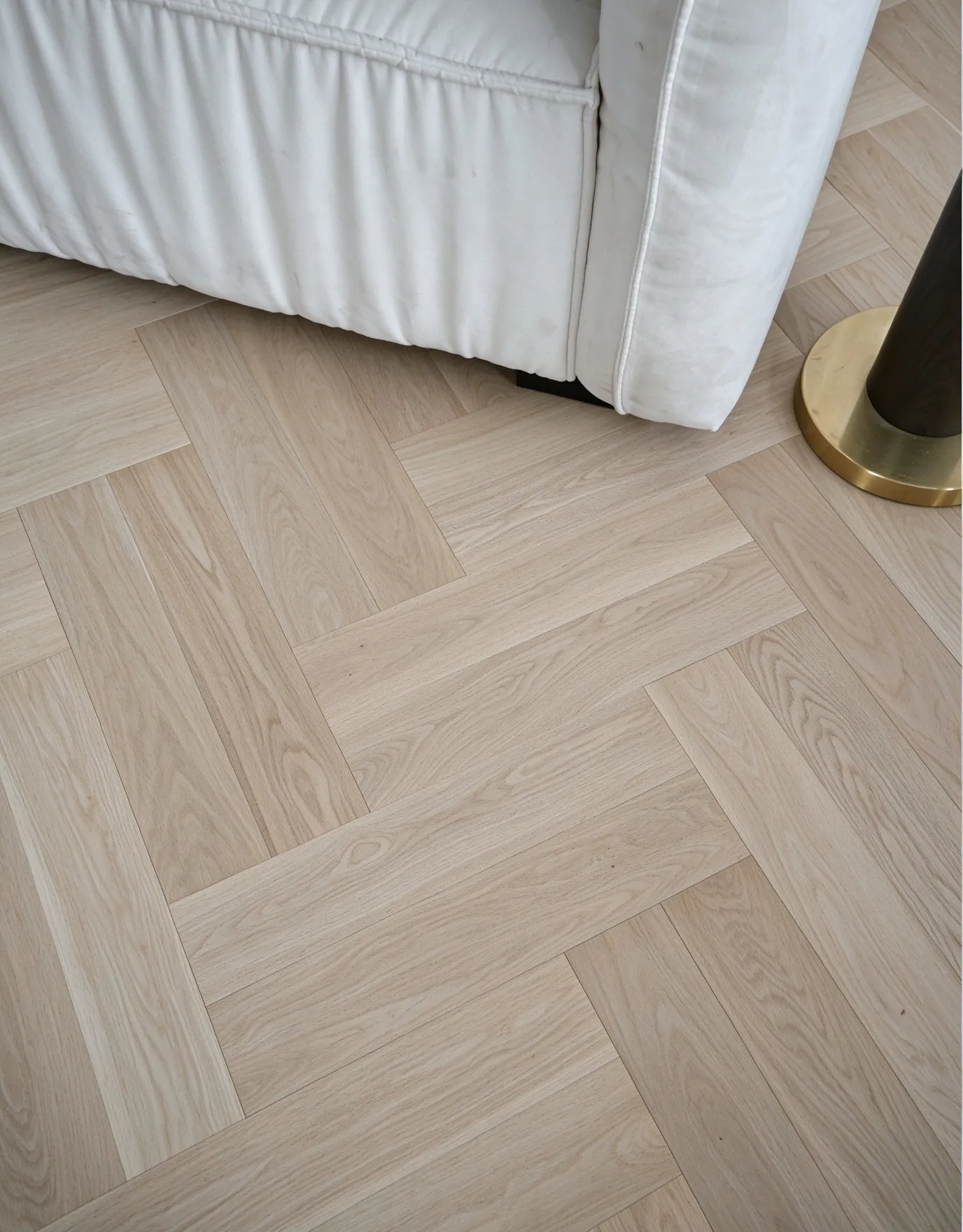
Light bleached European oak herringbone, 3 mm solid oak top layer on a multilayer base.
Get The Quantity And Cut Allowance Right Before Production
Herringbone is unforgiving on quantity. Ask your installer for a set-out drawing before you place the production order, and check it against these points:
- Waste factor. Straight-lay planking and diagonal herringbone need different allowances; the correct number comes from your actual room geometry, not an industry rule of thumb. Confirm the figure with your installer in writing and let them own it.
- The axis of the field. Decide whether the pattern points to the main entrance, runs parallel to the longest wall, or is centred on a fireplace or joinery run — then mark that axis on the slab drawing.
- Board length multiples. A herringbone field works best when board lengths divide cleanly into the room's running dimension. Where they do not, the cut blocks land in the most visible position instead of at a hidden perimeter.
- Consistency across containers. Order the full quantity for one area from one production batch, and keep spare material from that same batch for future repairs. A later top-up order can differ in tone even with an identical SKU.
- Packaging and pallet protection for long boards on a sea leg, including edge protection and desiccant, plus photographs of the loaded container before sailing.
Verify Import Terms And Site Readiness, Not Just The Floor
Buying direct from a Chinese factory shifts responsibilities that an Australian distributor would normally carry. Before you sign, confirm who does each of these:
- Freight mode and Incoterms — door-to-door delivery to your site address, or port only, and who arranges customs clearance in Australia.
- Import documentation: commercial invoice, packing list, certificate of origin and any permits required for timber products entering Australia. Ask the supplier which documents they issue and which you must obtain locally.
- Cargo insurance for the sea leg, and who files a claim if boards arrive damaged or wet.
- Delivery window against your slab handover date. Timber needs a dry, enclosed, conditioned space to acclimatise in; flooring that arrives before the roof is on has nowhere safe to go.
- Substrate readiness: screed flatness and moisture readings, heating commissioning completed, and site cleanliness at installation start.
- Who supplies adhesive, primer, trims, thresholds and stair nosings — these are frequently omitted from an overseas quotation and bought locally at a premium.
On warranties and standards: do not accept a general assurance that a floor "meets Australian requirements". Ask your specifier or building surveyor which standard applies to the specific application — residential or commercial, slip and fire performance for a common area, any impact-sound requirement between storeys — and request test documentation against that named requirement from the manufacturer. Where documentation is not available, have the product assessed locally before it goes into a specification.
How A Manufacturer's Project Team Should Support The Order
We supply flooring as part of wider villa and hospitality fit-outs, alongside joinery, wall panelling, doors, lighting and loose furniture — see our turnkey project services and custom and OEM service. That coordination is where flooring usually goes wrong on site: the floor, the skirting profile, the threshold detail at stone, and the joinery reveal all have to be dimensioned together. Published Australian project references include villas in Sydney, Melbourne, Perth and North Turramurra; scope details are on each case page rather than assumed here.
For a flooring-only enquiry, expect a competent supplier to give you: a written specification sheet with the construction detail above; physical samples from the candidate batch; a cut-list review against your set-out drawing; a packing and container-loading plan; and named contact for the production run. If any of those are missing, ask for them before payment terms are agreed.
Send us your floor plan and the pattern direction you want. We will quote the construction, board size, finish and grade you specify, review your installer's cut list, and confirm freight and documentation through to your Australian site address.
Contact PHILLIP — Phone / WhatsApp: +86-13928214007 | Email: santerson@qq.com | Enquiry page