
Shelving is rarely the item that decides a project budget, yet it is often the detail that makes a finished room feel resolved. When a buyer specifies custom shelving accessories alongside the cabinetry and joinery already on order, they gain storage that fits the exact wall, matches the approved finish palette, and arrives in the same shipment as everything else. This guide explains when those benefits are worth the extra specification work, and when an off-the-shelf shelf is simply the better answer.
What "custom shelving accessories" actually covers
In a project catalogue, this term does not describe one product. It covers the smaller components that make a shelving arrangement usable: shelf panels in glass or timber, brackets and frames, dividers, trim pieces, and the lighting and hardware that let an open shelf read as part of the joinery rather than an afterthought. In the Santerson Shelving Accessories listing, for example, finish, layout and dimensions are specified per project, which is exactly what distinguishes a made-to-measure component from a standard retail shelf. Because the accessories are configured at order stage rather than stocked in fixed sizes, the specification conversation happens on paper before anything is cut.
The same configurable approach applies across the wider shelving range. Floating modular shelves, bookshelf systems and open niche shelving are listed with made-to-measure sizing, material and finish choices, and layouts tailored to the space. The accessories connect those systems to each other and to the surrounding cabinetry.
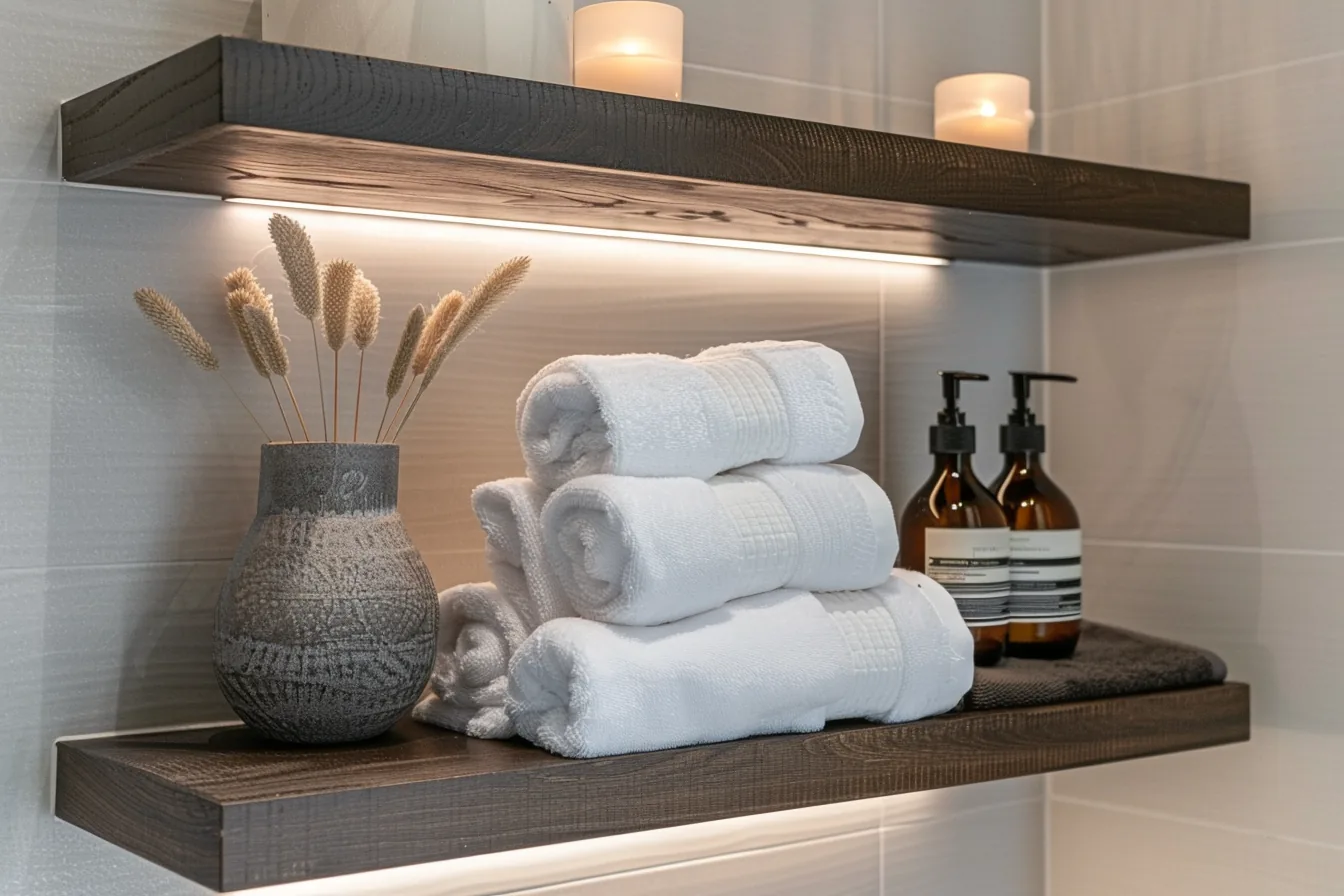
Configurable shelving accessory listing: finish, layout and dimensions are specified per project.
Five situations where custom accessories earn their place
1. The wall is not standard.
Recessed niches, sloping ceilings, columns, service runs and non-modular room dimensions are the most common reason project buyers move to made-to-measure shelving. A shelf specified for a bathroom niche or a floor-to-ceiling alcove has to clear pipework, tile setout and waterproofing details that a fixed-size product cannot accommodate.
2. Finish continuity matters across the specification.
In hotel guest rooms, serviced apartments and villa interiors, shelving usually sits next to wardrobes, vanities and wall panelling that have already been colour-matched. Ordering accessories in the same material and finish run as the cabinetry avoids the visible mismatch that occurs when a locally sourced shelf is brought in later.
3. You are buying several unit types from one supplier.
Shelving accessories are simplest to justify when the project already sources wardrobes, kitchen cabinets, media walls and bathroom storage from the same factory. One specification sheet, one production schedule and one shipment reduce the coordination load on site.
4. Integrated lighting is part of the design.
A lit display shelf needs a mounting detail for the fitting and an agreed position for cabling and its driver before the panel is made. Specifying the shelf together with integrated cabinet lighting settles those details on one drawing instead of leaving them to two trades on site.
5. The item repeats across the project.
A single shelf is rarely worth a custom order. Repeated guest-room niches, or one display module carried through several lobby bays, spread the specification effort across many units and make approval of one configuration enough to release the whole run.
When standard shelving is the better decision
Custom work carries specification and lead-time costs that are not always justified. These are the conditions under which standard products usually win:
| Project condition | Better approach |
|---|---|
| Room dimensions match standard modular sizes and no services interfere with the wall | Specify standard shelf sizes and spend the budget on higher-impact finishes |
| Only one or two units are required, with no finish matching to existing joinery | Source standard units locally to avoid shipping a small custom item |
| The design intent is deliberately replaceable or reconfigurable furniture | Freestanding open shelving rather than built-in accessories |
| The programme cannot absorb a sample approval cycle before production | Standard products with documented dimensions, ordered early in the schedule |
What a buyer needs to confirm before ordering custom accessories
Specification checklist
- Final wall dimensions taken from the finished surface, not the structural shell — tile, plasterboard and waterproofing all consume depth.
- Load expectation for each shelf: books, glassware, stone vanity tops and display pieces need different panel thickness and support spacing.
- Material and finish reference matched to the cabinetry already approved for the project.
- For lit shelves, the electrical specification and driver position confirmed with the site electrician before the panels are made.
- Fixing method suitable for the wall build-up, confirmed with the site contractor before panels are made.
- Packaging and handling notes for any glass shelf panels travelling in a shared container.
Product listings on this site describe configurable dimensions and finish options rather than fixed technical values. Dimensions, materials, hardware and electrical specifications should be confirmed for each configuration before order release.
How the custom route fits a turnkey procurement flow
SANTERSON has operated as a custom furniture and interior products manufacturer since 2008, supplying project customers in hospitality, villa and office work. Custom and OEM service covers bespoke design and prototyping, material and finish selection, and production of components that match the rest of the specification.
For buyers coordinating several trades, this consolidation is the practical argument. The same supplier producing modular bookshelf systems, storage walls and bathroom joinery can also produce the niche shelving and lighting details that tie those elements together, then ship them with the rest of the package under door-to-door delivery arrangements.
One practical note on order size: because accessories are small relative to a wardrobe or cabinetry run, they work best when added to an order already in place rather than produced as a standalone batch.
A practical decision rule
Consider custom shelving accessories when at least two of these are true: the wall geometry is non-standard, the finish must match joinery already on order, lighting integration is part of the design, or the item repeats across multiple rooms. When none of them apply, standard sizes keep the programme short and the budget clear.
Specify shelving with your joinery package
Send drawings, room dimensions and finish references, and the team will confirm configurations, materials and compatibility for each project before production begins.
Contact SANTERSON — Phone/WhatsApp +86 139 2821 4007 · Email santerson@qq.com
Dimensions, finishes and electrical details on product pages are configurable options. Confirm them for each project configuration before placing an order.