
A single ceiling fixture rarely decides whether a room reads as finished. What buyers actually feel on site is consistency: the ring light above the sofa, the panel joinery behind it, the flooring underfoot and the curtains at the window all answering to the same brief. That is exactly why our Modern Metal Ring Ceiling Light, Minimalist LED Flush Mount for Living Room & Bedroom is specified less as a stand-alone item and more as one line in a coordinated fit-out schedule.
What the fixture brings to the room
The design is deliberately quiet. A polished metal circular frame carries a black central structure with integrated LED strip lighting, so the light source itself stays hidden and the ring reads as a graphic outline on the ceiling rather than as hardware. Because it is a flush mount, it needs no down-throw and does not cut into ceiling height — helpful in apartments with modest floor-to-ceiling dimensions, in hotel corridors, and in bedrooms where a pendant would sit too low over a bedside circulation route.
The published product description positions it for living rooms, bedrooms, studies and lobbies. That range is not accidental: the same ring geometry works above a lounge seating group, over a study desk zone, or repeated in a row along a lobby ceiling where rhythm matters more than drama. Illumination is soft and ambient, so in most layouts the ring supports general lighting while task light is carried separately by wall sconces, floor lamps or integrated cabinet lighting.
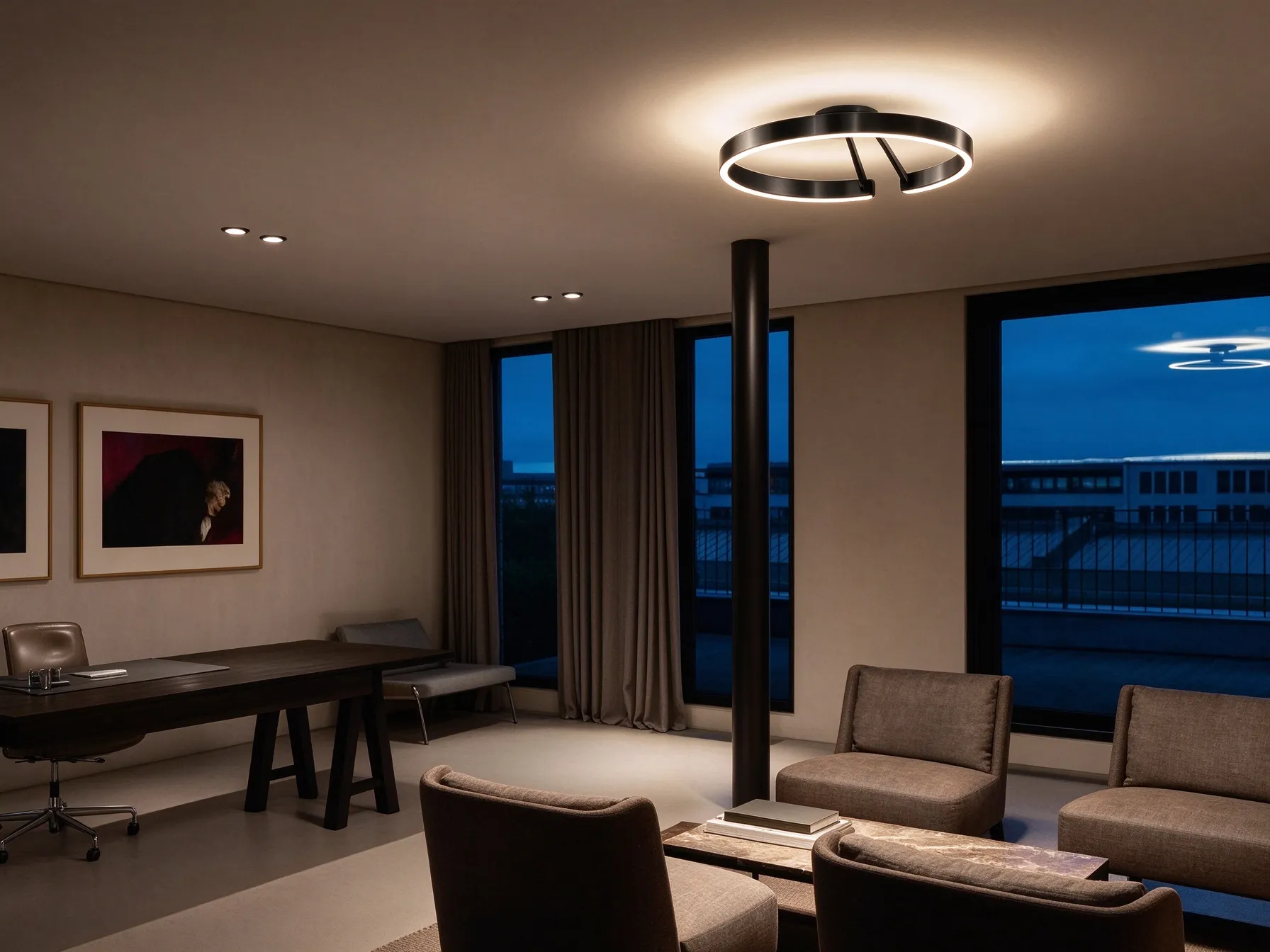
Polished metal ring frame, black central structure and integrated LED strip lighting.
Why a single light is hard to buy on its own
In project work the fixture arrives in a schedule, not a shopping cart. And that schedule is usually split between suppliers: one for lighting, one for cabinetry, one for flooring, one for wall and ceiling finishes. Every split adds its own drawing set, its own shipping window, its own site query, and its own risk of a finish tone that no longer matches once everything is installed.
The practical problems repeat across jobs:
- Metal finishes are ordered against a sample board, then compared months later against veneer panels and glass partitions that came from a different factory.
- Ceiling openings, set-out dimensions and driver locations are fixed by the ceiling contractor before the lighting schedule is final.
- Replacement or spare units are ordered after handover, and the original specification is no longer traceable to a supplier who still holds the tooling.
None of these are lighting problems in isolation. They are coordination problems, which is why procurement teams increasingly group lighting with the finishes it has to sit next to.
How the ring light sits inside a coordinated package
As part of turnkey villa and hospitality solutions, the fixture is handled as one entry in a single project schedule that also covers wall panel systems, custom cabinetry, bathroom ceramics, vanities, flooring, rugs and outdoor furniture for terraces and pool decks. Specified together, the ceiling light, the wall panel systems below it and the integrated cabinet lighting in the joinery can be reviewed against one set of finish samples at one time, instead of being reconciled on site.
For living room and bedroom packages specifically, we typically group the ring light with:
- Media walls, modular shelving and wardrobes, where a matching metal frame detail can be repeated in open shelving and glass-front units;
- Vanity units, mirror cabinets and ceramics in the adjoining bathroom, so metal tones carry from one room to the next;
- Engineered wood flooring, area rugs and window dressings that set the contrast the ring outline reads against;
- Companion fixtures from the same lighting range — flush mounts, wall sconces and pendants — so the language of the ceiling continues at eye level.
A practical five-step specification route
- 1. Fix the ceiling first. Confirm ceiling type, clear height and whether the ring is surface-mounted on a flat board or set into a recessed detail. Flush mounts assume a solid, level fixing surface.
- 2. Decide the light role per room. Ambient only, or ambient plus a task layer. Write the number of fixtures and their positions onto the reflected ceiling plan before any finish order is placed.
- 3. Match finishes in one sample review. Put the ring frame finish side by side with cabinet hardware, glass frames, skirting and flooring samples. Do it once, with everything on the same table.
- 4. Group the order. Combine lighting with the interior fixtures and finishes it will be installed against, so one production run and one shipment cover both.
- 5. Book spares at the same time. Order the quantity your facilities team will need for handover and the first years of operation, while the specification is still in production.
Delivery, installation and after-sales under one contact
Because the same team handles design coordination, production and logistics with door-to-door delivery, a package containing lighting, cabinetry, ceramics and finishes is consolidated rather than tracked across five separate consignments. Site work then follows the installation and after-sales support scope: fitting, inspection of snags, spare parts and maintenance follow-up. For projects in Australia, where our published project cases include villa and residential work in Sydney, Melbourne, Perth, Willoughby and North Turramurra, enquiries are handled through our project team before any schedule is committed.
SANTERSON has been manufacturing furniture and building materials since 2008, and supplies one-stop furniture and building materials for villa, hotel and office projects. Import terms, duties, transit arrangements and warranty scope are confirmed project by project rather than assumed.