
A freestanding pedestal basin looks simple on a mood board and complicated on a purchase order. If you are specifying the Freestanding Pedestal Basin 1003S, Modern Round Ceramic Stand Basin for Bathroom for a villa in Sydney or Melbourne, a boutique hotel fit-out, or an apartment renovation, the model name and the photograph are only the start. Below is the checklist we suggest you work through before you place an order from China, item by item, with the evidence you should ask the supplier to put in writing.
Start With What the Product Page States
The published description for model 1003S lists a tapered round silhouette in vitreous ceramic with a high-gloss glaze, a pre-reserved tap hole for a single faucet, and a back panel that fixes to the wall so the freestanding body carries load stably. The stated overall size is 490×490×805 mm. Because it stands on its own pedestal rather than on a vanity cabinet, it is often chosen where the design intent is a clean curved form and an uncluttered wall.
Product-page copy is written to introduce the item, not to serve as a submittal document. Ask for the current technical drawing for 1003S — overall dimensions, waste outlet position, tap hole position and fixing detail — and check that drawing against your own setting-out drawings before you order.
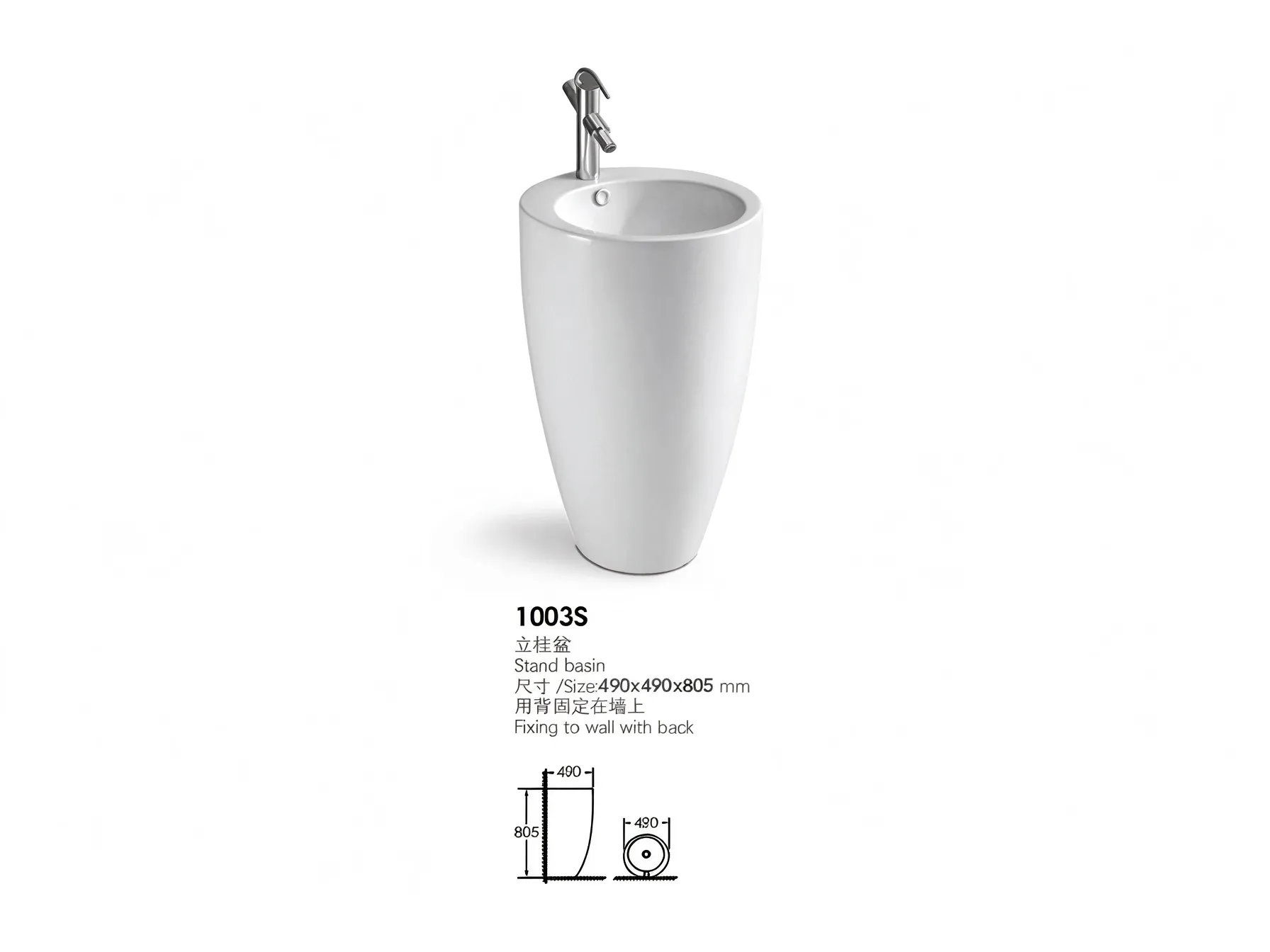
Model 1003S as published on the SANTERSON product page. Confirm the drawing, not the picture.
The Verification Checklist for Australian Buyers
1. Dimensions and clearances, from the drawing not the brochure
- Request a dimensioned drawing for 1003S showing the basin rim, pedestal footprint, tap hole position and the waste outlet position.
- Confirm the 490×490 mm footprint against your finished floor level, wall finishes and any adjacent toilet or shower screen, including handle and towel-rail clearances.
- Check the 805 mm overall height against your client's expectations for a washbasin, and confirm whether the height is measured to the rim or to the highest point of the body.
2. Waste, trap and rough-in set-out
- Ask which waste type the basin is supplied with — pop-up or free outlet — and whether the set-out is floor-mounted or wall-mounted for the pedestal.
- Send your plumber's rough-in drawing to the factory before production, and get written confirmation that the outlet position matches. This is where most rework costs appear on imported sanitaryware.
- Confirm the trap and connector are included in the shipment or listed as a local purchase, so nothing arrives short at handover.
3. Fixings to the wall and what your wall is
The 1003S is secured through a back panel against the wall. That detail matters for the substrate behind the tiles. Ask the supplier which fixings are supplied, and confirm with your builder whether the wall is stud framing, brick veneer or double brick, and whether noggins or solid blocking are needed at the fixing line. A freestanding basin that leans on a lightweight partition without blocking will move over time.
4. Tapware compatibility
The description states a reserved tap hole for single faucet installation. Confirm the hole diameter and the spout reach required so your deck-mounted mixer covers the basin properly, and confirm whether the tapware ships with the basin or is sourced locally to match Australian water-rating requirements.
5. Glaze quality and cleaning regime
The vitreous ceramic body and dense glaze are described as resisting water stains, limescale and discolouration. For a hotel or a hard-water area, ask what cleaning agents the manufacturer recommends and which ones to avoid, then write that into your maintenance manual. Aggressive acidic descalers dull any glaze over time.
6. Certification and compliance claims
7. Packaging, freight and damage protocol
- Ceramics break. Ask what packaging standard applies to 1003S — moulded foam, timber crate, corner protection — and how the pieces are loaded in the container.
- Agree in advance how breakage is documented on arrival (photographs, unloading notes) and what the replacement or credit process is.
- Confirm who arranges freight and customs paperwork. SANTERSON describes Furniture Logistics and Door-to-door Delivery, including sea, air and rail forwarding with commercial invoices, packing lists and certificates of origin. Get the Incoterms and the delivered price in writing rather than inferring them.
8. Order quantity, spares and lead time
Confirm the minimum order quantity for 1003S, the production lead time stated on your purchase order, and how many spare units you want in the same container. For a hotel or multi-unit project, ordering spares with the original batch avoids colour and glaze variation on later replacements.
How It Compares With Other Freestanding Models in the Same Range
If 1003S is under consideration alongside alternatives, compare footprints before you commit to a layout. The published catalogue shows a square 1004S stand basin with a compact 400×400 mm footprint for smaller bathrooms, and a gold-line accent model, 1050B, listed at 460×360×850 mm. All three are described as wall-fixed through a back panel with a reserved tap hole, so the differences you should weigh are shape, floor area, overall height and how the form reads against your tiling.
| Model | Published form | Stated size |
|---|---|---|
| 1003S | Tapered round, freestanding pedestal | 490×490×805 mm |
| 1004S | Square, freestanding pedestal | 400×400×850 mm |
| 1050B | Slim tapered body with gold line accent | 460×360×850 mm |
Sizes above are the figures published on each product page. Re-confirm them against the technical drawing for the exact production batch, because a drawing revision can change a rim diameter or an outlet position without the catalogue text being updated.
Specifying It as Part of a Bathroom Suite
Sanitaryware reads better when the pieces belong to one family. If you want a consistent look across a guest floor or a villa's bathrooms, ask which basins, wall-hung pans and bidets are offered in the same series, and request the matching list for your project before you lock the schedule. The 1004 series, for instance, is described as pairing its pedestal basin with a wall-hung pan and a wall-mounted basin of the same family, while the Floor Standing Bidet 1038F is described as matching its own 1038 series toilet. Confirm every model number against your specification sheet rather than assuming cross-series compatibility.
The same logic applies beyond ceramics. A bathroom package usually pulls together vanities and cabinetry, showers, lighting, wall and floor finishes, and mirrors. Coordinating those items with one supplier who also handles Turnkey Interior Project Solutions reduces the number of separate drawings, delivery windows and trades you have to manage on site.
Documents Worth Receiving Before You Pay the Deposit
| Document | What it settles |
|---|---|
| Dimensioned technical drawing for 1003S | Overall size, tap hole and waste positions, pedestal footprint |
| Packed dimensions and container loading plan | Cube, handling on site, breakage risk |
| Written rough-in confirmation against your plumbing drawing | That the outlet lines up with what your plumber has set out |
| Certificate copies relevant to this model | What your certifier and state authority will accept |
| Proforma invoice with Incoterms, itemised charges and spare units | The real delivered cost, not just the unit price |
| Breakage and replacement terms | What happens if ceramics arrive damaged |
| Recommended cleaning and maintenance guidance | Glaze life in service, especially for hotels |
A Practical Sequence That Avoids Rework
- Send the model number and your bathroom layout to the supplier, and ask for the drawing plus a quotation with spares priced separately.
- Return the drawing to your plumber and builder for rough-in and wall-blocking comments before you sign off production.
- Have your certifier confirm the compliance route for the model in your state.
- Approve production only after the rough-in, compliance and freight terms are all in writing.
- Inspect cartons at delivery with photographs, then install after wall finishes are complete to avoid site damage.
Common Problems On Imported Basins, And How To Head Them Off
- Waste outlet does not meet the set-out. The fix usually means breaking floor or wall finishes. Prevent it by exchanging drawings in writing before production starts.
- A freestanding body that rocks after handover. This is often a substrate problem rather than a ceramic problem. Confirm solid blocking at the back-panel fixing line and check that the pedestal seat is bedded level on the finished floor.
- Tapware spout falls short of the rim. Check the spout reach against the published basin dimensions before you buy mixers locally.
- Glaze haze after a period of cleaning. Usually traced to aggressive descalers. Get written cleaning guidance and put it in the owner's manual or hotel operations manual.
- Replacement units that do not match. Later production runs can vary slightly in glaze tone. Order spares with the original container for any multi-bathroom project.
Talk to Us Before You Order
SANTERSON is a China-based furniture and building materials manufacturer supplying villa, hospitality and office projects, with Australian project references in Sydney, Melbourne, Perth, Willoughby and North Turramurra. If you are evaluating the 1003S stand basin for a project, send us your drawings and we will confirm what the model can be supplied with and what still needs local sign-off.
Contact: PHILLIP | Phone / WhatsApp: +86-13928214007 | Email: santerson@qq.com | Our Services