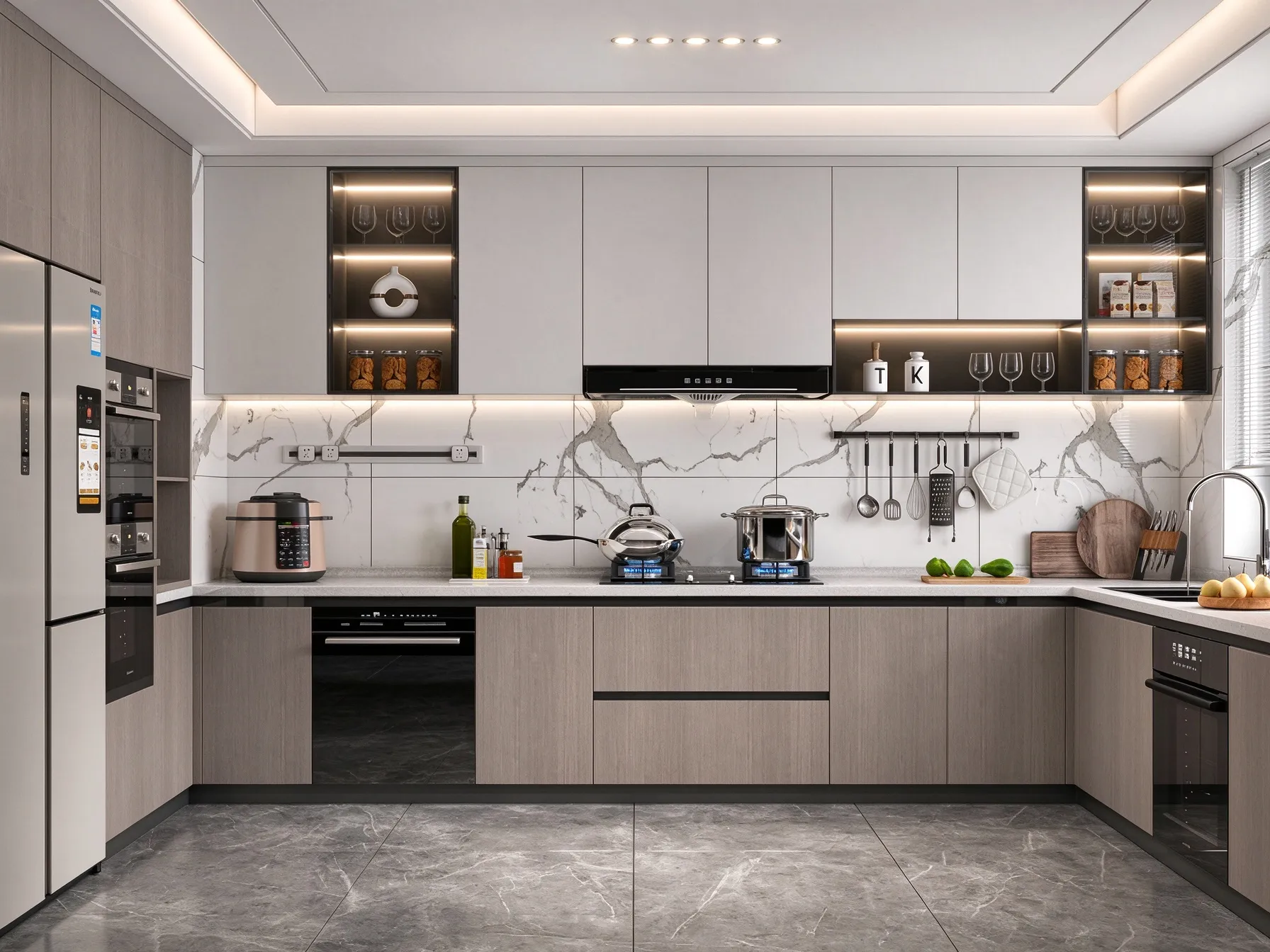
Two-tone wood and white cabinetry has become the default choice for villa kitchens, serviced apartments and boutique hotel suites because it keeps a space feeling warm without going dark. Sourcing that joinery direct from a China-based manufacturer cuts out the middle layer, but only if you brief it properly. Below is the practical sequence we follow with project buyers: what to specify, what to send, and how to check the result before the containers are booked.
The look itself is simple: natural wood grain on the tall units or the island, flat matte white on the run of wall cabinets. The grain carries the warmth, the white keeps sightlines clean in an open-plan layout. Where it goes wrong in overseas sourcing is rarely the design — it is the handover between the drawing and the factory floor.
Why this combination works for villa and apartment kitchens
A single-colour kitchen in a large villa tends to read as either cold or heavy. Splitting the palette solves that without adding mouldings or decorative panels. In our two tone wood & white modern kitchen cabinets, the wood grain sits on the end panels and tall housing while the wall run stays matte white, with glass-fronted display cabinets lit by warm LED strips on either side. The same logic applies at project scale: keep the busy elements — refrigerator housing, oven housing, pantry stack — in the wood tone, and let the worktop-level cabinetry recede.
Integrated appliances are part of why this style is worth specifying rather than buying locally off the shelf. Cabinet depth, ventilation gap and hinge type all change once an oven or a column refrigerator goes into the run, and a made-to-measure factory build absorbs those dimensions instead of hiding them behind a trim piece.
What to decide before you send an enquiry
Enquiries that arrive with only a mood board get quoted on assumptions. The following decisions, settled in advance, are what turn a rough price into a firm one.
1. Door style and handle detail
- Flat panel / handleless — the cleanest match for white. Our Two Tone European Cabinets cover the flat-panel route, and profiled aluminium channel handles can be specified where a finger pull is preferred.
- Shaker — a framed door in white with a wood-tone island, which suits coastal villas and heritage conversions. See Two Tone Shaker Cabinets.
- Slab with a wood veneer door — for hotel and high-end apartment work where the grain needs to be real timber rather than a printed decorative surface.
2. Surface finish, and what it has to survive
White shows fingerprints; wood tone shows scratches. That trade-off drives the finish choice more than the aesthetic does.
| Finish | Best for | Watch out for |
|---|---|---|
| Matte lacquer / matte panel | High-traffic family kitchens, apartment stock units where a soft, low-glare surface is wanted | Low-sheen white marks more easily than gloss; specify a wipe-resistant surface for the sink run |
| High gloss acrylic | Compact or poorly lit kitchens that need reflected light | Every panel edge and hinge alignment shows under direct downlighting |
| Wood veneer | Boutique hotel and villa projects where grain continuity matters across a long run | Grain matching between door, panel and drawer front must be agreed on the sample, not assumed |
| Melamine / textured laminate | Apartment schemes with tight budgets and a need for a scratch-resistant surface | Edge banding colour has to be approved in writing; it is the first place a cheap job gives itself away |
Our Two Tone Matte Cabinets and Two Tone Veneer Cabinets are both built to project-specific dimensions with the finish selected per job, so the same layout can be quoted across several budget tiers.
3. Carcase and internal fit-out
Specify the carcase board and thickness, not just the door. Then specify what goes inside: drawer stacks versus shelves in the base units, corner solutions (pull-out carousel or magic corner), tall-unit pantry racking, cutlery dividers, and provisions for a wine fridge or an under-bench refrigerator. Where appliances are being sourced locally, send the appliance model list early — recess dimensions and ventilation clearances come from those datasheets.
4. Hardware
Hinges, drawer slide rails, support legs and connecting brackets travel with the cabinetry on our custom built-in kitchen cabinets programme. Decide up front whether soft-close is required throughout or only on the main run, and whether hinges are supplied pre-mounted to the door or loose in cartons for the site fitter.
The documents that make an overseas quote reliable
- Dimensioned elevations of every wall run, with ceiling heights, floor-to-slab levels and window sill heights marked
- Positions of soil stack, water inlet, waste, and the electrical ring for oven, hob and extractor — including whether the extractor ducts out or recirculates
- A material board from the factory: door sample, carcase sample, edge band sample and one worktop sample in the selected stone
- The LED specification for glass display cabinets — strip type, colour temperature, transformer location and how it is switched
- A written note of anything not being supplied by the factory, so no site trade item falls between two contracts
How a custom cabinetry order actually runs
SANTERSON works as a China-based furniture and building materials manufacturer supplying project buyers, and kitchen joinery is usually one line item inside a wider fit-out. The sequence on the custom & OEM service side runs from the design brief and quotation through detail confirmation, then production, shipment and follow-up.
- Brief and layout. Elevations are checked against the architectural drawings. Where a villa kitchen opens into a living area, the same wood tone usually continues into the media wall, pantry and sideboard — worth ordering together so the grain matches.
- Quotation and detail confirmation. Panel material, finish, hardware brand and internal fit-out are fixed line by line. Sample boards go out before this closes.
- Production and quality control. Doors, carcases and worktops are made to the approved drawings. This is where a second set of eyes on grain direction and edge banding pays for itself.
- Packing and shipping. Cabinetry is packed panel by panel with the hardware sets labelled against each run. Freight moves by sea, air or rail with the export paperwork handled at our end, and site delivery can be arranged to the project address rather than a port.
- Installation and after-sales. Panels are laid out on site in run order so the fitter is not decoding carton labels. Snag lists come back with photographs, and replacement panels are made against the stored drawings.
Bundling kitchen joinery with the rest of the fit-out
The reason project buyers source cabinetry from a general manufacturer rather than a specialist joinery workshop is consistency across trades. When the same factory produces the kitchen, the wardrobes, the vanity units and the wall panelling, the wood tone and the white are mixed to one batch, and the panels meet each other at reveal lines without a colour argument on site. Our turnkey solutions cover villa, hospitality and office projects across design, production, logistics and installation; custom kitchen cabinets for residential and hotel projects sit inside that scope alongside bathrooms, lighting, flooring and window dressings.
Published project work includes villa fit-outs in Sydney, Melbourne, Perth and North Turramurra, where cabinetry and joinery were supplied together with loose furniture. Scope details for any specific job are confirmed case by case rather than assumed from the location.
Checking the goods when they land
- Count cartons against the packing list before signing, and photograph any damaged crate while it is still sealed
- Open one door of each type and check the edge banding, then hold two doors side by side to confirm the white is one colour and not two batches
- Lay out a full run on the floor dry, without fixings, to catch a reversed door or a swapped panel before anything is screwed to a wall
- Test every LED transformer and every drawer slide at bench height before the worktop goes down
- Keep the shop drawings and the finish codes on site — they are what a replacement panel gets matched to two years later
Send us your kitchen elevations
Share drawings, appliance list and finish preferences, and we will return a quotation with panel specifications and internal fit-out itemised. Sample boards for wood tone and white finishes are available before production.
Contact: PHILLIP | Phone / WhatsApp: +86-13928214007 | Email: santerson@qq.com
Reference project image — two tone wood and white kitchen with LED-lit glass display cabinets.