
When an outdoor dining set and sun lounger package arrives from a supplier as a single quotation, the price line is rarely the hardest part to read. What decides whether a Aluminum & Teak-Look Slat Outdoor Dining Set & Adjustable Sun Lounger proposal is actually good value is everything around the number: whether the specification answers the questions your site conditions raise, whether the quantities match the layout you are building out, and whether the allowances for finish, dimension and spare parts were settled before production started rather than after.
Start With the Site Conditions, Not the Furniture
Aluminium-and-slat collections of this type are specified for resort pool decks, villa terraces, café patios and coastal properties. Those four settings impose very different duties on the same item, and a proposal that reads well on paper can be wrong for your site. Before reviewing any line item, write down the conditions your set has to survive:
- Splash and chlorine exposure. A lounger stored two metres from a pool edge is wet with treated water several times a day. Ask what surface treatment the frame carries and whether it is stated for chlorinated and coastal environments, not simply "weather-resistant".
- Salt air. Within walking distance of the coast, powder-coat quality and fastener material matter more than the silhouette. Confirm the coating process and ask which hardware grade is used.
- Drainage and standing water. Slat tops shed rain quickly, but only where the slats run to a free edge. Check the drawing for how water exits at the table ends and under the lounger frame.
- Stacking, storage and off-season handling. A hotel closing its terrace for winter needs to know whether chairs stack, whether the lounger folds, and where both sit between seasons.
- Floor finish. Decking, pavers and timber surrounds scratch differently. Ask for the foot detail so you can protect the surface you have already paid for.
A supplier who engages with these conditions in writing is worth more than one quoting a lower price against an unchanged standard specification.
Read the Frame and Slat Specification Carefully
The commercial argument for this construction is maintenance. Aluminium does not rust in a humid, chlorine-rich pool environment, and a slatted top with a teak-look texture avoids the oiling, cracking and fading cycle that solid timber brings to a high-traffic terrace. That argument only holds if the proposal specifies what you are buying.
In the specification block, look for:
- The frame profile and wall thickness on the dining table, chairs and lounger, not just "aluminium frame".
- The coating method and colour code. Ask whether the finish is a standard catalogue tone or a matched project colour, because matched tones usually change both price and lead time.
- Weld and joint treatment at the sled-base corners, where coatings thin during fabrication.
- Slat fixing method — clipped, screwed or captured in a channel. This determines whether a damaged slat can be replaced individually or whether a whole panel goes back to the factory.
If any of these are missing, they are not minor omissions. They are the difference between two quotations that look identical and perform very differently in year three.
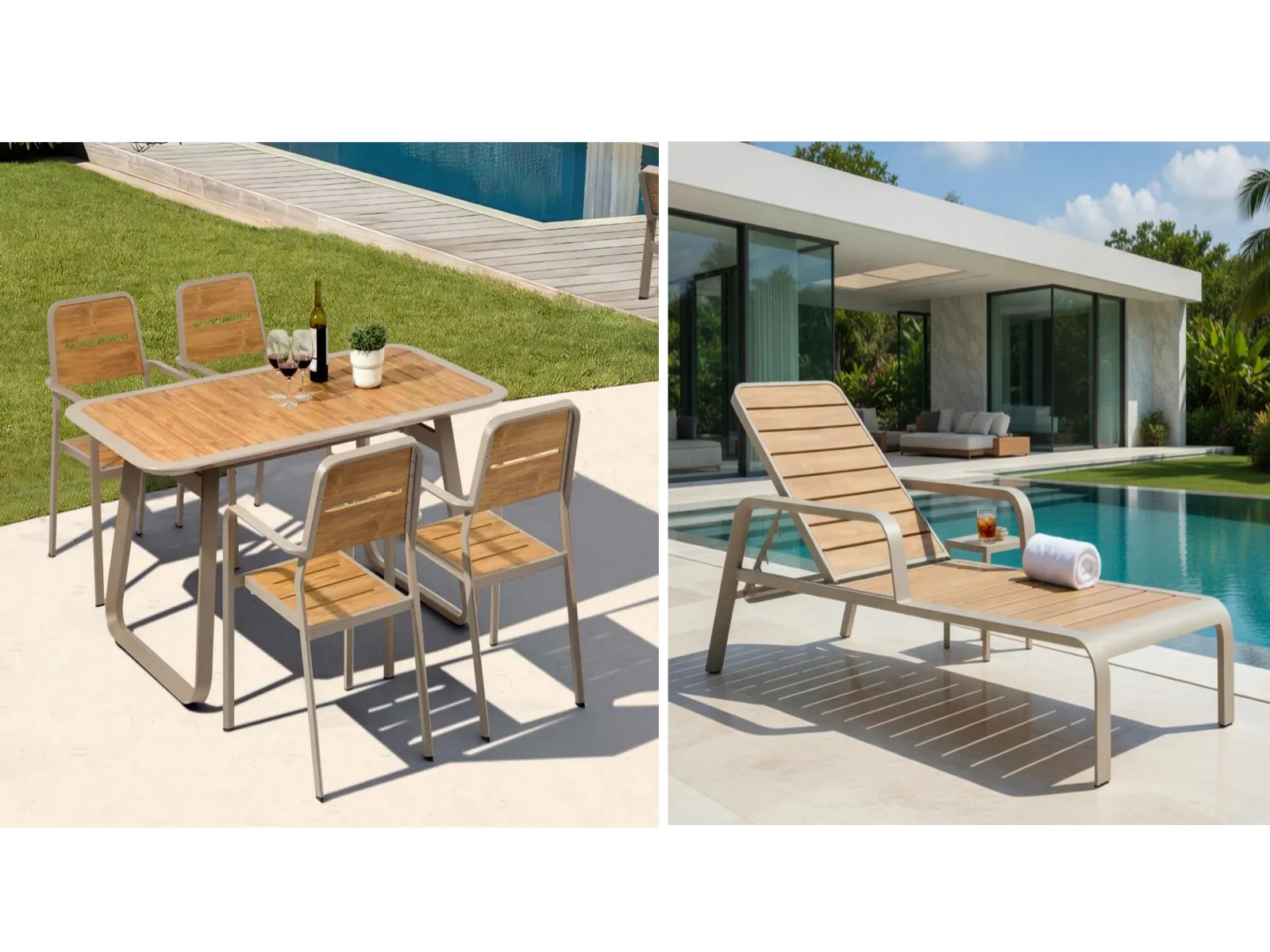
Sled-base aluminium chairs, slatted tops with a teak-look finish and a multi-position lounger: the configuration most resort and villa projects specify for poolside dining and lounging zones.
Check the Lounger Mechanism Before You Check the Price
The adjustable sun lounger is the component most likely to fail first and the one guests complain about most quickly, yet it usually appears in a proposal as a single line with no mechanism detail. Ask specifically for:
- Adjustment type. Multi-position ratcheted backrest or continuous (stepless) adjustment. Ratchets are simpler to service; stepless frames offer finer positioning but have more parts.
- Number of locked positions and where the stop points sit in the recline range.
- Frame base style. Fixed sled base, wheeled for layout changes on a large deck, or folding for venues with limited off-season storage. If your proposal lists one base only, ask whether the others are available at the same specification.
- Sling or cushion material if the lounger is not slatted through — a breathable mesh that drains and dries quickly behaves very differently on a pool deck from a padded cushion that holds water.
Where the pool deck needs higher throughput than a slatted lounger suits, ask for both options quoted side by side. A supplier running a full Aluminum Sling Sun Lounger Collection in static, wheeled and folding frame versions can put the trade-off in front of you on one sheet instead of leaving you to discover it after installation.
Pin Down What "Teak-Look" Means in Writing
This is the clause most often left vague, and it is the one that causes disputes at handover. "Teak-look" describes an appearance, not a material. In your proposal it should be tied to a specific finish reference: the texture treatment, colour code and top-coat system applied to the aluminium slat. Then confirm three practical points:
- Surface temperature in direct sun. A textured, lighter-tone slat runs cooler underfoot and underhand than a dark smooth finish on an exposed deck. Ask for swatches in both tones and compare them outdoors, not in the sample box.
- Cleaning regime. Confirm what the site team can use daily and what they must never use, so housekeeping does not strip the finish in the first quarter.
- Fade behaviour over the warranty period, and whether a matched colour on a later repeat order is guaranteed to match the first delivery.
Getting this written down costs nothing at proposal stage and removes the most common argument at practical completion.
Match Quantities to Your Seating Plan, Not to the Supplier's Default Set
Catalogue packages are built around a default configuration. Commercial projects rarely need that one. Rebuild the quantities yourself from the layout drawing and send the supplier your list rather than accepting theirs:
| Zone | What to count | Common proposal error |
|---|---|---|
| Poolside dining | Covers at peak, table footprint against circulation width, chair clearances for service staff | A default six-seat set specified where the plan needs four two-top tables instead |
| Terrace and café frontage | Table count against the operating licence's permitted seating | Under-ordering chairs because turnover was assumed rather than agreed |
| Lounger deck | Sun orientation, shade hours, walkway widths between rows | Loungers ordered without a spare allowance for high-use positions |
| Shaded dining pavilion | Whether dining sits under a hardtop gazebo and how the set fits the bay spacing | Dining set sized before the shelter dimensions were fixed |
Also state explicitly whether mixed quantities across collections are allowed. A resort that wants slatted dining at the pool, sling loungers on the deck and a bar-height set at the poolside counter should be quoted as one coordinated order, not four separate ones with four sets of terms.
Test Whether Customisation Is Really Inside the Price
Most proposals for this category say "custom colours and dimensions available". Treat that as a placeholder until you know what it covers commercially. Ask, in writing:
- Which dimensions can change — table length and height, chair seat height, lounger length — and which are fixed by the tooling.
- Whether a non-standard dimension changes unit price, minimum order quantity or production lead time.
- What prototype or first-article approval is offered before full production runs.
- Whether finishes can be matched to an existing joinery, decking or façade palette on site.
This is where a manufacturer running genuine custom furniture and OEM work separates itself from a trader. If the reply to your dimension question is "we will check with the factory", you are reading a trading proposal, and your commercial risk profile changes accordingly.
Compare Proposals on One Sheet
Line up every quotation against the same rows. The columns below are the ones that expose real differences between proposals that look comparable:
| Evaluation row | What a complete answer looks like |
|---|---|
| Frame and coating detail | Profile, thickness, coating method, colour code, hardware grade |
| Slat finish reference | Named texture and colour system, not the phrase "teak-look" |
| Lounger mechanism | Adjustment type, locked positions, base style options |
| Quantities | Your seating plan rebuilt line by line, with a spare allowance stated |
| Customisation inclusions | Which dimension and finish changes are priced in, and at what MOQ |
| Packaging and loading | Pack list per container, protection at corners, loading plan |
| Delivery terms | Incoterms stated, freight and customs documentation named, tracking confirmed |
| After-sales scope | What is covered, what counts as wear, replacement parts availability, who installs |
Two rules of thumb settle most close comparisons. First, a proposal that names the supplier's door-to-door logistics scope — freight mode, paperwork, container loading and tracking — transfers far less hidden cost to you than one that quotes FOB and leaves the rest to your forwarder. Second, read the after-sales page as a set of terms to confirm rather than promises to rely on: what is covered, how quickly issues are handled and who performs installation should all be in your contract, not only in marketing copy.
Five Questions Worth Sending Before You Accept
- Send the full dimensional drawing for the table, chairs and lounger, including recline positions and folded or stacked dimensions.
- Confirm the slat finish reference and provide physical swatches in two tones so we can test surface temperature on site.
- State which dimension changes are inside the quoted price and what minimum quantity applies to a matched colour.
- List the spare parts available for the lounger mechanism after year two of service.
- Set out the packaging, loading and delivery scope for our port, with the documents you will supply.
The quality of those five answers tells you more about how the project will run than any number in the quotation.
Red Flags in an Outdoor Package Proposal
- One price covering "dining set plus lounger" with no split line items, so nothing can be substituted later.
- "All-weather" stated with no description of the coating or fastener materials behind it.
- Adjustable backrest mentioned without the mechanism type or number of positions.
- Quantities taken from a catalogue set rather than your layout drawing.
- No packaging, loading or delivery detail anywhere in the document.
- After-sales terms expressed as response-time claims with no definition of coverage or exclusions.
Material and performance statements on product pages are supplier descriptions. For a specific project, confirm the coating system, mechanism service life and any local compliance requirements for your site in writing before they become part of the contract.
Send us the layout, not just the enquiry. SANTERSON manufactures outdoor collections — dining sets, loungers, cabana daybeds and hardtop gazebos — alongside interior fixtures and building materials, so poolside dining, the shaded pavilion beside it and the guest-room joinery can be coordinated under one turnkey project scope. Frame colours, table dimensions and lounger base styles are produced to project requirements.
Browse the wider range in outdoor furniture for villas and resorts, or contact us with your drawings for a proposal you can actually compare line by line.