
A ceiling light that sits almost flat against the slab looks simple on a spec sheet: a panel, a frame, some LEDs. That simplicity is exactly where buying mistakes happen. This guide walks through what to check before you order a modern ultra-flush LED ceiling light in round or square for bedrooms and living rooms — from room-by-room sizing and light quality to mounting conditions, project coordination and what to confirm with the supplier in writing.
What "Ultra-Flush" Actually Changes in a Room
A flush-mount fixture sits tight to the ceiling with little or no gap; an ultra-flush or ultra-flat design reduces that depth further, so the fitting reads as a thin disc or square of light rather than an object hanging in the room. In practice this matters in three situations:
- Lower ceilings and circulation paths. Where clear height is limited, every centimetre of fixture depth counts above beds, walkways and seating. A low-profile panel keeps headroom while still lighting the whole room.
- Minimalist interiors. A clean round or square panel with a slim frame stays quiet against a plain ceiling, which is why these fixtures are specified for contemporary bedrooms, living rooms and children's rooms instead of decorative pendants.
- Recurring room types in projects. Hotels, serviced apartments and villa developments repeat the same ceiling detail across many rooms. A simple flush profile is easier to detail, install and maintain consistently than sculptural fixtures.
SANTERSON's version of this product type is described as an ultra-flat ceiling light with a clean round or square panel, a slim frame and even LED illumination, intended for bedrooms, living rooms, children's rooms and modern interiors. That description is the starting point for evaluation — the rest of this article shows what to verify around it.
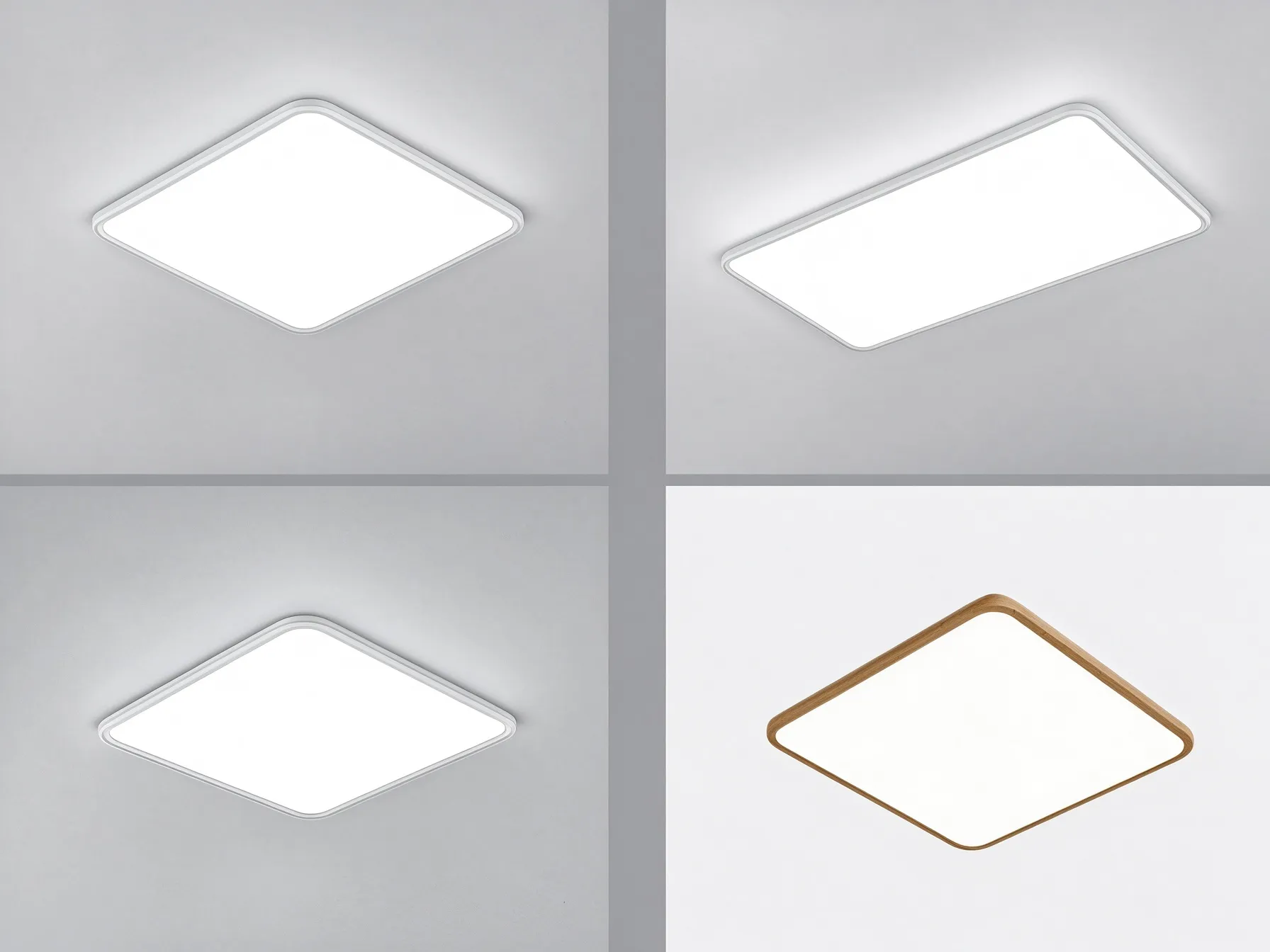
Step 1: Decide Round or Square by Ceiling Geometry, Not Taste Alone
Both shapes deliver the same basic function, so choose based on how the fixture sits in the room:
| Condition in the room | Practical reading |
|---|---|
| Furniture laid out symmetrically (bed centred, seating axis) | A round panel centred on the axis reads as balanced and is the usual default for bedrooms. |
| Rectangular living room or a long ceiling run | A square panel, or two matching panels along the long axis, distributes light more evenly than one oversized round fitting. |
| Ceiling features such as coves, bulkheads or beams | Match the fixture geometry to the ceiling lines; square panels align cleanly with right-angled detailing. |
| Mixed room types across a project | Specifying the round shape in bedrooms and the square shape in living areas keeps one product family, which simplifies ordering and spares. |
Step 2: Judge the Light, Not Just the Fixture
"Even LED illumination" is a claim you should be able to test. Ask the supplier these specific questions and get answers in writing:
- Diffuser construction. Is there a full-face diffuser that hides the LED sources, and does it spread light without visible hot spots? A panel that looks uniform from below is what comfortable ambient light depends on.
- Colour temperature choice. Warm white suits bedrooms and living rooms; neutral white suits studies, corridors and children's rooms. Confirm which fixed or selectable options the range offers, and keep one temperature consistent across a project.
- Dimming behaviour. If the room will have a dimmer, confirm which driver and control method the fixture is supplied with and which dimming systems it has been tested with. Driver compatibility is a common source of flicker and drop-out after installation.
- Consistency between units. For multi-room orders, ask how the supplier controls colour consistency across production batches, so panels installed side by side in a corridor or open-plan space match.
Step 3: Check the Mounting Condition Before You Order
Flush fixtures fail more often at installation than at lighting. Before confirming quantities, check:
- Ceiling substrate. Concrete slab, gypsum board and suspended ceiling grids each need different fixings and back-plates. Confirm the fixture's mounting method suits what is actually on site.
- Driver location. An ultra-flat panel has very little internal space, so the driver usually sits in the ceiling void or in the back box. Confirm there is room to reach it for service — a light you cannot access is a light you cannot maintain.
- Set-out and first-fix coordination. The junction box position must be set before the ceiling is closed. Send fixture dimensions to the electrical contractor early, not after the ceiling is finished.
- Spares access. For project orders, order spare units and confirm the supplier can reproduce the same panel and driver later; discontinued drivers are a frequent maintenance problem.
Step 4: Match the Fixture to the Right Supplier Model
For single-room renovations, any reliable local lighting source may do. For villas, hotels and multi-unit developments, buying ceiling lights as part of a broader fit-out package usually reduces coordination work. A furniture and building materials supplier that also handles lighting, joinery, ceramics, flooring and wall finishes can keep the whole room specification — ceiling lights, vanities, wardrobes, cabinetry and panelling — on one drawing set and one shipment.
SANTERSON is a China-based manufacturer and one-stop supplier working on villa, hospitality and office projects, with services covering design coordination, custom/OEM production, logistics and door-to-door delivery, installation support and after-sales service. Lighting sits inside the same catalogue as Modern Metal Ring Ceiling Light, wall lamps and pendants, which makes it practical to build a layered lighting scheme — ambient, task and accent — from one source. Published project cases include villas in Sydney and Melbourne, Platin Housing work in Willoughby and North Turramurra, and a Perth project listing.
If you are specifying for an Australian project, confirm import terms, duties, delivery scope and warranty handling case by case with the supplier rather than assuming any single service level applies to every order.
Step 5: Run a Sample Before Committing to Quantities
A sample order is cheap insurance. Test it in the real room and check:
- Uniformity — no bright dots or dark corners across the panel face.
- Colour cast — how the light renders wall, floor and fabric finishes you have already selected.
- Profile in situ — whether the slim frame really reads as minimal from bed and sofa height.
- Switching and dimming behaviour with your chosen control gear.
A Pre-Order Checklist
- Shape and diameter/side length confirmed against ceiling geometry and furniture layout.
- Colour temperature fixed across the project; dimming requirement stated.
- Driver type, location and service access agreed with the electrical contractor.
- Mounting fixings confirmed for the actual ceiling substrate.
- Sample tested on site before bulk order.
- Spares quantity agreed; packaging and replacement terms confirmed in writing.
Frequently Asked Questions
Is an ultra-flush LED panel bright enough for a living room?
A single low-profile panel works well as ambient light in small to medium living rooms. In larger or open-plan layouts, plan two or more panels on the ceiling grid and add floor and wall lighting for task and accent layers, rather than relying on one oversized fitting.
Round or square — does one last longer than the other?
Shape has no effect on lifespan. Longevity depends on driver quality, ceiling ventilation around the driver and how accessible the unit is for maintenance — which is why the mounting checks in Step 3 matter more than the outline of the panel.
Can bedrooms and living rooms use different shapes from the same range?
Yes, and this is a common project strategy: round panels in bedrooms, square panels in living areas, keeping one product family for consistent light quality, shared spares and simpler reorders.