
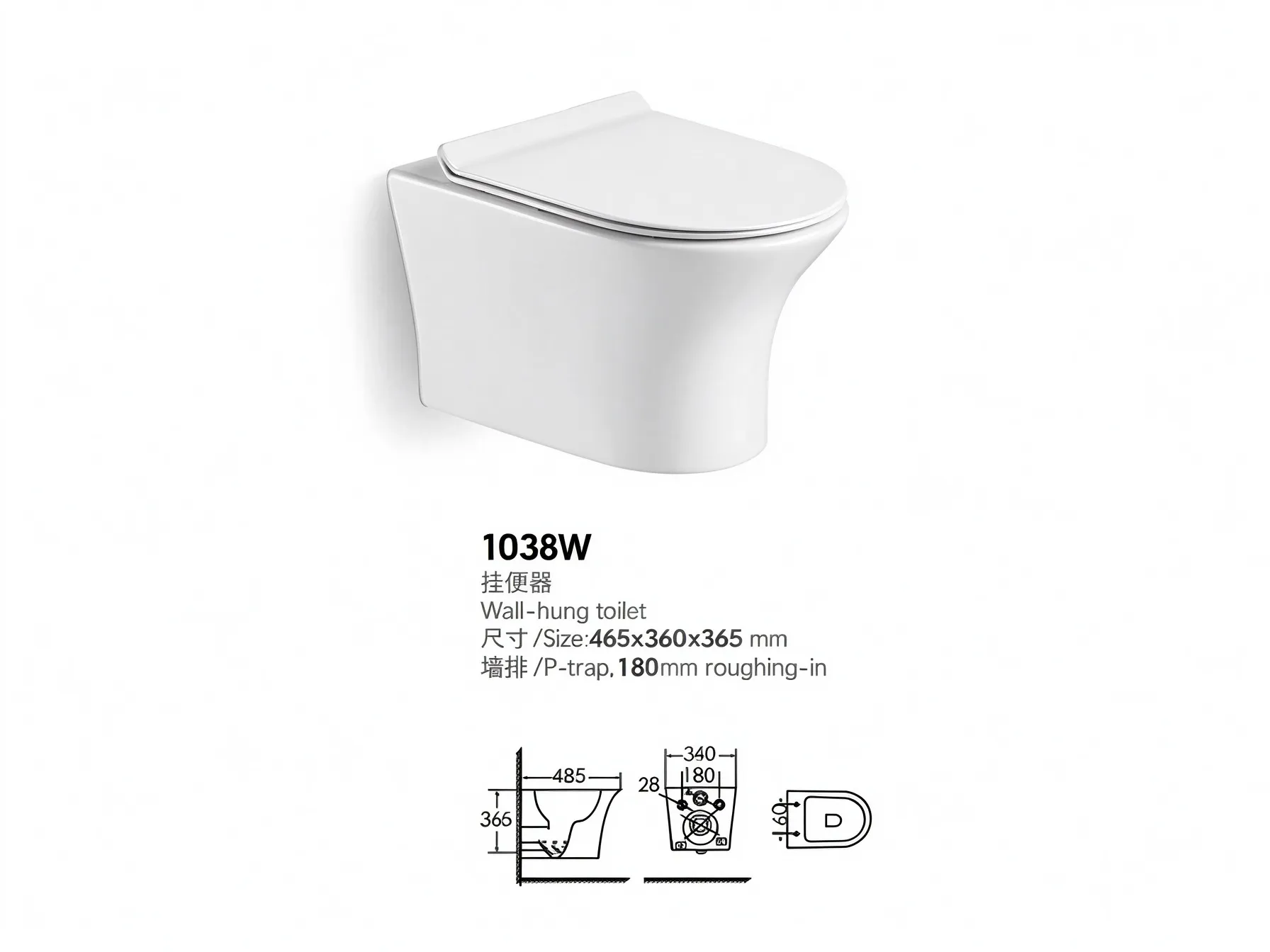
A wall-hung WC looks simple on a drawing. It is the one item in the bathroom schedule that fails loudest when it is specified late, because the frame, the carrier and the drainage all sit inside the wall. This article walks procurement teams and project managers through placing the Wall Hung Toilet 1038W, Rimless Ceramic Wall Mounted WC for Modern Bathroom inside a whole-project materials schedule — the line items to create, the technical fields to fill before an order is released, and how the ceramic coordinates with the rest of the sanitary package when one supplier covers furniture, fixtures and finishes.
Why the wall-hung WC belongs in the early schedule, not the finishing schedule
In a villa or hospitality fit-out, materials schedules are usually issued in tranches: structural and envelope items first, then floor and wall finishes, then joinery, then loose furniture. Sanitary ceramics tend to drift to the back of that queue because they arrive near the end of site works. The wall-hung toilet breaks this pattern. Once the pan is selected, the concealed cistern and support frame have to be fixed to structure and connected to a soil outlet at a defined height and depth, and that work is closed over with wall lining, waterproofing and tiling.
If the ceramic selection arrives after the wet-area lining is complete, the practical options are unattractive: break out the finished wall, accept a floor-standing alternative in rooms designed for a floating pan, or hold the trade while the specification is confirmed. All three cost more than the time it takes to specify the pan during design development. For this reason we place the wall-hung WC in the same tranche as tiling and joinery, not with loose furniture.
Reading the 1038W against your bathroom type
The 1038W is a vitreous ceramic pan with a seamless glaze and clean, minimalist lines, designed for wall mounting with a concealed tank system so the floor beneath stays clear. Two characteristics decide where it belongs in a project schedule:
- Compact footprint. The product is described as compact, which suits guest washrooms, single-bathroom villas and hotel rooms where the clear floor area is tight.
- Wall drainage with a 180 mm P-trap rough-in. This is a wall outlet, not a floor outlet. It fixes the position of the soil pipe and the depth of the framing pocket, so it has to be reconciled with the drainage drawing before any order is placed.
The empty floor zone is also a maintenance argument, which matters in hotels and commercial washrooms where housekeeping crews clean daily. The pan leaves no base rim for dirt to collect against, and the wall-hung format pairs naturally with floating vanities so the same clear-floor language runs through the room.
The line items to create in the materials schedule
A wall-hung WC is not one line. Splitting it into separate rows prevents a partially delivered bathroom and keeps long-lead components visible. The rows we recommend:
| Schedule row | What it carries | Timing note |
|---|---|---|
| Wall-hung pan, ceramic | Ceramic colour and glaze finish, trap type and rough-in, mounting height, seat and cover set | Specify at design development; the finish choice is a client decision and should not be left to site |
| Concealed cistern and carrier frame | Frame size, fixing method to structure or stud wall, actuator plate finish, load rating | Long lead in most packages; must reach site before wall lining starts |
| Drainage and soil connection | Wall outlet position, offset allowance, sound insulation behind the lining | Coordinated with the M&E drainage drawing, not the interior finish drawing |
| Waterproofing and tiling to the recess | Tank access panel location, tile set-out around the cut-out | Sequenced after the frame is signed off on site |
| Accessories and spare parts | Replacement actuator plate, seat spares, seal kits | Order with the main package so warranty spares exist at handover |
Each row should carry a quantity by bathroom type, not one lump figure per floor. In villa work this exposes where layouts repeat, and repeated layouts are what make a single rough-in dimension worth locking down early.
Coordinating the 1038W with the rest of the sanitary package
Consistency across rooms is easier when one supplier covers the wet areas. The 1038 series gives a straightforward route: the Wall Hung Basin 1038WB uses the same wall-mounted, floor-clear logic with a back-panel fixing, and the Floor Standing Bidet 1038F is described as matching the same series toilet to form a complete suite. Where a project needs a mixed specification — wall-hung pans in guest washrooms, floor-mounted WCs in main bathrooms — the Two Piece Washdown Toilet 1038A is listed with dual S-trap and P-trap options, which gives the drainage designer room to work where a wall outlet is not available.
The same coordination applies beyond ceramics. Shower sets, vanity lighting, mirror cabinets and bathroom storage sit in the same rooms and are usually scheduled by the same consultant. Grouping them under one procurement package reduces interface risk between trades and keeps finish schedules aligned.
Working it into a one-stop procurement package
SANTERSON is a China-based manufacturer and one-stop furniture and building materials supplier covering villa, hospitality and office projects, with services spanning design coordination, custom and OEM manufacturing, door-to-door logistics and installation support. For a project already sourcing joinery, flooring, lighting and outdoor furniture from one source, adding the sanitary ceramics to that package has practical benefits:
- One technical file. Pan dimensions, cistern depth and vanity widths come back from a single source, so the bathroom elevations can be checked against one set of datasheets instead of six.
- Coordinated container planning. Ceramics are heavy and fragile alongside timber and upholstery. Declaring them in the same shipment plan lets packing and container loading be arranged around them rather than bolted on later.
- Fewer variations at handover. Snag lists shrink when one supplier answers for both the joinery and the ceramics that meet at a vanity wall.
The custom and OEM service also covers bespoke finishes and materials, which is relevant when a project's ceramic colour has to match a custom vanity or a specified actuator plate. Confirm what can actually be produced for your order rather than assuming catalogue options extend to the whole range.
Practical checks before you release the order
- Confirm the trap and rough-in on site. Measure the actual wall outlet position against the 180 mm P-trap figure stated for the 1038W, and record any offset in the schedule.
- Confirm framing depth. The concealed tank needs a pocket of defined depth; check it against your wall build-up and the tile thickness on top.
- Confirm the seat and cover set is included or priced as a separate line, so the room can be handed over complete.
- Order one bathroom as a proving set before releasing the full quantity. Frame fixing, tile cut-out and actuator plate finish are all easier to correct on the first unit than across a floor.
- Agree who installs. Wall-hung pans are only as good as the frame fixing; state whether installation is by your local contractor or covered under the supplier's installation and after-sales support.
- Verify compliance requirements yourself. Import rules, water-fitting standards and building-code acceptance in the destination country are the project's responsibility to confirm; do not rely on catalogue wording for this.
Where this fits in Australian villa and hospitality work
Published project references include villas in Sydney, Melbourne, Perth, Willoughby and North Turramurra. Wall-hung WCs appear frequently in that type of work because the floating format reads as larger in compact guest bathrooms and matches the handleless joinery and floating media walls typical of contemporary villa interiors. If you are specifying for an Australian project, treat local certification, plumbing codes and installer availability as items on your own verification list alongside the supplier's technical sheets.
Send us your bathroom schedule
Share your room set-out, drainage layout and finish palette, and we will price the 1038 series ceramics against it as part of a combined furniture, fixtures and building-materials package — with technical sheets for every line before you commit to an order.
Contact PHILLIP | Phone / WhatsApp: +86-13928214007 | Email: santerson@qq.com