
A curved sectional in woven rope with solid teak arm caps looks simple on a render and complicated on the loading dock. Before your Metal Rope Outdoor Curved Sectional Sofa Set with Teak Armrest enters series production, a small set of physical finish samples settles most of the arguments that would otherwise be settled on site, in front of a client, with a container already on the water.
This is the suite we build for beach resorts, coastal villas and hotel terrace lounges: a curved modular sectional, single armchairs and nesting coffee tables, hand-woven metal rope over a powder-coated aluminium structure, finished with natural teak arm caps. Fabric patterns, frame finishes and layout sizes are all adjustable for project orders, which is exactly why the sample stage matters — every variable you approve on paper has to survive as a physical piece in your hands.
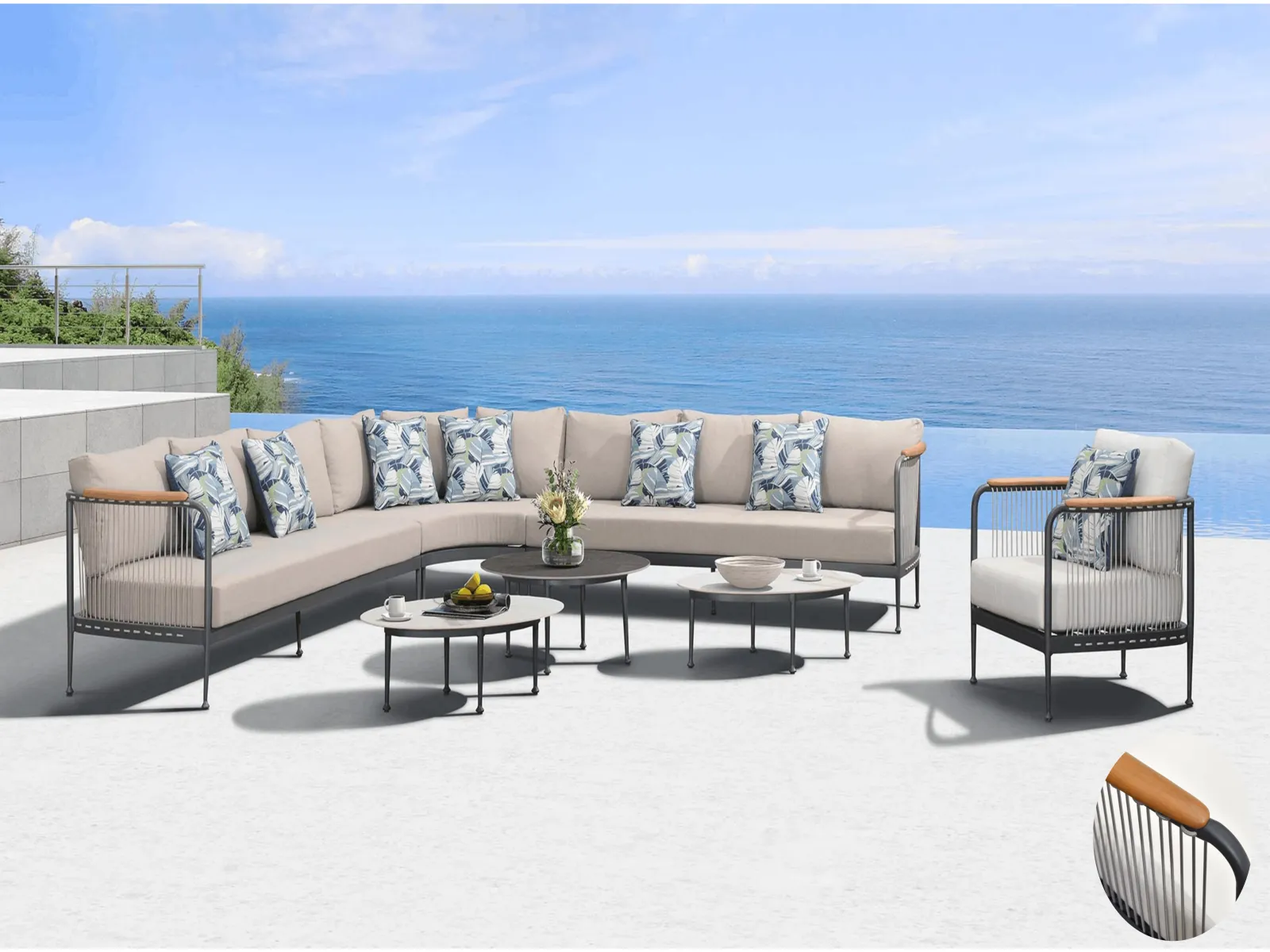
Reference layout of the curved sectional suite with nesting coffee tables and teak arm caps.
What a finish sample pack should contain for this set
Ask for one board or bag per material family, not one flat colour card. For a rope-and-teak sectional the useful pack is small but specific.
- Rope: two or three lengths of the actual weave profile in the colours under discussion, each long enough to see several repeats of the weave and how the strands sit against one another on a curve.
- Frame: a powder-coated aluminium coupon in the specified RAL or house colour, plus a cut-off from a welded joint so you can inspect coating coverage at the weld line.
- Teak: two arm-cap offcuts, one sanded and oiled as production would deliver it, one left un-oiled so you can see how the tone develops as the oil weathers away.
- Cushion fabric: a swatch large enough to see the printed or woven pattern in full, plus the piping, zip and seam sample rather than just the face cloth.
- Cushion foam: a cut block of the density you are specifying, so you can sit on it — firmness is not something a data sheet communicates honestly.
- Nesting table finish: the tabletop edge detail and how the nested frames clear each other, which is where dimension changes usually show up first.
The checks to run on every sample before you sign off
Work through these in order. Each one answers a question that becomes expensive after production starts.
1. Weave tension and repeat
Look for even strand spacing, no slack runs, and a consistent change of direction where the weave turns around the curve. A hand-woven rope skin reads badly as soon as the pitch changes mid-curve, and that fault is visible from across a lounge terrace — not at arm's length.
2. Coating coverage at welds and cut ends
Inspect the powder-coated coupon at the welded joint and at any drilled or cut point. Thinning, lifting or bare metal there is the finding to act on, because a seaside terrace works hardest on exactly those spots. A coupon tells you how the coating holds at joints before the frames ship.
3. Teak tone across several offcuts
Judge teak from more than one piece. Agree an acceptable band of tone and grain variation now, with the lighter and darker ends of that band represented in the pack, rather than approving a single perfect sample and rejecting a delivery later.
4. Fabric pattern alignment at seams
Printed scatter cushions are part of the design intent on this suite, so check that the pattern matches across zip lines and corner panels. A misaligned print reads as a defect to a guest even when the cloth itself is correct.
5. Cushion recovery
Press the foam block firmly and hold it, then release. Slow or incomplete recovery is the failure mode that makes lounge seating look tired inside a season of daily resort use, and no data sheet communicates it as well as your own hand.
6. Nesting clearance
Slide the coffee tables together and watch for frames or tops touching. Dimension adjustments made during sampling change stacking behaviour first, and this is the part of the set that guests handle every day.
Approve a physical mock-up for the curved modules
For straight furniture a sample swatch is enough. For a curved modular sectional it is not. Request one full curved module, fully upholstered and roped, before the balance of the run starts.
- Set it on the floor at your real dimensions. Lay out the module with the armchairs and coffee tables and walk the arrangement. A curve that looks generous in a CAD file can pinch the circulation route you planned for the terrace.
- Check the joint hardware between modules. Confirm the connectors hold alignment when you push the set sideways, because guests move sectional pieces without asking.
- Photograph it in daylight and at dusk. Rope weave changes character under low light, and printed cushion patterns shift with colour temperature. Match those photographs against your mood board before approving the finish combination.
- Test the teak against your cleaning regime. Wipe the oiled offcut with whatever the site team will actually use. If the finish clouds, agree the maintenance product at the same time as the finish.
Document what you approved, in writing
Most disputes in project furniture are not about quality but about what was agreed. After sign-off, keep three things: the signed sample board with a reference number on each material, the approved layout drawing with module sizes and radius noted, and a short note of anything explicitly excluded from this approval.
Then hold one full duplicate set of samples in the project file. When goods arrive and something looks different, you compare against the same reference rather than arguing from a photograph on a phone.
Where this fits in the order timeline
Sample production and shipping take real calendar time, so start them before the commercial details are fully closed. Our Custom & OEM Service covers bespoke finishes, textures and prototyping for exactly this stage, and once you approve the pack we schedule series production against your delivery window rather than the other way round.
For hospitality buyers ordering several outdoor zones at once, review the samples for this set alongside related rope-and-teak configurations such as the Rope Weave Outdoor Sofa Set with Teak Armrest & Nesting Coffee Tables. Approving one shared rope colour and one shared teak tone across a terrace, a pool deck and a garden lounge keeps the whole outdoor programme visually consistent and simplifies future replacement orders.
As a China-based furniture and building materials manufacturer, we produce this suite together with the rest of the outdoor programme — pergolas, daybeds, loungers, dining sets — and coordinate it with interior fixtures and finishes in a single project package. That means the rope colour you approve for the sectional is the same reference we hold when we later quote cushions, replacement modules or an adjacent terrace set.
Send us the drawings, the site photographs and the finish direction you are working to, and we will prepare the sample pack for this curved rope sectional before production planning starts. That single step is where most of the risk in outdoor project furniture gets removed.