
A floor lamp rarely decides a project on its own, yet it is one of the first items a buyer is asked to approve. In a villa living room or a hotel arrival lounge, the arc standing lamp sits in the open, next to seating that guests photograph, and it has to survive daily use by people who are not your maintenance team. The Modern Black Arc Floor Lamp, Minimalist Cylinder Reading Lamp for Living Room & Hotel is a useful example to work through, because the checklist it demands — reach and height, head direction, base footprint, finish, spares, packaging and electrical documentation — is the same checklist that decides whether an imported lighting item lands on site clean or becomes a snag at handover.
Why this lamp type keeps appearing in project specifications
The arc floor lamp solves a problem that ceiling and wall lighting cannot. A reading chair in a villa living room, or a lounge chair in a hotel lobby, usually has no junction box above it and no wall behind it. Recessed downlights glare into the eyes of someone seated there, and a wall sconce is not an option when the seat floats in the middle of the plan. A curved pole that reaches over the seat from a base placed beside a side table gives you task light exactly where the reader needs it, while the same fixture reads as a sculptural object when it is switched off.
The black arc version with a cylindrical head leans towards hospitality and contemporary interiors. A slim curved pole and a cylindrical shade give two things designers ask for at once: warm, focused light on the seat, and dramatic uplighting that washes the wall or ceiling behind it. That double output is why the same fixture can serve a guest-room reading corner and a lobby seating group without looking out of place in either.
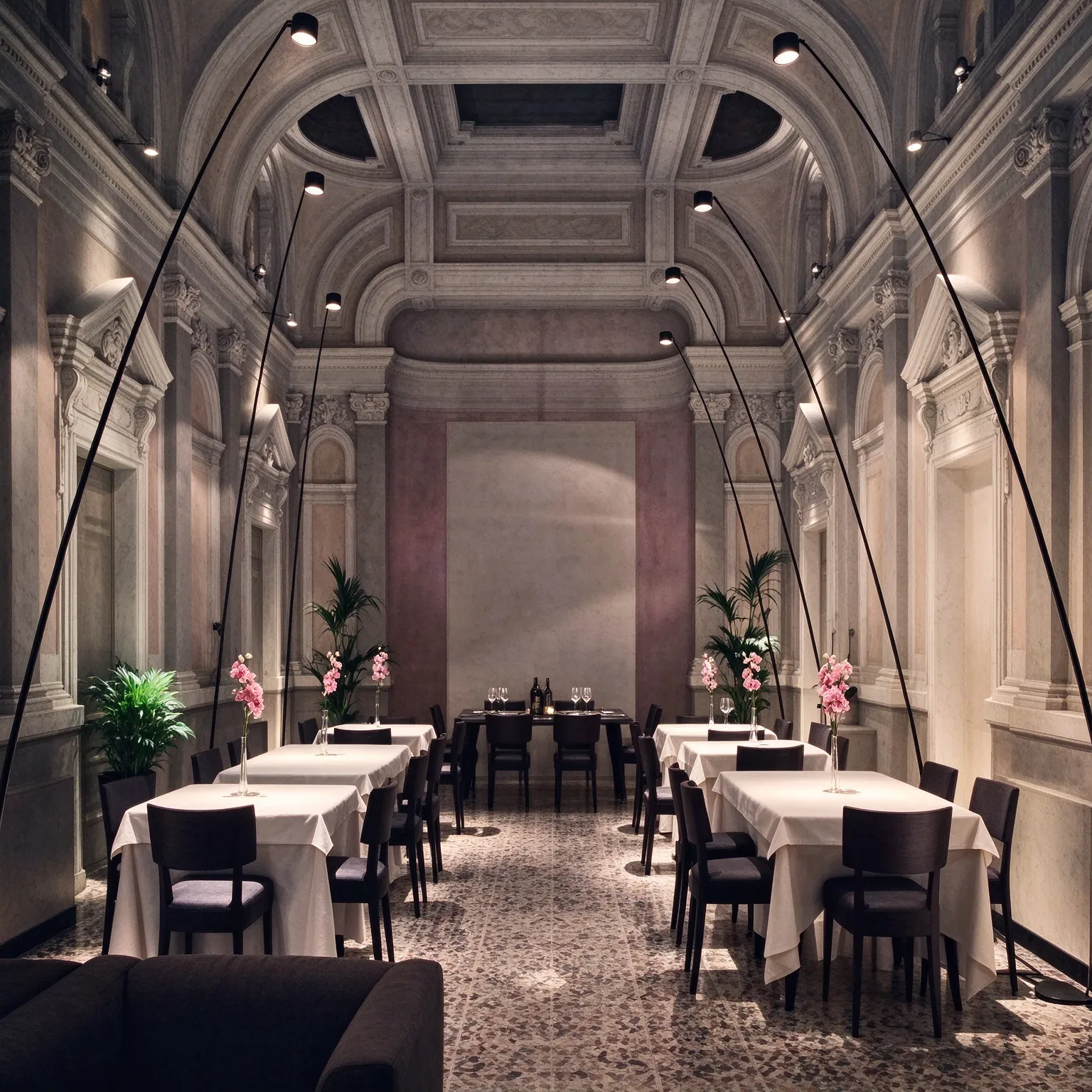
Modern Black Arc Floor Lamp — slim curved pole, cylindrical head, focused warm light. Product page: santerson.com/2244.html
Point 1: Match the arc geometry to the seat, not the other way round
Before you ask for a price, get the reach and overall height of the arc on the drawing. The head must sit over the reader's shoulder, roughly above the armrest line, not over the middle of the seat cushion and certainly not behind the headrest. Ask the supplier for the horizontal offset from the base centre to the lamp head and the total height, then plot both onto your furniture layout at 1:1 against the actual chair you have specified.
- Check that the arc clears the armrest and any side table, so the pole can pass without touching the furniture it is meant to serve.
- Confirm the base footprint fits where it must go — behind the sofa, in a corner, or between two lounge chairs — and that it does not sit in a walkway or block a door swing.
- If your seating layout differs from room to room, ask whether the reach can be adjusted before tooling rather than assuming one size fits every guest room.
Where the plan needs a wider disc shade and softer ambient wash instead of a focused cylinder, compare it with the Modern Arc Floor Lamp, Curved LED Standing Lamp for Living Room & Bedroom. Same family, different head, and choosing deliberately between the two is better than accepting whatever shade the factory has tooled.
Point 2: Light quality — ask what you actually need to see
For a reading lamp, the practical questions are narrow and answerable: how much light reaches the page, is it warm enough for an evening setting, does the shade keep the source out of sight when someone is seated or standing nearby, and is there any glare at eye level in the lobby. A cylindrical head suits this because it throws light down and up while keeping the emitter concealed.
What you should not do is accept a datasheet number that nobody can stand behind. On the published product page for this lamp, lumen output, wattage, colour temperature and electrical compliance details were not part of the copy. So write those figures into your own specification only after the factory confirms them in writing for the batch you are buying, and ask for the same confirmation on the dimming behaviour if your lobby scenes require it.
Point 3: Finish and materials under real use
Black finishes look decisive in a render and unforgiving on site. Ask what the black actually is — powder coat, plating or painted finish — and how it behaves when it is bumped by luggage, cleaned weekly by housekeeping, and handled during installation. A matte or satin surface hides fingerprints and swirl marks far better than a high-gloss one in a public area.
- Request a physical finish sample, not a photograph, and hand it to the interior designer with the hardware and fabric boards.
- Ask how the pole joints and the head connection are made, since that is where wobble and paint chipping appear first.
- Confirm what cleaning agent housekeeping may use, and get it in writing before the snag list starts.
Point 4: Stability, weight and floor protection
An arc lamp carries its mass outboard. The head overhangs, a guest leans on it, a housekeeper's trolley clips the pole, and a light base tips. Ask for the base weight and material, whether ballast is built into the base, and whether the base sits flat on your actual floor finish. Then check the interface between the base and the floor: felt pads, rubber feet or a hard disc that will mark timber or stone.
This matters more in Australia-facing projects than buyers expect. The published project references for this supplier include villas in Sydney, Melbourne, Perth, Willoughby and North Turramurra, where engineered European oak flooring is a common specification across the fit-out. A metal base on timber needs a defined protective interface, agreed before delivery, not discovered at handover.
Point 5: Electrical and safety documentation for the receiving market
This is where imported lighting most often stalls. The lamp arrives looking perfect, and the electrical inspector rejects it because the paperwork does not match what the local authority wants. Do not let a supplier's marketing copy answer this on your behalf.
- Confirm the input voltage for the destination market, the plug or hardwiring arrangement, and whether the driver is internal or external — an external driver needs somewhere to hide and something to fail-proof.
- Ask which certifications the shipped batch carries, and request copies of the certificates that name the model you are ordering, not a family range.
- Have your local electrician or compliance consultant review those documents before production starts, so any change is made at the factory instead of on site.
For an Australian project, the acceptance criteria belong to the local authority and your electrical contractor. Treat their requirements as the specification and ask the factory to meet them; do not assume that a listing valid in another market transfers automatically.
Point 6: Spares, serviceability and the long tail of ownership
A hotel buys lamps for ten years of operation, not for the handover photograph. Ask what fails first — usually the driver, then the shade fitting — and how a maintenance technician opens the fixture. Then order spares with the original batch: spare drivers, a small number of complete units per floor type, and the specific screws or clips used in assembly.
Buying spares at the same time as the main order avoids paying freight twice later on, and it protects you when a model is discontinued or revised. Put the spare quantity in the purchase order rather than relying on a promise of future availability.
Point 7: Packaging, delivery and installation reality
Arc poles bend in transit if they are packed like straight ones. Ask for the packing drawing: how the curved pole is supported, whether the head ships separately, what protects the finish at contact points, and how many units go into one carton. Then match that against how the cartons will actually be handled — lift size, stair access, guest-room door width, and where unpacking can happen without damaging flooring.
A supplier whose scope runs from design and production through to logistics and door-to-door delivery removes several handovers from your schedule, but only if the packaging details are agreed before production. The same applies to installation and after-sales support: clarify what is included, who does it on site, and what happens when a unit arrives damaged.
Point 8: Coordinating lighting with the rest of the fit-out
Buying lamps as a separate package from cabinetry, flooring and wall finishes creates duplicated samples, duplicated freight and duplicated snag lists. When standing lamps, wall sconces and the rest of the interior fixtures come from a single lighting and fit-out range, one supplier reconciles finishes across them, and one production schedule covers them.
That coordination is where a custom and OEM service earns its place. Where the standard catalogue item does not match your seat height, your black finish, or your electrical requirement, ask for the change at the design and prototyping stage rather than asking the site team to improvise around it.
A buyer's checklist before you place the order
- Arc reach and total height plotted against your actual chair at 1:1.
- Confirmed head type — focused cylinder or wide disc — chosen deliberately for the room.
- Lumens, colour temperature, wattage and dimming behaviour confirmed in writing for this batch.
- Physical finish sample approved by the designer; cleaning agent agreed with housekeeping.
- Base weight, ballast, floor interface and protection defined for your actual floor finish.
- Voltage, driver arrangement and named-model certificates reviewed by a local compliance consultant.
- Spare drivers and complete units ordered on the same purchase order.
- Packing drawing agreed; delivery route, unpacking area and installation scope written into the order.
If you are specifying arc floor lamps or other lighting for a villa, hotel or office project, send us the room layout, the seat you want lit and the electrical requirements of the destination market. We will confirm reach, head type, finish options, spares and packing before production starts, so the fixture arrives ready for installation instead of joining the snag list. Enquiries: santerson.com/contact.