
A swim spa quotation is easy to compare on price and hard to compare on substance. Two proposals for a six-metre outdoor swim spa can look almost identical in the specification table while hiding very different assumptions about structure, insulation, plant capacity and site support. The Outdoor Swim Spa WS-S06CT-L is a useful reference point for that exercise, because it sits in a configurable swim-and-hydrotherapy range where the quoted line items matter more than the model name.
The checklist below follows the order in which problems actually appear on a project: first whether the shell suits the site, then whether the equipment list matches the duty you asked for, and finally whether the supplier can deliver, install and support the unit after it leaves the factory.
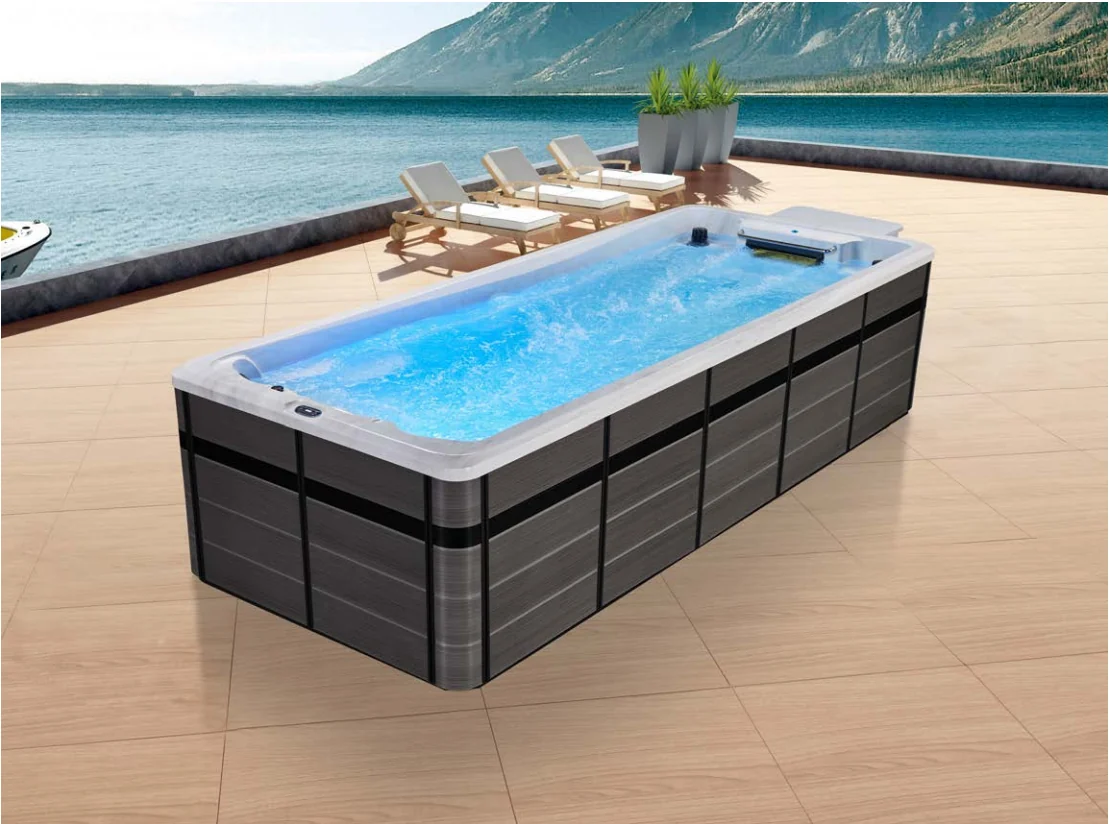
Reference model used in this article: Outdoor Swim Spa WS-S06CT-L.
1. Start with the envelope, not the jets
The catalogue entry for this model lists an overall envelope of 6670 × 2380 × 1400 mm. Treat those three numbers as a starting point for a site conversation rather than as final dimensions, because the number that decides feasibility is not the length on paper but the clearance on site: turning radius at the property boundary, gate width, overhead power lines, tree canopy, and whether a crane or hiab will be needed to set the shell onto a slab or deck.
Ask the manufacturer to state, in writing, which dimension is the shell and which includes cladding, steps and any plant enclosure. A proposal that only repeats catalogue figures has not yet been checked against your drawings. A useful comparison point inside the same range is Outdoor Swim Spa WS-S06CT, whose catalogue envelope is shorter at 5880 × 2380 × 1400 mm with the same 2380 mm width and 1400 mm depth. If a supplier offers you the shorter variant without asking why, that is a sign the proposal was generated from a catalogue rather than from your site.
2. Read the equipment list as a duty statement
The published specification for this model shows one control system, one swim training system, one water pump, one filter pump, 31 jets in total, four LED lights and a total power figure of 8.35 kW. Those quantities tell you what the standard configuration contains; they do not tell you whether that configuration suits the way the spa will be used.
Two questions are worth putting to every bidder:
- Is the swim training set sized for lap swimming or for gentle resistance walking? The same single-set line item covers very different duty levels, and a resort gym and a private villa rarely want the same one.
- What is the total power figure assumed to run at, and on what supply? A total connected load in the region of 8.35 kW needs an electrical design behind it: circuit sizing, protection, earthing and the location of the isolator. Ask for the wiring requirement before you price the electrical contractor’s variation.
Jet count deserves the same scrutiny. Thirty-one jets can be distributed for seating massage or spread across a lying-in position, and the layout changes how the interior reads once someone is actually in the water. Request a jet layout drawing with seat positions marked, not just a quantity.
3. Separate standard content from options
Catalogue-listed options for this range include control systems, UV sterilisation, water pumps, heat pumps, sand filtration, insulation and steps. Availability and compatibility vary by model, so the same option name may carry different equipment behind it on two proposals.
This is where low bids usually recover their margin. Compare line by line and make each bidder state the following:
- Which control system is included as standard, and which upgrade is priced as an option
- Whether sterilisation is ozone, UV or both, and what the service interval is for whichever is fitted
- The heat pump output and the ambient condition it is quoted at, since a heat pump rated in mild conditions behaves differently in a cold-climate villa terrace
- The insulation specification for the shell and cabinet, which drives running cost more than any single equipment item
- Whether steps, handrails and any plant enclosure are included, or arrive as site variations later
4. Check the structure behind the shell
A full water volume of this size puts real load on whatever it sits on, and the cabinet has to carry that load without flexing the acrylic interior. Ask what reinforcement the cabinet uses, how the unit is supported at the corners and mid-span, and what slab or deck loading the manufacturer expects. A supplier who answers with a loading requirement is thinking like an engineer; one who answers “any flat surface will do” is not.
If your project needs a non-standard footprint, that question becomes more interesting rather than less. The range includes spas built to customised shapes such as square, round, oval and curved layouts for gardens, terraces and leisure areas, so a site with an awkward terrace can be answered with design work instead of a compromise. Establish early whether the bidder is quoting a catalogue shell or offering shape and finish changes, because those two answers carry very different lead times.
5. Test the supplier’s project capability, not just its product
For a villa or hospitality scheme, the swim spa rarely arrives alone. It lands alongside outdoor furniture for villas and resorts, poolside loungers, paving, screening, lighting and bathroom fixtures, and every one of those packages has its own drawings, samples and delivery window. A single supplier handling the whole scope reduces the number of interfaces where responsibility gets argued over.
Ask for evidence that matches your job:
- A named contact who handles project coordination, not only sales
- Whether design support exists upstream — space planning, layout drawings and 3D renderings before production starts
- How freight is arranged: sea, air or rail, customs paperwork, packaging and container loading plans, and door-to-door delivery to your address
- What happens after arrival: installation, inspection and snag lists, spare parts availability and maintenance guidance
SANTERSON works as a China-based manufacturer and one-stop supplier of furniture and building materials for villa, hospitality and office projects, covering design consultation and space planning, material selection and product specification, manufacturing and quality control, project management with site coordination, and installation handover. That service structure is what makes it reasonable to put a swim spa, the surrounding poolside furniture and the rest of the fit-out into one procurement package rather than four separate contracts.
6. Verify the claims before you sign
Marketing copy on both sides of this transaction tends to be confident. Before anything becomes a contractual commitment, put three categories in writing:
| Claim type | What to require from the supplier |
|---|---|
| Performance and running cost | Heating and filtration duty stated at defined ambient conditions, plus the electrical supply requirement for the quoted configuration. |
| Compliance and installation | Confirmation of what applies in your jurisdiction, obtained from your own certifier or engineer. Do not accept a supplier’s general assurance of local code compliance as a substitute. |
| Warranty and response | Written warranty terms with exclusions, named spare parts for pumps, jets, controls and lighting, and the actual process for raising an issue after handover. |
This is also the point at which company background figures should be checked rather than repeated. Factory area, headcount and export percentages appear on supplier websites in more than one version; if those numbers matter to your bid submission, ask the manufacturer for the current figure and cite that, not a brochure.
7. A short comparison sheet that works
Send each bidder the same six headings and you will see quickly which proposal was built for your site:
- Delivered shell dimensions with a setting-out drawing, including cladding and steps
- Equipment list separated into standard and optional, with make or duty stated for each item
- Insulation and cabinet construction detail, plus slab or deck loading requirement
- Electrical supply requirement and control arrangement for the quoted configuration
- Freight method, delivery point and who is responsible at each stage of transport
- Installation scope, snag process, warranty terms and spare parts list
A proposal that answers all six with drawings and stated conditions can be compared on price without surprises. One that answers only the first line is quoting a product; the rest of your cost will show up later as variations.
To price the WS-S06CT-L against your own site conditions, or to compare it with other sizes in the swim and hydrotherapy range, send the terrace or deck drawing and the intended use to SANTERSON and request a configuration sheet rather than a quotation. That single change in what you ask for usually changes the quality of everything that comes back.