
A wall-hung bidet looks simple on a specification sheet: one item code, one photo, one line in the sanitary-ware schedule. On site it sits against a wet wall, connects to water supply and waste, and carries loads that a floor-standing fixture does not. That is why approval of model 1004F should close out a short list of technical and coordination questions first. The checks below are the ones project teams normally settle before a sanitary-ware order is released for production or shipment.
What the published listing already states
The product page for the Wall Hung Bidet 1004F, Modern Ceramic Wall Mount Bidet for Bathroom describes a vitreous ceramic body with a smooth glossy glaze, a rounded rectangular outline, and a wall-mounted structure fixed through a back panel. Listed overall size is 545×360×410 mm. The floating installation leaves the floor beneath clear, which is the practical reason architects specify wall-hung ware in villas, boutique hotel guest rooms and European-style bathrooms: the floor can be mopped in one pass with no base pedestal to work around, and no sharp corners sit at ankle height.
Those are description-level facts. They tell you what the fixture looks like and how it is fixed in principle. They do not yet tell your team whether the bidet can physically be installed on the wall you have built, plumbed the way you have plumbed it, on the date you need it on site.
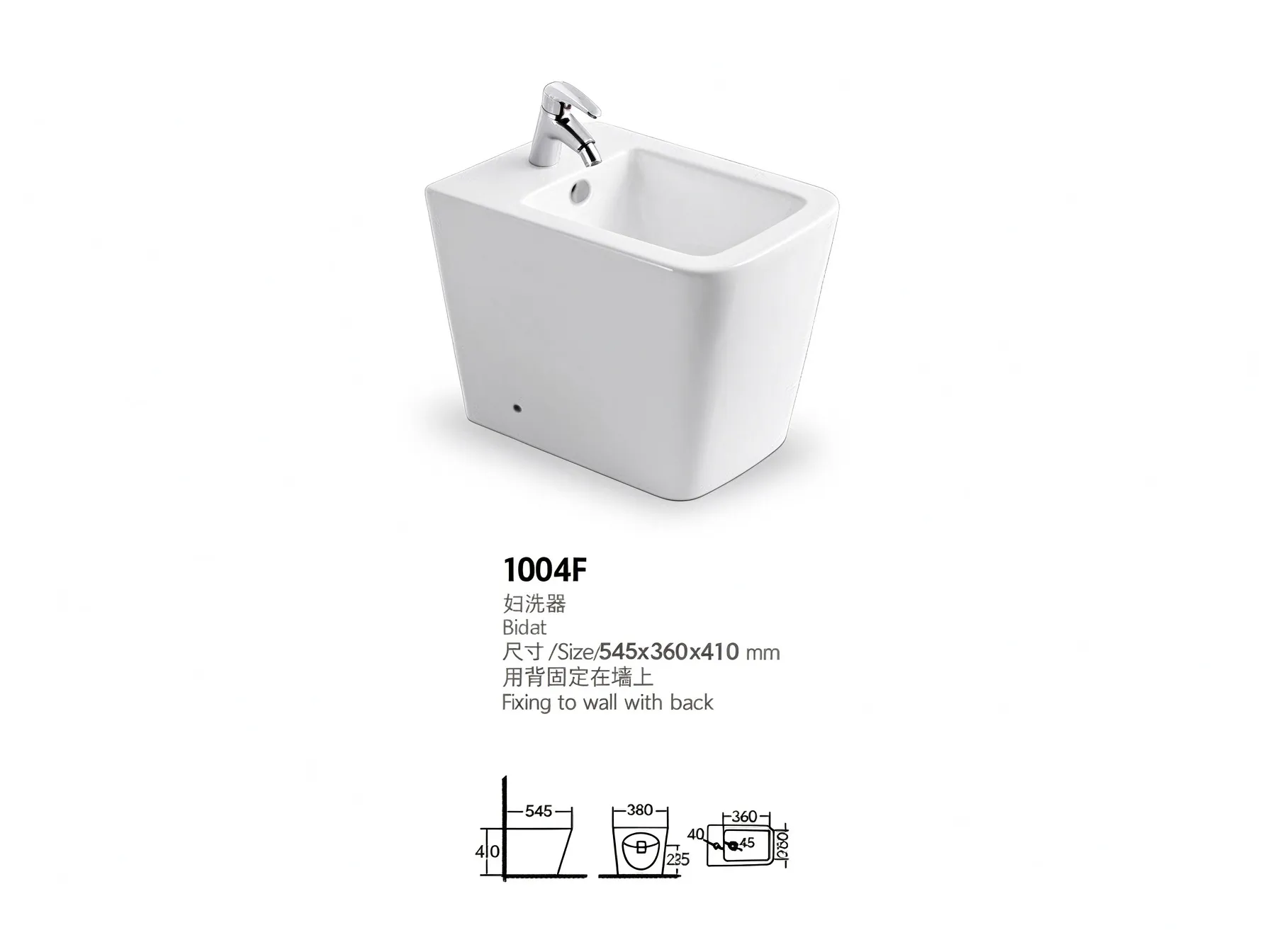
Check 1: waste type and rough-in dimensions
This is where approvals usually stall. The published listing for 1004F does not state a trap type or a rough-in dimension, so treat both as open items and take them from the current technical sheet rather than assuming the bidet shares the geometry of a wall-hung WC in the same range. For comparison, the page for the Wall Hung Toilet 1038W states an 180 mm P-trap wall drainage arrangement — a figure that belongs to that WC, not to the bidet. Before approval, ask the supplier to confirm in writing:
- the waste outlet type — P-trap (wall) or S-trap (floor) — and the spigot size;
- the vertical and horizontal centre-line of the waste outlet from finished floor and finished wall;
- whether a concealed carrier, bracket set or in-wall frame is required, and which one;
- the position of the back-panel fixing points relative to the finished floor level.
Then hand those figures to the plumbing contractor while the wall is still open. A 20 mm mismatch between a prefabricated frame and a waste outlet becomes a chase, a patch and a claim; caught on paper it costs one email.
Check 2: the wall behind the fixture
Wall-hung ware transfers its load, plus the user's load, into the wall through the bracket or carrier. The listing says the 1004F is fixed with a back panel but does not state a load rating or an approved substrate. Before sign-off, confirm:
- the wall build-up at that location — masonry, steel stud with lining, timber stud, or a prefab bathroom pod;
- the fixing method the supplier recommends for each substrate, and whether the carrier or brackets come with the bidet or must be ordered separately;
- minimum lining thickness and blocking or noggin positions your builder has to provide;
- clear width either side of the fixture, so the bidet does not clash with the adjacent WC, vanity or a door swing.
In light-gauge steel studwork and in modular pods this decision belongs to the structural and prefab coordinator, not to the finish specifier. Put it on the coordination register early.
Check 3: water supply, mixer and control
A bidet needs hot and cold supply, a mixer or thermostatic control, and in many layouts a hand sprayer or tap-set that is not shown on the ceramic product page. The published description for 1004F does not list included fittings. Confirm what is in the box and what is a separate line item:
- bidet mixer or thermostatic valve — exposed, semi-recessed or concealed;
- sprayer, tap-set or combination fitting, including its finish code;
- supply centre distance and whether an isolation valve set is supplied;
- whether the chosen control is compatible with the project's hot-water system temperature and pressure range.
Finish codes matter more than they appear. A chrome tap-set ordered against a matte or gold-line specification is a variation once tiles are on the wall. Match finish codes across basins, WCs and bidets in one schedule line.
Check 4: suite consistency across the guest-room type
Specifying one fixture per room type is how a project ends up with three different ceramic profiles in visually identical bathrooms. The 1004 series exists as a coordinated range, and the published pages make those cross-links explicit: the Wall Hung Ceramic Basin 1004B is listed at 510×420×380 mm with a back-panel wall fixing, and the Freestanding Ceramic Pedestal Basin 1004S covers layouts where the basin sits on the floor instead.
Where a project needs a mix of wall-hung and floor-standing ware — guest WCs wall-hung, accessible rooms floor-supported — check that the ceramic shape, glaze and edge profile read as one family across both. If they do not, either change the pairing or accept a deliberate mixed look and record it in the design intent.
The Floor Standing Bidet 1038F is a useful alternative when the wall cannot take a wall-hung fixture, when an accessible or aged-care layout needs floor support, or when the waste is already a floor S-trap. Its page describes a freestanding body fixed to the wall with back support and an ergonomic curved shape. Choosing between the two is usually decided by structure and waste route, not by preference.
Check 5: dimensions against your setting-out drawings
| Item | Published overall size | What to verify on your drawings |
| Wall Hung Bidet 1004F | 545×360×410 mm | Projection from finished wall, clearance to adjacent fixture, rim height above finished floor as installed |
| Wall Hung Ceramic Basin 1004B | 510×420×380 mm | Rim height, tap hole position, clearance to mirror and splashback |
Take the figures from the current technical sheet, not from the brochure or the image gallery. Listed sizes describe the ceramic body; installed dimensions include brackets, carrier depth, tiles and adhesive. Set out from finished floor and finished wall levels that your builder has actually committed to.
Check 6: glaze, cleaning regime and maintenance handover
The listing describes a dense glazed surface that resists stains and mineral deposits. That claim only holds if the cleaning products your housekeeping team uses agree with it. Confirm before handover:
- the supplier's approved cleaning agents, and which products are excluded — acidic descalers and abrasive powders are the usual problems;
- spare-parts availability for the chosen control set, so a failed valve in year three does not force replacement of the whole fixture;
- what the warranty covers for ceramic versus for taps, seats and concealed carriers, which are often supplied and warranted separately.
Ask for these answers in writing at quotation stage. Housekeeping specifications written after handover tend to be wrong.
Check 7: quantities, packaging and the delivery window
Ceramic ware is a breakage risk and a long-lead item in most project programmes. For a wall-hung bidet specifically, the concealed carrier or bracket set may travel separately from the ceramic, arriving on a different consignment and holding up the wet-wall close-in. Confirm:
- unit quantities per room type plus spares held for the defects period;
- whether carriers, brackets and controls ship with the ceramic or as separate cartons;
- packing specification and container loading plan for fragile ware;
- the delivery address, Incoterms and who handles customs clearance on your project.
SANTERSON describes itself as a China-based furniture and building materials manufacturer offering one-stop supply, with services that cover custom and OEM production, logistics and door-to-door delivery, installation and after-sales support. Those services can consolidate sanitary ware with the rest of the fit-out — cabinetry, lighting, wall panelling, flooring and loose furniture — into one procurement package. That consolidation is worth something on a multi-trade project, but it does not replace your own checks: import terms, duties, transit time and delivery scope should be confirmed case by case for the destination country, and local plumbing and building requirements remain the responsibility of the licensed installer on site.
Check 8: local compliance and the installer's sign-off
Nothing in a supplier listing constitutes evidence of compliance with the plumbing or water-conservation rules of the country you are building in. Before approval, have the local licensed plumber confirm that the waste arrangement, carrier and control set can be installed and certified to local requirements, and that backflow prevention where required is covered. Where your project needs documentation for a certifier, request it from the supplier as part of the order rather than after delivery.
A short approval checklist
Close these out before releasing the order:
- Waste type and centre-line confirmed in writing; matches the wall framing already set out.
- Carrier or bracket set identified, priced, and included in the delivery schedule.
- Substrate and fixing method approved by whoever owns the wall structure.
- Mixer, sprayer and finish code specified once, consistently across the suite.
- Installed dimensions checked against finished floor and finished wall levels.
- Cleaning regime and spare-parts position agreed before handover.
- Local plumber has confirmed installability and certification route.
Answer each point above and the 1004F stops being a risk item on the sanitary-ware schedule. Skip them and the fixture is approved on a photograph — which is exactly how wet-wall variations get built.