
A pull out corner cabinet is the one kitchen unit whose value depends entirely on hardware that has to survive being loaded, extended and retracted every day for years. The carcass is easy to compare; what fails in the field is usually the runner, the mounting point or the finish — and a large share of avoidable site problems trace back to how the unit travelled from the factory to the property. If you are specifying these cabinets for a villa, apartment or hospitality fit-out, here is the packaging checklist worth putting in front of your supplier before production starts.
Why Packaging Decisions Are Made Long Before the Cabinet Arrives
Our Pull Out Corner Cabinets are made to measure for each project, with the layout, material and finish specified per space. That flexibility is exactly what makes packaging a bespoke conversation rather than a standard carton choice. A made-to-measure corner unit arrives as loose components — carcass panels, pull-out baskets or drawer stacks, runners, hinges and fixing brackets — and each group has different handling risks.
Three practical reasons the packaging question deserves attention at the quotation stage, not at despatch:
- Replacement is slow, not fast. A damaged corner unit on site does not get swapped from a local warehouse. It re-enters production, then re-enters a container and a customs clearance. The schedule cost of a breakage is far larger than the packaging upgrade that could have prevented it.
- Hardware is the fragile part. Extended runners and their mounting brackets are the components most likely to be bent in transit. A bent runner is not cosmetically fixable — the drawer will bind for the life of the cabinet.
- Packaging shapes your freight cost. The way carcasses are nested, protected and palletised determines how many cubic metres the kitchen package occupies in a container. If you are consolidating cabinetry with flooring, lighting and other fixtures from one supplier, cube efficiency is part of the landed cost.
What to Ask Your Supplier to Confirm in Writing
Put these points on the pre-production confirmation sheet. A supplier who manufactures cabinetry for export projects should be able to answer each one specifically rather than generically.
| Point to confirm | Why it matters on site |
|---|---|
| Protection method for carcass panels and finished faces | Corner units have long, visible side panels that take the abrasion. Confirm edge protection, surface interleaving and corner guards rather than assuming a general wrap covers them. |
| How runners and baskets are separated from panels | Metal hardware strapped against a finished panel will scuff or chip it. Hardware should travel in its own boxed pack, fixed so it cannot shift inside the package. |
| Racking or blocking inside the container | Cabinets travel flat or upright depending on the loading plan. Ask how the packages are secured against the movement that occurs on a long sea leg, and who prepares the loading plan. |
| Pack marking and unit-by-unit identification | On site, installers need to know which pack belongs to which cabinet position. Numbered packs matched to the shop drawings save days of sorting and reduce the chance of a wrong panel being cut. |
| What is on the packing list versus what is in the pack | Small fixings, adjustment brackets and hinge sets go missing most often. A packing list that itemises hardware per unit makes shortage claims specific instead of arguable. |
| Inspection and documentation before despatch | Ask what is checked and photographed before sealing. If a claim arises, dated pre-shipment evidence changes the conversation entirely. |
Matching the Cabinet Type to the Access You Actually Need
Packaging matters more when you have chosen the right unit in the first place. Pull-out systems are the strongest option where the corner is a working position — pots, pans and dry goods stored at the back of a deep corner, reached by extending the baskets forward instead of kneeling and reaching into a dark cavity. Where the corner holds items used occasionally, other configurations in the same collection may suit the plan better:
- Lazy Susan Corner Cabinets — rotating shelves for items you reach without extending the full cabinet depth.
- L Shaped Corner Cabinets — where the corner is part of a continuous run and the carcass must align with adjacent units.
- U Shaped Corner Cabinets — deeper corner configurations in larger kitchen layouts.
- Open Shelf Corner Cabinets — display or frequently used storage where doors would add clutter.
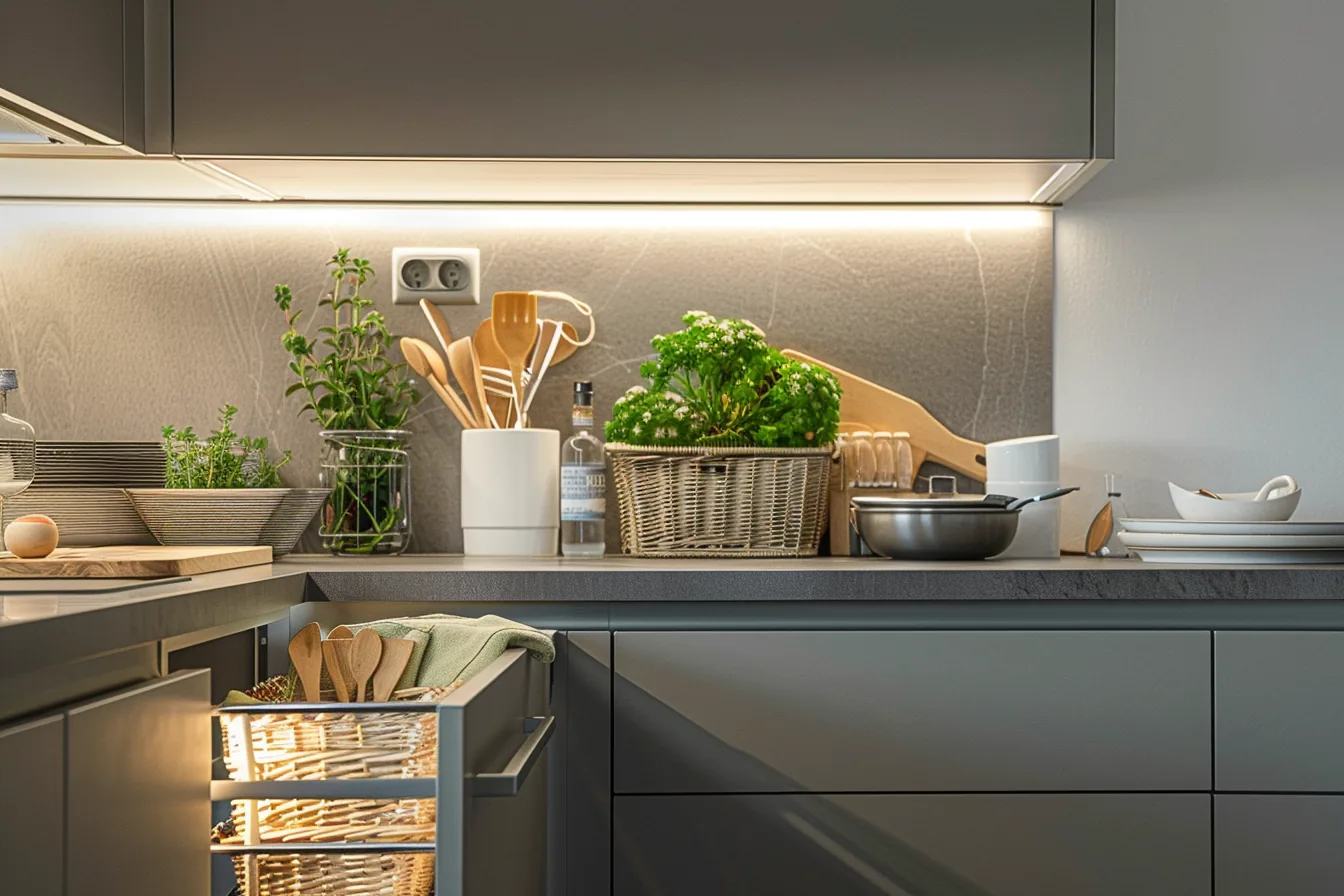
Pull-out configuration in the Santerson Corner Kitchen Cabinets collection. Dimensions, layout and finish are specified per project.
Fitting the Cabinet Into a Whole-Kitchen Order
Corner units rarely travel alone. In a residential or apartment project they normally ship alongside tall units, wall cabinets, worktops and appliance housings, which means one packaging plan has to cover panels of very different sizes and one delivery window has to cover several trades. Confirm the sequencing: if cabinetry arrives before the substrate, leveling and services on site are ready, the packages sit in storage and the risk of damage rises before installation even begins.
This is where a single supplier coordinating the package helps. Our Custom & OEM Service covers bespoke sizing, material and finish selection for cabinetry produced to project drawings, and our Logistics & Door-to-Door Delivery service covers freight forwarding, customs paperwork, packing lists and container loading planning. Ask us specifically how the cabinetry packages will be marked, secured and sequenced against the rest of your order — that detail belongs in the order confirmation.
A Simple Acceptance Routine on Arrival
Give the site team a short inspection routine so damage is caught while it can still be claimed:
- Check package count against the packing list before anything is moved into storage.
- Photograph any crushed, pierced or water-marked packaging before opening it, and keep the packaging until every unit is accounted for.
- Open one hardware pack and verify runner sets and brackets against the itemised list; if one pack is short, assume all are and check each.
- Dry-fit one pull-out unit — extend and retract it fully — before installing the rest of the run. Binding at this stage points to a bent runner or a mis-set mounting point, both easier to resolve now than after fixing.
Send us your kitchen drawings
Share the plan, elevations and the corner configuration you have chosen, and we will confirm sizing, finish options and the packaging and loading method for your specific shipment. Contact SANTERSON to start with a project brief and quotation.