
A glass pendant light looks simple on a spec sheet: tubes, connectors, a cable run, a light source. In practice it is one of the hardest pieces in a room to get right, because every element of it is visible at once — from below, from the dining chairs, from the staircase landing and from the adjoining living room. This guide explains what actually decides whether a modern transparent glass tube pendant light works in your dining room or living room, and what to confirm with your supplier before you place an order.
What this type of pendant light is made of
The Modern Transparent Glass Tube Pendant Light, Minimalist LED Chandelier for Dining Room & Living Room in our catalogue is built from transparent glass tubes joined by black connectors, with glowing LED rings inside the assembly. The design language is deliberately restrained: vertical suspension, repeated glass elements, a slim metal joint between them. Because there is no shade to hide behind, the quality of each component reads clearly in the finished installation.
When you compare options, ask your supplier to walk through four things specifically:
- Glass. Tube diameter, wall thickness, edge finishing and how the tubes are cut. Transparent glass shows mould lines, bubbles and chips far more readily than frosted or coloured glass.
- Connectors and frame finish. Black connectors become the visual rhythm of the piece. Confirm the finish (powder-coated, painted, anodised) and whether it matches other black metal in the room — door frames, window ironmongery, other lighting.
- Light source. Whether the LED rings are integrated or replaceable, what colour temperature they emit, and whether the fitting supports dimming. Warm light flatters a dining table; a cool, harsh source turns glass clinical.
- Suspension system. Cable length, how length is adjusted on site, canopy size, and the ceiling plate fixing detail. This is where most on-site problems appear.
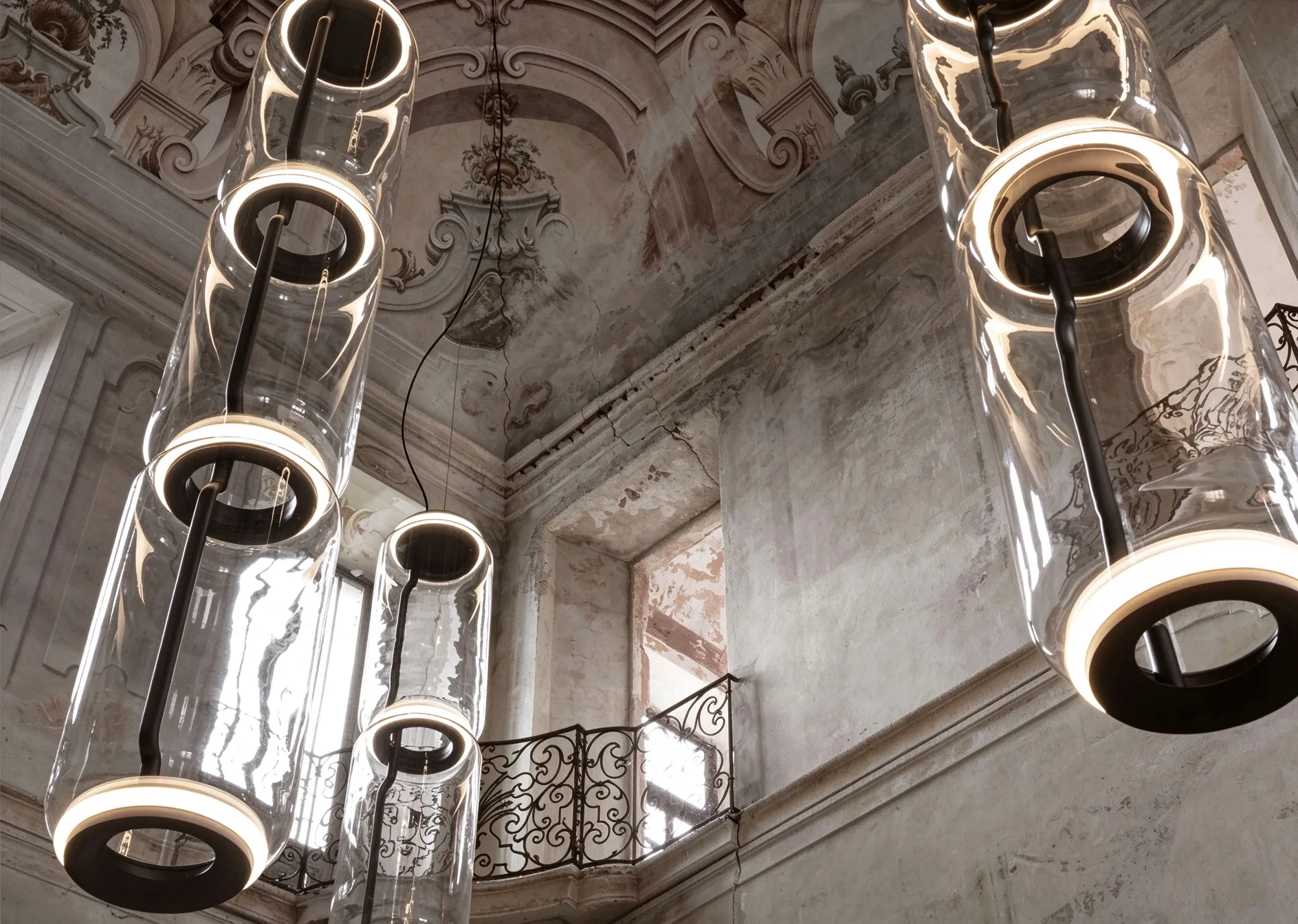
Transparent glass tubes with black connectors and LED rings — the layered vertical arrangement that defines this style.
Size and hanging height: decide these before you ask for a price
Two measurements drive everything else, and both come from the room rather than from the light.
Dining room. Measure the table length and width first. A pendant over a dining table should sit well above the surface so people can see across it and no one bumps into it when clearing plates; the commonly used reference is roughly 75–90 cm (30–36 in) above the finished table top, adjusted upward for taller occupants or a higher ceiling. The fixture width should stay inside the narrower dimension of the table rather than overhang it. Over a long rectangular table, one wide fitting and a row of smaller pendants are both legitimate answers — the difference is how much visual rhythm you want.
Living room. Here the pendant usually marks a zone: over a console, above a pair of armchairs, or in a void where the eye travels upward. In a double-height space or stairwell, vertical suspension is exactly what the glass tube form does best, since the piece reads as a column of light rather than a lump. Keep clear walkways free — no fitting should hang in the path between the sofa and the terrace door.
A buyer's checklist for glass pendants
| Point to confirm | Why it matters |
|---|---|
| Fully assembled or flat-packed | Glass shipped pre-assembled needs far more protective packing; partially assembled units need a clear on-site assembly sequence. |
| Packing method for glass | Moulded foam, corner protection and glazing cartons reduce breakage in ocean freight. Ask what the standard packing is and what is done on request. |
| Spare glass tubes available | Glass is the part most likely to be damaged in transit or after handover. Confirm that replacement tubes can be ordered later, matching diameter and finish. |
| Electrical standard for your country | Driver, plug, wiring and any certification requirements differ by market. State the destination country at quotation stage, not at shipping. |
| Dimming and control | Whether the fitting works with the dimmer system already specified in the project, and whether it is included or supplied locally. |
| Mounting substrate | Gypsum board, timber batten, concrete or steel each need a different fixing. Confirm what is above the ceiling before installation. |
| Sample or photograph of the actual finish | Black connectors photographed on white can read as charcoal in your room. A photo in situ, or a finish sample, prevents that mismatch. |
| Lead time and how items are grouped | If lighting is ordered with flooring, cabinetry and furniture, confirm which items ship together and which arrive separately. |
Where the cost actually sits
For a glass pendant, price differences usually come from glass quality and consistency, the metalwork finish, and the driver — not from the overall silhouette. Two fittings can share the same proportions and perform very differently after two years, when a cheap driver flickers or a poor coating on the connectors discolours. Buying the cheapest visual match is where projects most often pay twice.
Equally, cost rises when an order is placed without room measurements and then needs rework: a shortened cable run made on site, an extra ceiling plate, replacement glass after transit damage, or a driver that does not suit the local supply. The checklist above exists to move those decisions to the quotation stage, where changing them is inexpensive.
Buying it as part of a wider fit-out
Lighting rarely fails as an isolated purchase — it fails when it arrives out of step with the finishes around it. A glass pendant specified alongside lighting products, engineered wood flooring and wall cladding panels has to be produced, packed and shipped on one schedule. That is the logic of working with a one-stop furniture and building materials supplier: instead of chasing several factories on separate lead times, lighting, joinery and finishes are coordinated as one procurement programme.
Where a project needs a different drop length, connector finish or arrangement, custom manufacturing covers bespoke dimensions and finishes, with design and prototyping before full production. For delivery, furniture logistics and door-to-door delivery covers freight by sea, air or rail, packaging and container loading, customs paperwork and shipment tracking. Glass needs particular care in packing, so tell us early that the order contains glazed lighting.
Five questions worth asking before you commit
- Can you send a photograph of this exact fitting installed, not only a studio image on a white background?
- What is the colour temperature of the LED rings, and is dimming supported with my existing control system?
- What is the maximum and adjustable drop length, and how is the length set on site?
- How are the glass tubes packed for international freight, and can spare tubes be reordered later?
- Which electrical specification will be supplied for delivery to my country?
If a supplier answers those five clearly, you can judge a glass pendant from drawings and photographs with reasonable confidence. If the answers are vague, ask for a single sample fitting before committing to a whole floor.
Send us your room dimensions
Share the table size, ceiling height and a photo of the space, and we will advise on drop length, arrangement and finish for this fitting — along with a quotation covering production, packing and delivery to site. Reach us through our contact page to start the conversation.