
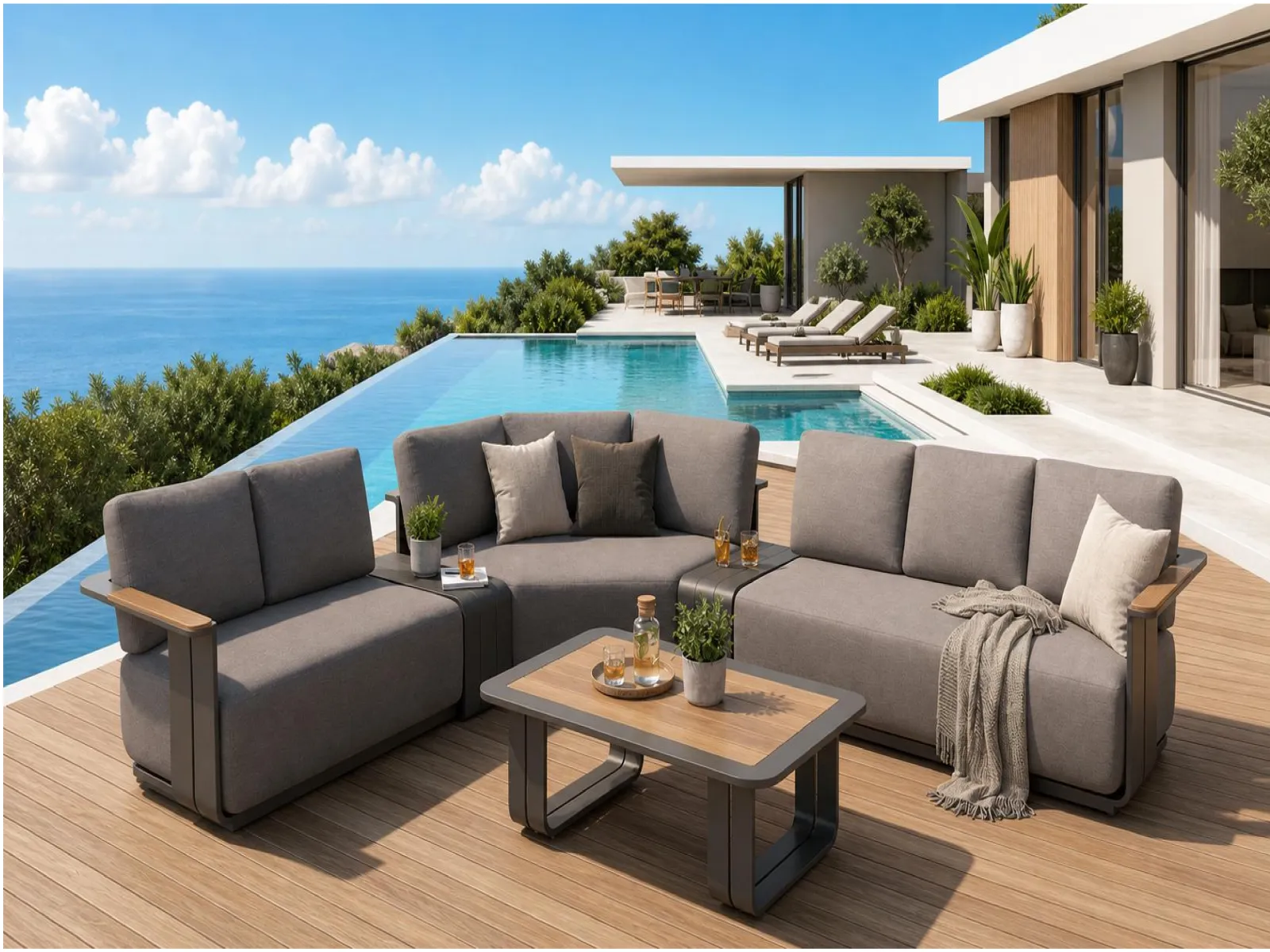
A modular aluminium outdoor sofa set with a teak tabletop and teak armrests sits at the awkward end of an outdoor budget. It is heavy enough to be a fixed part of the terrace design, expensive enough that a buyer is expected to justify it, and configurable enough that two quotations for the "same" set can look nothing alike. The good news is that the decision becomes straightforward once you stop comparing pictures and start comparing frames, modules, timber, cushion make-up and the paperwork around project orders. This guide walks through exactly what to check on a supplier product page, what to ask for in writing, and when a modular aluminium-and-teak set is simply the wrong answer.
What "modular", "aluminium" and "teak" each actually mean here
Three words carry all the commercial weight in this product category, and each one hides a range of quality levels. Read them as specifications, not adjectives.
Modular means the set is built from repeatable seat units — corner modules, armless middle modules, ottomans or side benches — that can be arranged into a straight sofa, an L-shape, a U-shape or two separate groups. The value is not flexibility for its own sake; it is that one order can serve a covered terrace now and a pool deck later, and that a damaged module can be replaced instead of the whole suite.
Aluminium means the structural frame is metal rather than timber or steel. For coastal and poolside settings this matters more than appearance: aluminium does not rust the way untreated steel does, and it stays light enough that a housekeeping team can reconfigure seating between events. Powder coating is the finish that protects it, so ask what coating system is used and how corners and welds are prepared, because those are the first places a cheap finish lifts.
Teak on this type of set is usually an accent, not a structure. On our modular aluminium outdoor sofa set with teak tabletop and armrest, teak appears on the armrests and the coffee-table surface while the load-bearing frame is aluminium. That split is deliberate: teak gives warmth under the hand and at table height, aluminium handles the structural and weathering job. Some buyers want solid teak through the whole frame; that is a different product with a different price, so confirm which of the two you are being quoted.
Watch for one particular inconsistency in this category: some listings describe "natural teak" while visually similar sets use a teak-effect slat surface. Both are legitimate choices — an aluminium-and-teak-look option can be more consistent in colour across a large order and cheaper to maintain — but they are not the same purchase. If a product title, a short description and a specification block disagree about whether the timber is solid teak or a teak-effect finish, ask for the exact material call-out before you compare prices.
The frame: what to verify on a spec sheet
Aluminium framing looks identical in photographs across price points. The differences are in thickness, joinery and coating, and they show up after three or four seasons rather than on day one.
| Item to confirm | Why it decides the purchase |
|---|---|
| Tube profile and wall thickness | Determines whether a long, armless middle module sags over time. Wide unsupported spans need heavier profiles. |
| Weld and joint finishing | Ground, smoothed welds mean the coating covers continuously; raw welds are where corrosion starts. |
| Powder-coating system and colour sample | Screen images mislead. Request a physical finish sample in the actual frame colour for project sign-off. |
| Levelling feet / floor interface | Pool decks and paver terraces are rarely flat; adjustable feet protect both the frame and the paving. |
| Fixing method between modules | Clips or brackets that hold modules together stop a U-shape from drifting apart in use. |
If a supplier cannot answer these five points, they are quoting you a photograph. Ask for a written specification sheet with the quotation.
Teak details: solid versus teak-effect, and what maintenance follows
Teak armrests and a teak tabletop are the two touchpoints of the set, which is why they wear first and matter most to guests.
- Solid teak weathers to a silver-grey unless oiled. It can be sanded back, so scuffs on an armrest are recoverable — an argument for solid timber in high-traffic resort settings.
- Teak-effect slats keep a uniform colour across a large order and generally need less routine attention, which is why they suit pool bars and rooftop terraces with many identical sets.
- Fixings and end-grain sealing decide how long either option lasts outdoors. Ask how timber pieces are attached to the metal frame and whether cut ends are sealed.
- Tabletop thickness and edge profile change the perceived quality more than any other detail in photographs, and thin slats with sharp edges read as budget at close range.
Decide your maintenance policy before you choose the timber. A hotel that will not oil furniture annually should buy a teak-effect surface deliberately, rather than buying solid teak and letting it go patchy.
Cushions and fabric: the part buyers under-specify
The cushions are the whole comfort story, and they are also the consumable element of any outdoor suite. On this set the cushions are thick, padded and upholstered in a weather-resistant performance fabric intended to take prolonged sun exposure and light rain.
- Fabric type and colour-fastness — ask what the performance fabric is and how it behaves under strong UV, since fading is the most visible failure in a sunny climate.
- Removable covers — zip-off covers that can be laundered extend the serviceable life of a set dramatically; non-removable foam means the module is written off when the fabric fails.
- Foam density and drainage — outdoor foam must drain rather than hold water. Ask about the fill and whether cushions can be left out after rain.
- Spares policy — for hospitality orders, confirm that replacement cushion covers in the same fabric can be reordered years later.
Layout and modularity: buying the right configuration, not more modules
Modular sets are easy to over-order. Measure the space in terms of circulation, not just footprint: a U-shape needs clear approach on three sides, an L-shape works against a wall or planter, and a straight run with ottomans can be split for events.
- Draw the arrangement to scale and check sight-lines and door swings before choosing module counts.
- Count seats realistically — a corner module is comfortable for one, generous for two only if it is deep.
- Keep at least one armless middle module spare in the plan, because that is what lets the same order serve a second layout later.
- Check how the set behaves with shade structures — pergolas and hardtops change both the weathering load and the arrangement.
If your layout is fixed, modularity may be a cost you do not need. A fixed aluminium frame conversation set with teak tabletop and arm caps gives the same aluminium-and-teak combination in a defined three-plus-two-plus-table arrangement, at lower complexity. Where the terrace will keep changing — event space, restaurant edge, resort lawn — an L-shaped aluminium corner sofa with teak-effect slat tops adds side benches that double as extra seating.
Customisation, MOQs and project orders
For villas, boutique hotels and resorts, the standard catalogue specification is rarely the final answer. This is where a manufacturer differs from a reseller: cushion fabric can be swapped to match an interior scheme, frame colours can be matched to a powder-coating sample, module combinations can be re-cut to a floor plan, and dimensions can be adjusted for door widths and lift sizes.
As a custom furniture manufacturer, we cover bespoke finishes, prototyping and flexible minimum order quantities for outdoor collections. Before you commit, get three things in writing: the exact fabric and frame finish codes, a signed-off sample or prototype where the order volume justifies it, and a clear statement of what is standard versus customised in the price. Customisation that is not documented on the purchase order becomes an argument at delivery.
Logistics, installation and after-sales: the questions that separate suppliers
Outdoor suites arrive bulky and awkward. Ask how the set is packed, how many crates it comes in, whether modules ship assembled, and what the receiving arrangement looks like on site.
- Packaging and container loading — good packing protects powder-coated corners; poor packing produces chips you will discover after the concrete is poured.
- Freight terms and paperwork — commercial invoice, packing list and origin documents should be confirmed before dispatch, not after.
- On-site assembly and snag inspection — who assembles the set, and who signs it off against the order?
- Spare parts availability — replacement modules, armrests and covers are what keep a five-year-old set in service.
SANTERSON works as a villa and hospitality furniture and interior fit-out supplier, including door-to-door delivery, installation support and after-sales service. If you are furnishing an outdoor space as part of a wider build, coordinating the seating with flooring, screens, pergolas and lighting in one order removes the coordination risk that individual product purchases create.
A practical decision checklist
- Is the timber solid teak or a teak-effect finish, and is that stated consistently across the listing?
- Has the supplier given frame profile, coating system and joint finishing in writing?
- Are cushion covers removable, and can replacement covers be reordered?
- Does the module mix match a drawn layout with circulation, or is it an upsell?
- Are customised items documented with fabric and finish codes on the order?
- Are freight terms, packing, assembly and snag sign-off agreed before production?
If you can answer all six, you are buying on specification rather than on a photograph — which is the only reliable basis for an outdoor purchase.