
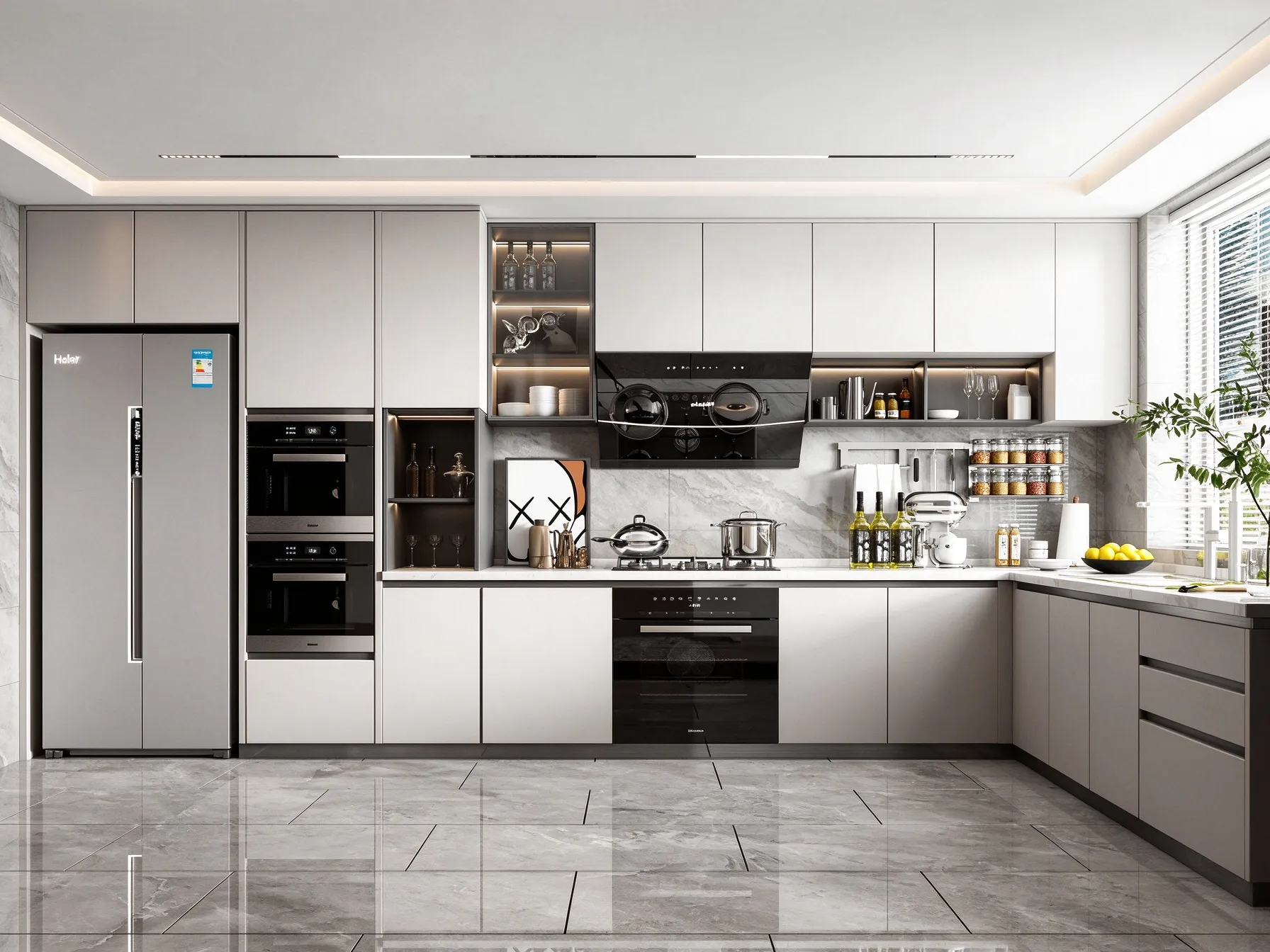
Grey flat-panel cabinetry with a lit glass wine display has moved from show-kitchen photography into real specification sheets for villas, high-rise apartments and boutique hotel suites. The look is calm, the storage is deep, and the glass cabinet does the decorative work that open shelving used to do. Once a project team decides on that direction, the next question is rarely design — it is procurement: who builds it, what exactly gets confirmed before production starts, and how the units arrive on site ready to install.
Why this cabinet specification travels well
A grey modern kitchen cabinet with LED glass wine cabinet is a compact package of decisions. Layered two-tone grey flat panels keep the wall quiet. Closed cabinets hide the everyday items; one or more tall glass cabinets carry bottles, goblets and tableware under warm built-in LED lighting. A tall housing reserves space for stacked ovens, so appliances sit flush instead of protruding. A stone-look backsplash is specified as stain-resistant and wipeable.
The same logic appears across the range. In a light and dark grey two-tone layout, the upper run reads light and the lower run carries the darker tone, with glass display cabinets placed on either side of the cooking zone and a strip light under the wall units over the countertop. That variation is worth noting for sourcing, because it shows what an overseas factory can adjust per project: panel colour split, glass cabinet position, internal partition layout, appliance housing and finish.
For buyers, this is a product family that tolerates remote specification. Dimensions are made to the site drawing rather than chosen from a fixed module list, so a run that has to clear a structural column or wrap a service riser is not a special order problem.
Confirming the scope before you request a quotation
Most sourcing friction in custom cabinetry comes from an incomplete brief, not from the manufacturer. Before approaching a supplier, lock down four items:
- Measured drawings. Wall lengths, floor-to-ceiling height, positions of sockets, water outlets, extract ducting and any unevenness in the substrate. Cabinet makers work from these; they do not adapt a showroom plan for you.
- Appliance schedule. Model numbers and dimensions for built-in ovens, refrigerator, dishwasher and wine storage. Tall housings and ventilation gaps are cut around this list.
- Door and finish sample decision. Matte or gloss grey, single tone or two-tone split, wood-look combination. Ask for the actual panel sample, not a photograph on a screen.
- Hardware expectation. Soft-close hinges, drawer runners, handleless or handle detail, touch-to-open where a clean face is required. Hardware quality is what a kitchen feels like after three years of use.
A supplier working to custom built-in kitchen cabinets for hotel and apartment projects will normally quote against this pack, together with the supporting hardware — hinges, drawer slide rails, support legs and connecting brackets. If a quotation arrives without those items itemised, ask for them separately; loose or substituted hardware is where a good-looking installation starts to fail.
Evaluating an overseas cabinet manufacturer
Distance changes what you can inspect personally, so evaluate the supplier on evidence instead of impressions. Four checks carry most of the weight:
- Same-category track record. Look for kitchens already delivered to villa, apartment and hospitality projects rather than a catalogue that spans every material in the building trade.
- A physical pre-production sample. One door panel with edge detail, one drawer box with runners, one glazed cabinet corner with its lighting channel. That single package tells you more about edge banding, glass seating and finish consistency than any specification sheet.
- Written confirmation of the variable items. Panel board type, surface finish, LED driver specification, appliance cut-outs and partition layout, all restated in the order confirmation. Verbal adjustments made during production are the most common cause of disputes.
- A named coordination contact. Cabinet orders involve drawings, revisions, hardware lists and shipping marks. One person holding that thread through production and despatch is worth more than a shared inbox.
Company scale claims — factory area, headcount, export percentage — appear differently across different pages of many supplier sites. Treat those figures as background, not as the basis for your decision. Ask instead what was made, for whom, and whether you can see the drawings and the delivered result.
Customisation and OEM options that matter on site
The custom and OEM service described by manufacturers such as SANTERSON covers bespoke dimensions, panel colours and surface finishes, prototyping, and matching furniture hardware. For apartment blocks and hotel floors this usually means one approved kitchen type repeated across units with controlled tolerances, while a villa or penthouse level gets a different handle detail or glass cabinet arrangement.
Two practical points for repeat-specification projects. First, agree the finish reference — board code, colour batch and gloss level — before the first production run, because later batches from a different batch of panels are visible in raking light. Second, keep the internal partition schedule identical across repeated units unless a unit genuinely differs; changing internals per bathroom or apartment multiplies checking time on site.
Where a project needs a fully clean front, handleless and minimalist detailing is available as part of the same cabinetry family. Custom minimalist kitchen cabinets for home renovation use flat panels with concealed handles or touch-to-open mechanisms, which pairs naturally with a lit glass display cabinet: the glass does the visual work, everything else stays closed.
Freight, packaging and arrival checks
Cabinets are heavy, flat and easy to damage at the corners, so specify the loading plan in writing. Manufacturers offering logistics and door-to-door delivery handle sea, air or rail freight, export paperwork such as commercial invoices, packing lists and certificates of origin, container loading and shipment tracking to the site address. For a project buyer this reduces the number of parties involved, but it does not remove your own checks:
- Confirm Incoterms, who pays duty, and who clears customs at destination before the goods are produced.
- Ask for a packing list keyed to room or unit numbers, so installers open the right bundles first instead of unloading everything.
- Photograph the container seals and any damaged cartons on arrival. Corner damage on panel ends is the most frequent claim, and it needs evidence from the day of delivery.
- Check glazed cabinet doors and LED modules at unloading, not at installation. Replacing a light strip through a finished wall is expensive work.
Transit time, import duty and clearance requirements differ by destination and change without notice. Get them quoted for your specific port and project date rather than relying on general statements from a supplier website.
Installation handover and after-sales
A kitchen package arrives as panels, carcasses, doors, worktops and hardware. The installation and after-sales support described by one-stop suppliers covers on-site fitting, inspection of snags, warranty coverage, spare parts and maintenance. Whether that support reaches your site, and in what form, is a project-specific question — confirm it for your location before the order rather than assuming it.
Whatever the arrangement, run the same handover checklist: level and aligned carcasses with doors adjusted to even gaps; soft-close hardware tested on every door and drawer; glass cabinet lighting operated for a full cycle; appliance housings ventilated as specified; and a signed snag list with named responsibilities and dates. Keep spare panels and hardware from the delivery — a colour-matched replacement ordered two years later is not guaranteed.
A practical sequence to follow
Sourcing this cabinet type works best in fixed steps: measured drawings and appliance schedule; shortlist of suppliers with comparable project evidence; sample door, drawer and glass-cabinet corner; quotation with hardware itemised; written confirmation of finishes, dimensions and LED specification; production with one approved pre-production reference; packed and shipped under agreed Incoterms; then on-site fitting against a snag list. Every step produces a document you can hold someone to.
If you are specifying grey flat-panel cabinetry with an LED glass wine cabinet for a villa, apartment or hospitality project, send your drawings and appliance list to SANTERSON and ask for a quotation that itemises panels, hardware, lighting and packing — that single document will tell you quickly whether the supplier is ready for your project.