
An integrated TV panel wall looks simple on a rendering and is anything but simple on site. It combines joinery, wall substrate, cable routing, ventilation, hardware and finish matching in one built element. For a project buyer, the supplier question is therefore not "can you make a panel" but "can you coordinate all of it so it arrives ready to install".
SANTERSON is a China-based furniture and building materials manufacturer working on villa, hospitality and office projects. The Santerson Integrated TV Panels sit inside the Media & TV Walls collection and are made to measure: finish, layout and dimensions are set per project rather than picked from a fixed catalogue size. The checklist below is how we would assess that kind of supplier on any project, residential or commercial.
1. Does the supplier make it to measure, or only to a standard size?
Media walls fail most often at the room, not the panel: a ceiling that is out of level, a recess that is 20 mm shallow, a floor finish that changes the datum height. A supplier who works from fixed modules will solve this on site with packing pieces and sealant. A made-to-measure operation solves it in the drawing.
For integrated TV panels, ask what the supplier actually needs from you to quote: dimensioned elevations, the screen model or at least its recess envelope, the position of power and low-voltage points, and the surrounding wall build-up. A supplier who asks for all four is quoting realistically. One who quotes from a photograph is not.
2. Can they show the adjacent product families in the same finish?
An integrated TV panel rarely stands alone. It usually meets a floating unit, a storage bay, sometimes a door that should disappear into the same wall face. When those elements come from different workshops, the veneers, lacquers and edge details will not match, and the whole wall reads as an assembly of parts.
- Floating TV Units in the same Media & TV Walls collection, for a suspended base or shelf line.
- Integrated Door & Paneling, where a concealed door has to sit flush with the panel face.
- Wood Veneer Panels and Textured Panels, to extend the same language into the rest of the room.
SANTERSON manufactures furniture and building materials under one roof, which is where a one-stop supplier earns its keep: cabinetry, wall panelling, flooring, lighting and screens can be specified together and produced against one finish schedule. Ask for the finish samples as physical items — veneer swatches and lacquer boards — not digital images.
3. Who resolves the technical interfaces?
This is the question that separates a panel maker from a systems supplier. Before an order is placed, someone has to answer:
- Ventilation for the recessed screen and any components — open rear, spaced stand-off, or a service gap.
- Cable routes: where conduits land, how many points, whether the panel carries them invisibly.
- Mounting method and load path: solid substrate, steel backing, or a timber frame built by others.
- Access for service — a hinged or removable section rather than a permanently closed box.
- Reveal and shadow-gap details where the panel meets plasterboard, stone or joinery.
Product pages for configurable systems such as integrated TV panels list finish, layout and dimensions as project-specific and ask buyers to confirm dimensions and technical needs per project. Treat that as a real instruction: put your screen model, substrate detail and services layout in front of the supplier's technical team early, and get the interface drawing back in writing.
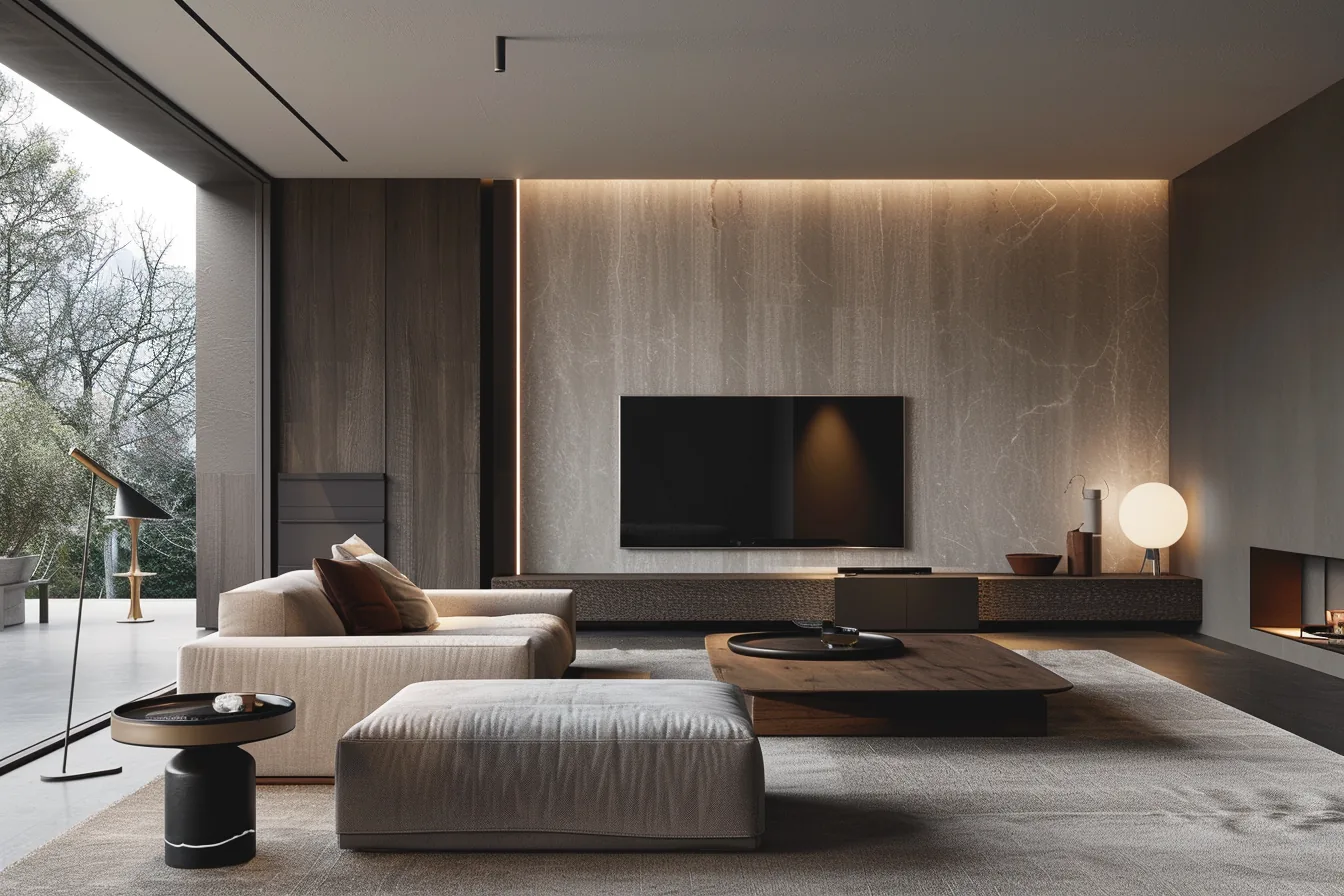
Media & TV Walls: integrated TV panels produced to project-specific layout, finish and dimensions.
4. Is there one contract or five?
For a villa fit-out or a hotel room floor, the buyer's real cost is coordination. Panels from one vendor, media units from another, doors from a third, and someone has to police tolerances between all three. With turnkey solutions covering villas, hospitality and offices, the same team handles design coordination, production, logistics and site support, which keeps a single party accountable for the finished wall.
SANTERSON's stated workflow runs consultation, design and planning, production, logistics, installation and after-sales. The practical benefit is that the shop drawings you approve are the drawings the factory builds from, and one package ships together instead of three deliveries chasing each other.
5. Packaging, shipping and arrival condition
Large panel elements are damaged in transit far more often than in manufacture. Ask specifically how panels are crated — vertical or flat, edge protection, whether the finish face is separated — and how the crate markings map to your room-by-room installation sequence. Logistics and door-to-door delivery covers freight forwarding by sea, air and rail, customs paperwork, packaging and container loading, tracking and delivery to site. Confirm Incoterms, insurance cover and the delivery address on your own project; do not assume a quoted service level until it is in the contract.
6. Installation support and what happens afterwards
A wall system installed by a local crew who has never seen this detailing will need information: setting-out drawings, a fixing schedule, an installation sequence, and someone to call when the on-site dimension differs from the drawing. Ask whether the supplier provides on-site guidance or remote supervision, and what is included. Installation and after-sales support lists on-site installation, inspection and snags, warranty coverage, spare parts and ongoing maintenance; the exact terms, response times and exclusions should be confirmed for your project before order.
A short buyer checklist
- Made-to-measure sizing against site-surveyed dimensions, not catalogue modules.
- Physical finish samples approved before production, matched across panels and joinery.
- Technical interface drawing covering ventilation, cables, mounting and access.
- One accountable supplier for the wall and its adjacent elements.
- Crating and crate-marking agreed against the installation sequence.
- Written installation support scope plus confirmed warranty terms.
Send us the wall, not just the panel
If you are specifying integrated TV panels for a villa or hotel project, share the room elevation, the screen recess envelope and your services layout. The team at SANTERSON can quote the complete wall — panel system, media units, concealed door and matching finishes — against one finish schedule and one delivery. Contact PHILLIP on WhatsApp +86-13928214007 or email santerson@qq.com, or use the contact page.
Frequently asked questions
Can integrated TV panels be matched to existing cabinetry on a renovation?
Yes, when the existing work is accessible for sampling. Send or courier a sample of the current finish and the supplier matches veneer species, cut and lacquer sheen; matching a heavily weathered surface is where buyers should expect a close match rather than an exact one.
How far in advance should media walls be specified?
Before first-fix services. The recess envelope, cable routes and backing frame affect electrical and framing work, so a late decision means chasing site works. Specifying at the same stage as joinery keeps one coordinated set of drawings.
Do you supply panels only, without the rest of the fit-out?
Both work. Single-element supply is possible, but buyers usually consolidate because matching finishes across panelling, media units and doors is easier under one production order.
All dimensions, material selections, hardware, electrical arrangements, freight terms and after-sales terms for integrated TV panel projects are confirmed individually per project before production. Company figures such as factory area and export share vary between pages on this site and should be verified with the sales team.