
A modern balance arm wall lamp looks simple on a mood board and complicated on a purchase order. One long arm, one adjustable head, one circular wall base — and yet this is the fitting that gets value-engineered out of a project most often, because two suppliers can quote visually similar sconces that behave very differently once they are on site: different projection from the wall, different head movement, different finish, different driver behind the same shade. The questions below are the ones worth putting to any supplier before you approve a sample for a living room or study.
What the product actually is
The Modern Balance Arm Wall Lamp - Minimalist Long Arm Sconce for Living Room & Study on our catalogue has a circular wall base, an extended balanced arm and an adjustable light head. Its slim linear structure gives precise directional light and reads as a sculptural minimalist accent on walls, dining areas, studies and living rooms.
That description matters for procurement, because the form factor is the reason this style works in project interiors at all:
- The arm carries the light head away from the wall, so one fitting can serve a reading position or a desk corner instead of only washing the surface behind it.
- The adjustable head lets the same fitting cover task work in a study and softer light over a sofa in an adjacent living area.
- The slim linear profile stays visually quiet against joinery, panelling and headboards, which is why specifiers use it where a decorative shade would compete with the interior.
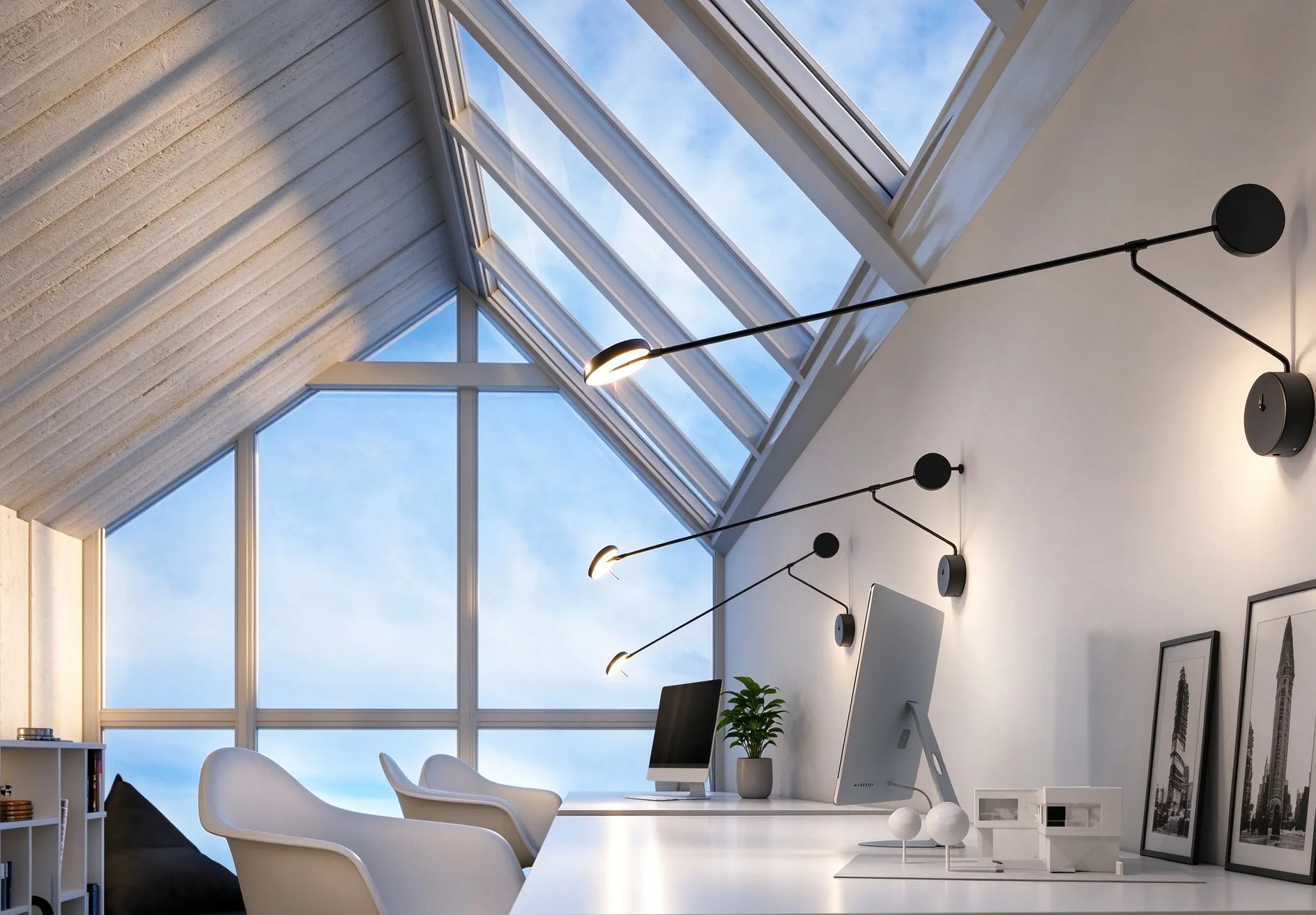
Circular wall base, extended balanced arm and adjustable head — the three elements a buyer should have confirmed before sampling.
Specification checks that decide whether the sample matches the drawing
Ask for these as numbers in writing, not as adjectives. If a supplier answers with "modern", "minimalist" or "hotel quality", you are still buying a picture.
| Item to confirm | Why it decides the outcome |
|---|---|
| Arm projection and overall width | Determines whether the head clears the back of a sofa, the edge of a desk or a bedside table, and whether the fitting can sit beside drapery or door leaves without fouling them. |
| Mounting height range and wall-base diameter | Fixes where electricians set out the back box. A changed base size after first fix means patching and re-decoration. |
| How the head adjusts, and how it holds position | Friction joint, ball or hinged knuckle — and whether it stays put after repeated adjustment in daily use. |
| Light distribution: where the beam lands, and what the wall does | A directional fitting can throw glare into a seated eye line or ring the wall behind it. Ask for lit photographs of the actual head, not renders. |
| Driver location and whether replacement is possible | Integrated drivers inside a slim arm are hard to service after installation. Knowing where the driver sits tells you how maintenance will happen in year three. |
| Finish build-up on the arm and base | The same "black" or "brass-look" can be powder coat, plating or a thin coating. Ask what process is used and how the finish is cleaned on site. |
| Fixings supplied, and the substrate they are rated for | Plasterboard, brick, timber battening and stone need different anchors and, in some cases, blocking behind the wall set out during construction. |
| Electrical data: voltage, wattage, colour temperature, dimming behaviour | These values are not shown on our product page for this model. They must be confirmed from your current datasheet and checked against the local supply and control system before ordering. |
How a project buyer reads supplier capability for this fitting
A single wall lamp is rarely the problem. The problem is that it has to match everything else in the same room, ordered from three different vendors.
1. Can they finish it to your joinery, not only their catalogue?
Long arm sconces sit against veneer, lacquer and stone panels more often than against plain paint. Check whether the supplier can produce bespoke finishes and textures as part of custom and OEM service, and ask what a finish sample looks like — a coated offcut of the actual arm profile, not a colour card.
2. Can they supply the rest of the room's lighting to match?
Where one fitting is directional and task-led, adjacent rooms usually need ambient light in the same family. Our lighting products range covers ceiling, wall, floor and pendant lights, so a study sconce, a bedroom wall light and a living room pendant can be specified with consistent finish and light quality rather than matched after the fact.
3. Do they understand walls, not only lamps?
Setting out a wall fitting against panelling is a coordination job. SANTERSON supplies building and construction materials alongside furniture, so wall finishes, joinery and the fixtures that penetrate them are handled in one production plan instead of three.
4. Is the quotation a scope or a price?
Confirm how the fitting is packed and protected, how many spares accompany each container, and what happens when one arm arrives bent. Our logistics and door-to-door delivery service covers freight forwarding, customs paperwork, packaging and container loading, shipment tracking and door-to-door delivery; the practical detail for a buyer is who owns damage in transit and how replacement units are shipped.
5. What happens at handover?
Ask what installation and after-sales support includes for lighting: adjustment of heads to the approved lighting layout, snags list handling, spare parts availability and warranty terms in writing. Directional fittings get adjusted on site — the question is who does it and at what cost.
A sample checklist worth enforcing
- One physical sample, mounted on a board of the same finish used in the project.
- Lit photographs taken at the room's actual ceiling height and ambient light level.
- The datasheet with voltage, wattage, colour temperature and dimming data signed off by your electrical consultant for the destination market.
- A written record of arm projection, head adjustment method and driver location.
- Finish sample approved against the joinery or panel sample, under site lighting.
- Spare quantity per order agreed, plus how replacements are shipped.
Where this fits in a one-stop procurement
Buyers who group lighting with the joinery, wall finishes and furniture it sits against save themselves the coordination cost. As a one-stop furniture and building materials supplier, SANTERSON has operated since 2008 as a China-based manufacturer serving villa, hospitality and office projects, with services running from design consultation and product specification through production, logistics, installation support and after-sales. That means the arm projection agreed with your designer can be carried through to the wall build-up, the joinery opening and the delivery schedule in one plan.
Send us the lighting layout
Share the room drawings or a reference image of the balance arm sconce you are specifying, together with target quantities and destination city. We will confirm what can be produced, which finish samples we can send, and what documentation you need for electrical approval — before you commit to a batch.
Contact SANTERSON to start the sample review.