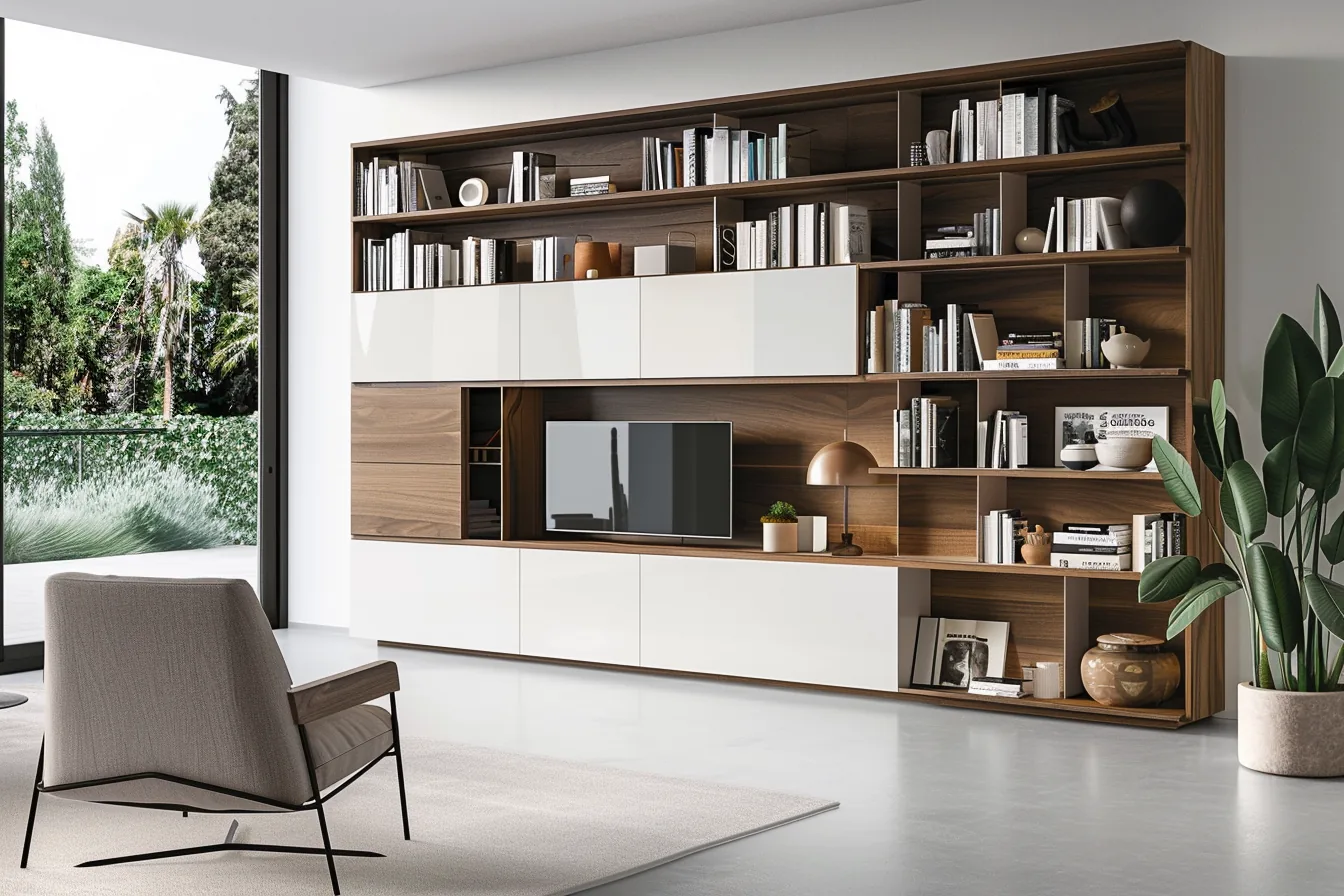
Why Closed Bookshelves Are Specified Differently From Open Shelving
Closed bookshelves look simple on a drawing: carcass, shelves, doors. In production they are one of the more specification-heavy items in a joinery package, because doors, hardware and internal fit-outs all change price and lead time, and none of them can be corrected after the panels are cut. Santerson Closed Bookshelves are made to measure for residential living projects, with finish, layout and dimensions set per project rather than chosen from a fixed catalogue size. That flexibility is exactly why the specification conversation matters: what you confirm at quotation stage determines whether the unit arrives as a clean built-in or as a site problem.
The practical list below is organised the way a manufacturer needs it. Each item is something to raise in writing before an order is placed, with the reason it affects cost or fit.
1. Dimensions and How the Unit Meets the Room
Send more than a wall length. A closed bookshelf quotation should be based on overall height, width and depth, plus how the unit is expected to meet floor, ceiling and side walls.
- Depth first. Shelf depth drives everything downstream: paperbacks sit comfortably on a shallower shelf, while display objects, storage boxes and large-format books need more. Depth also decides whether doors can open without fouling a passage or a bed.
- Floor and ceiling conditions. Older villas and apartments rarely have square corners or level floors. Confirm whether the unit is scribed, packed out, or detailed with a shadow gap, and who is responsible for making good on site.
- Carcass versus niche. A unit built into a prepared recess behaves differently from a freestanding carcass against a finished wall. Say which one you are buying.
If the run continues across the ceiling line or wraps an outside wall, raise it early. Wrapping corners and returning a closed bookshelf into adjacent joinery is a detailing decision, not an on-site adjustment.
2. Layout: What Goes Behind the Doors
Closed units are usually specified for storage density, so internal layout is worth more attention than the exterior.
| Internal element | What to specify | Why it matters |
|---|---|---|
| Fixed versus adjustable shelves | Number of shelf rows, pitch of adjustment holes, whether shelves are pinned or captured | Adjustable rows cost more but let owners reconfigure the unit for years of use |
| Shelf span and load | Clear span of each shelf and what it must carry: books, archives, ceramics, equipment | Long unsupported spans sag; a centre support or thicker panel may be required |
| Drawers and sliding elements | Drawer count, runner type, load rating, whether runners are soft-closing | Runners are ordered with the carcass; substituting later means new fronts |
| Doors as storage faces | Whether door interiors carry shallow racks or stay clear | Changes door thickness and hardware loading |
| Cable provisions | Where cables pass, whether grommets or cut-outs are needed | Cut-outs must be planned before panels are machined |
Where a project needs both display and concealed storage in one wall, mixing closed units with open shelving is normal practice. Our Santerson Modular Bookshelf Systems are configurable to the same project-specific dimensions and finish options, so a combined run can be specified as one package instead of two unrelated orders from different suppliers.
3. Doors: The Single Biggest Cost Variable
Doors are where closed bookshelves separate into price bands. Specify all four questions together, because they interact.
- Door type. Hinged, sliding or lift-up. Sliding doors need track and clearance detail; lift-up doors need mechanism space above the unit.
- Panel style. Flat panel, framed, ribbed glass or clear glass fronts each sit in a different cost band and read very differently in a room.
- Hinge hardware. Concealed or exposed, soft-closing or standard, and the required opening angle where the unit sits close to furniture or circulation.
- Handle strategy. Handles, integrated pulls or push-to-open. Push-to-open needs clearance behind the door; a handle choice should be tested against the finish, since some surfaces show contact marks.
4. Finish and Material Selection
Material and finish are project-level decisions on our side: the Custom & OEM service covers bespoke finishes and textures, with material choices spanning wood, metals, engineered stone and laminates, supported by 3D modelling and prototyping before production.
For buyers, three things decide whether a finish looks correct once installed:
- Grain direction and matching. Veneered and wood-effect panels have grain. State whether grain runs vertically or horizontally, and whether adjacent units must match as one continuous pattern.
- Sheen level. High gloss reflects lighting layouts and shows fingerprints in a family room; matte surfaces are more forgiving but read differently under warm lighting.
- Edge treatment. Where the unit terminates in view, ask how edges are finished. A visible return edge is the detail people notice first.
Ask for physical samples of the exact panel and door combination you have specified, not a generic finish swatch. Colour under showroom lighting and colour beside your own wall finish are two different decisions.
5. Lighting Inside the Unit
Closed bookshelves with glass fronts or open display bays usually need integrated lighting, and lighting has to be designed into the panels. Our Santerson Integrated Cabinet Lighting is specified together with the joinery, so wiring routes, driver location and switching are agreed before production rather than solved by surface trunking on site.
- Confirm where the driver sits and whether it remains accessible for service.
- Confirm switching: door-activated, wall switch, or sensor.
- Confirm colour temperature against the room lighting scheme so shelves do not read warmer than the rest of the wall.
6. Consistency With the Rest of the Joinery Package
A closed bookshelf rarely stands alone. It usually shares a wall or a corridor with wardrobes, media units and tall storage, and those items must match in carcass colour, door profile, edge thickness and hardware family. Ordering them together avoids the classic defect of a finished room: three similar-looking units that do not quite match because they came from separate orders.
Built-in furniture such as wardrobes, media walls and closed shelving can be specified through one package under our Built-in Furniture range, with the same finish schedule and hardware list applied across all items.
7. Delivery, Installation and What You Confirm at Handover
For international projects, closed bookshelves are panelised flat-pack or assembled carcasses depending on access and freight method. Two points to settle in the quotation: how the unit is packed and loaded, and who installs it. Our services cover logistics and door-to-door delivery, then installation with inspection and snagging at handover.
At handover, check the things that are cheap to fix before sign-off:
- Door alignment and consistent gaps across all doors in the run
- Soft-closing action on every hinge and drawer
- Shelf pins seated fully in every row, with no missing covers
- Unit level and scribed edges tight to floor, ceiling and walls
- Lighting output even along each shelf, with drivers accessible
A Short Specification Checklist Before You Request a Quotation
- Wall elevation with overall height, width and depth, plus floor and ceiling condition
- Intended shelf contents, so spans and load can be engineered rather than guessed
- Door type, panel style and hardware family
- Finish schedule matched to the adjoining joinery, with samples approved in writing
- Lighting layout, driver position and switching method
- Packing method, delivery address access, and installation responsibility
Bring those six items to the first conversation and the quotation comes back comparable rather than approximate. Send your drawings through our contact page and we will confirm feasibility, finish options and configuration for your project before pricing.