
Why a Separate Bidet Still Matters in Hospitality and Villa Bathrooms
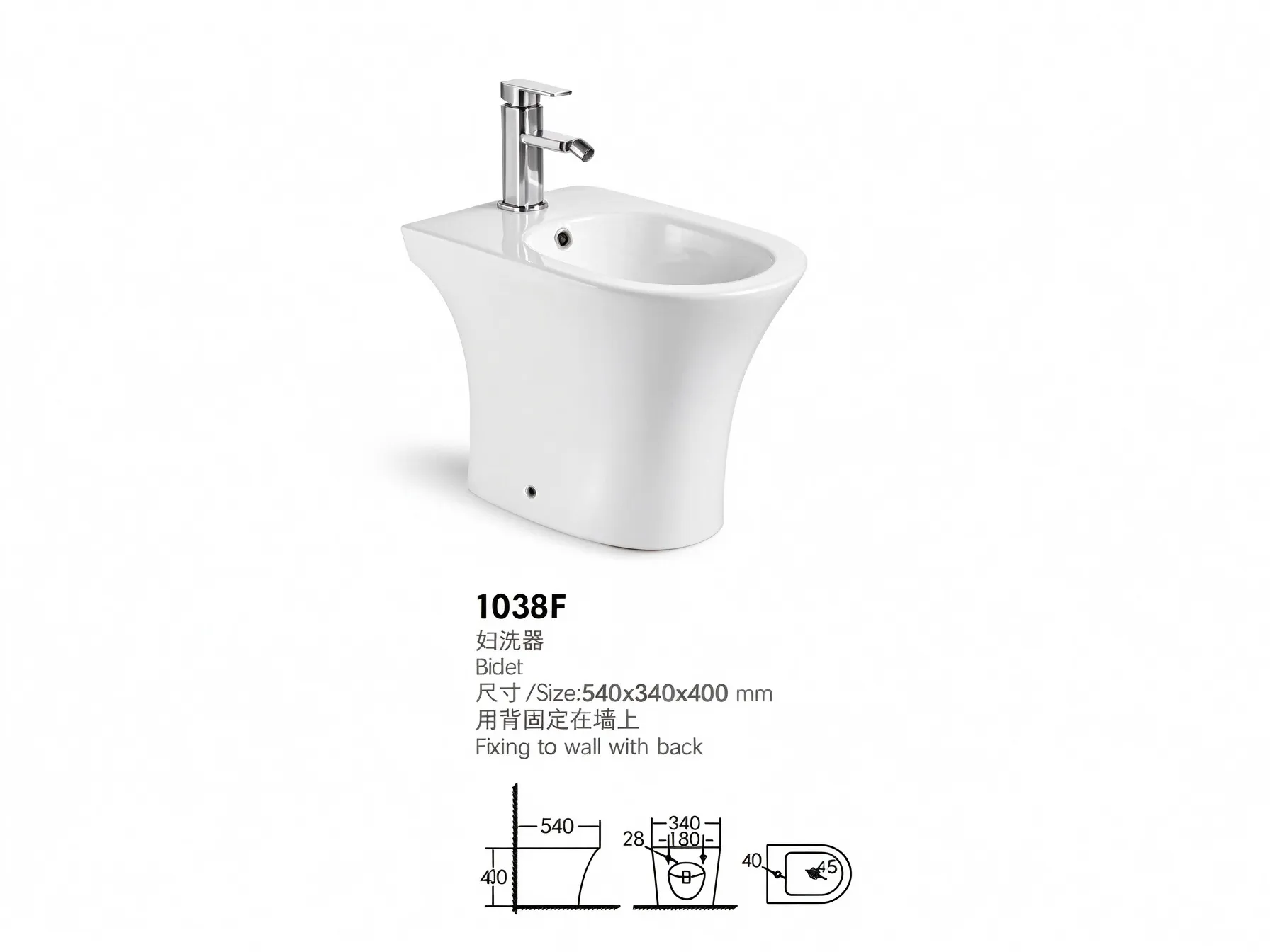
A floor standing bidet 1038F is a freestanding ceramic bidet basin that sits beside the water closet and is fixed to the wall through its back support. In guest bathroom layouts across Southern Europe, the Middle East and large parts of Asia it is an expected fitting rather than an extra. When a hotel group or a private villa owner specifies sanitary ware for a new build or a refurbishment, deciding whether the guest rooms carry a bidet changes the drainage layout, the fixture count per room and the procurement schedule at the same time. Getting that decision late is what turns a simple ceramic item into a site problem.
This guide looks at how to specify a floor standing bidet for a hotel or villa project: which installation conditions decide between a floor standing and a wall hung model, how to keep a matching sanitary suite across guest rooms and public restrooms, what to check in the glaze and body shape from a housekeeping point of view, and how a fixture order fits into a wider package of furniture and building materials.
Floor Standing or Wall Hung: The Decision Starts at the Drain
Bidets in this range are supplied in two mounting logics, and the choice is usually made by the slab below rather than by the designer above it.
The 1038F stands on the finished floor and braces against the wall behind it. Because its waste connection is reached at floor level, it suits positions where the soil pipe drops through the slab, and it does not require a concealed frame or a reinforced stud wall to carry the load. For villa bathrooms with cast-in-situ floors, and for hotel guest rooms built on concrete decks, this is normally the shorter route: set out the trap position, fix the back bracket to the wall, connect, seal and grout.
A wall hung alternative such as the wall hung bidet 1004F carries the fixture on a concealed frame instead, with the waste taken into the wall. That leaves the floor beneath the unit clear, which housekeeping teams value because mopping and disinfecting the perimeter of a bathroom becomes a single pass rather than a lift-and-reach task. It also reads as a cleaner line in a minimalist or European-style bathroom. The trade-off is structural: the wall build-up has to be set out before the tiles go on, not after.
A practical way to split a project is to use the wall hung option in guest bathrooms where the frame can be built into the partition from the start, and the floor standing option in staff, service and secondary bathrooms, or wherever an existing slab already has a floor outlet. Both approaches are available in the same catalogue, so a single supplier covers both conditions on one project.
Keeping One Sanitary Suite Across Guest Rooms
A bidet rarely travels alone. In a guest bathroom the visible set is the water closet, the wash basin and, where specified, the bidet - and if those three are drawn from different series, the room looks assembled rather than designed. Mixed radii on the ceramic, slightly different whites, and mismatched seat fixings are the usual symptoms, and they are visible to a guest within seconds of entering the room.
The 1038F is drawn to pair with the rest of the 1038 series. That gives a project team one ceramic profile across:
- Two piece washdown toilet 1038A, a close-coupled WC specified for both S-trap floor outlets and P-trap wall outlets, which is useful when a single hotel tower mixes slab-drained and wall-drained bathrooms.
- Wall hung toilet 1038W, a rimless wall mounted WC for guest bathrooms where a concealed cistern and clear floor area are already part of the design.
- Wall hung basin 1038WB, a wall mounted wash basin fixed by its back panel, with a bowl depth set to limit splashing at the vanity.
Specifying one series per room type also simplifies the bill of quantities. The spare-parts store holds one set of seat and cover sizes instead of three, and a replacement basin ordered in year six still matches the units installed in year one. For a villa owner working through several bathrooms at once, the same logic removes most of the visual guesswork.
What to Check on the Ceramic Before You Order Quantities
Bidets take more daily handling than most people expect, and in a hotel they are cleaned with the same frequency as the WC. Three details decide whether the fixture still looks presentable after several years of that routine.
Glaze quality
The 1038F is fired vitreous ceramic with a glossy glaze over the whole body. What matters on site is whether the glaze runs continuously over the rear rim and inside the overflow area, because unglazed or thinly glazed patches are where limescale and staining start to hold in hard-water locations. Ask the factory for photographs of the underside and the rear face of a sample before approving a bulk order, and check that the ceramic colour is stated with a reference code rather than simply "white", since shades vary between firings.
Body shape and clearance
The 1038F body is shaped with a curved, ergonomic rim so the user sits on a supported surface rather than a flat shelf. On paper that is comfort; in layout terms it sets the footprint and the knee clearance. Confirm the front projection against your bathroom drawings before fixing the position of the basin cabinet or the shower screen, because a bidet shifted by 100 mm to gain clearance usually costs access at the WC.
Cleaning routine
A smooth glazed surface with few crevices can be wiped down with a neutral cleaner on the normal housekeeping circuit. Avoid acidic descalers as a standing instruction: they are effective on scale but dull the glaze over time, and a dulled patch then holds scale faster. Where water is hard, set a periodic descaling step at a stated interval rather than treating every clean as a descale.
Where Bidets Belong in a Hotel Room Type Plan
Not every bathroom on a project needs one. A room-type plan is the cheapest place to make that decision, because it is drawn long before any tender package goes out.
| Location | Typical treatment | Why |
|---|---|---|
| Standard guest bathroom | Include where the source market expects it; otherwise reserve the drainage and cover the outlet. | Reserving the drop costs almost nothing at slab stage and protects a later upgrade from breaking the floor. |
| Suites and villas | Include as standard, in the same series as the WC and basin. | Guest expectation at this level is high and the bathroom is a selling point rather than a service space. |
| Public and lobby restrooms | Usually omitted; concentrate on WC, basin and touch-free fittings. | High turnover and vandalism risk make the additional fixture hard to justify. |
| Staff and service bathrooms | Floor standing models where a floor outlet already exists. | Simple fixing, no concealed frame, and easy replacement during the operating life of the building. |
| Villa guest bathrooms and wet rooms | Wall hung where the partition is being built to a design; floor standing in refurbishment. | Clear floor area under the fixture speeds daily cleaning on tiled floors. |
The point of reserving drainage even where no bidet is installed is simple: a covered floor outlet with a capped soil drop can be converted in an afternoon, while adding a waste after tiling means lifting the floor and re-waterproofing the shower zone.
Ordering Sanitary Ware Inside a Project Package
Ceramics are awkward to buy alone. A project team that orders bidets and WCs from one supplier, tiles from another, cabinetry from a third and lighting from a fourth ends up reconciling four sets of lead times, four packing lists and four delivery windows - and the bathroom still cannot be finished until the slowest package arrives.
SANTERSON works as a furniture and building materials supplier, so sanitary ware is specified alongside the other elements of the same room: engineered wood flooring, wall panels and ceiling systems, interior doors, built-in cabinetry and vanities, lighting, curtains and loose furniture. That single package approach shortens the coordination loop for a fit-out, because one technical team checks that the basin width matches the vanity carcass, that the tile colour and the ceramic white were selected together, and that the door swing still clears the WC.
Through custom and OEM service, projects can also place non-standard quantities against a shared tooling base - for example one series across several room types with different trim or packaging requirements. Logistics and door-to-door delivery covers freight by sea, air and rail together with the export paperwork, so ceramic consignments can travel with the joinery and furniture rather than as a separate shipment. Installation and after-sales support extends to site inspection and replacement parts after handover.
Australian villa and apartment work is a regular part of this kind of sourcing, with published project references in Sydney, Melbourne, Perth and Willoughby. Freight terms, duties and the local building requirements that apply to waste and vent arrangement should be confirmed for each project before order placement; they are set by the authority having jurisdiction on site, not by the product catalogue.
A Short Specification Checklist
- Confirm the drainage condition for each bathroom - floor outlet or wall outlet - before choosing between the 1038F and a wall hung bidet.
- Take setting-out dimensions from the technical sheet of the exact model, and issue them to the site team before the slab pour or frame closure.
- Specify the WC, basin and bidet as one series per room type so spares and replacement units stay compatible.
- State the ceramic colour with a reference code, not a generic "white", on the order.
- Agree the cleaning regime with the operator at handover, including how often descaling is scheduled in hard-water areas.
- Reserve capped drainage in bathrooms where a bidet is not specified now, so a future upgrade does not open up the floor.
- Order ceramics in one consignment with the related joinery and finishes wherever possible, and check lead times against the room completion date rather than the delivery date.
Next Step
If your project needs a floor standing bidet specified alongside matching sanitary ware, cabinetry and interior finishes, send us the room-type drawings and the fixture schedule. We will return a specification for the 1038 series or the closest suitable alternative, with quantities by room type, packing detail and a consolidated quotation covering the bathroom package together with the rest of the fit-out.
Send your bathroom schedule for a consolidated quotation
Contact SANTERSON to specify bidets, WCs and basins as part of one project package covering furniture, sanitary ware, wall and floor finishes, lighting and built-in joinery. Enquiries receive a reply within 24 hours during business days (Monday to Saturday, GMT+8). Visit our contact page or browse the full sanitary fixtures and bathroom range.