
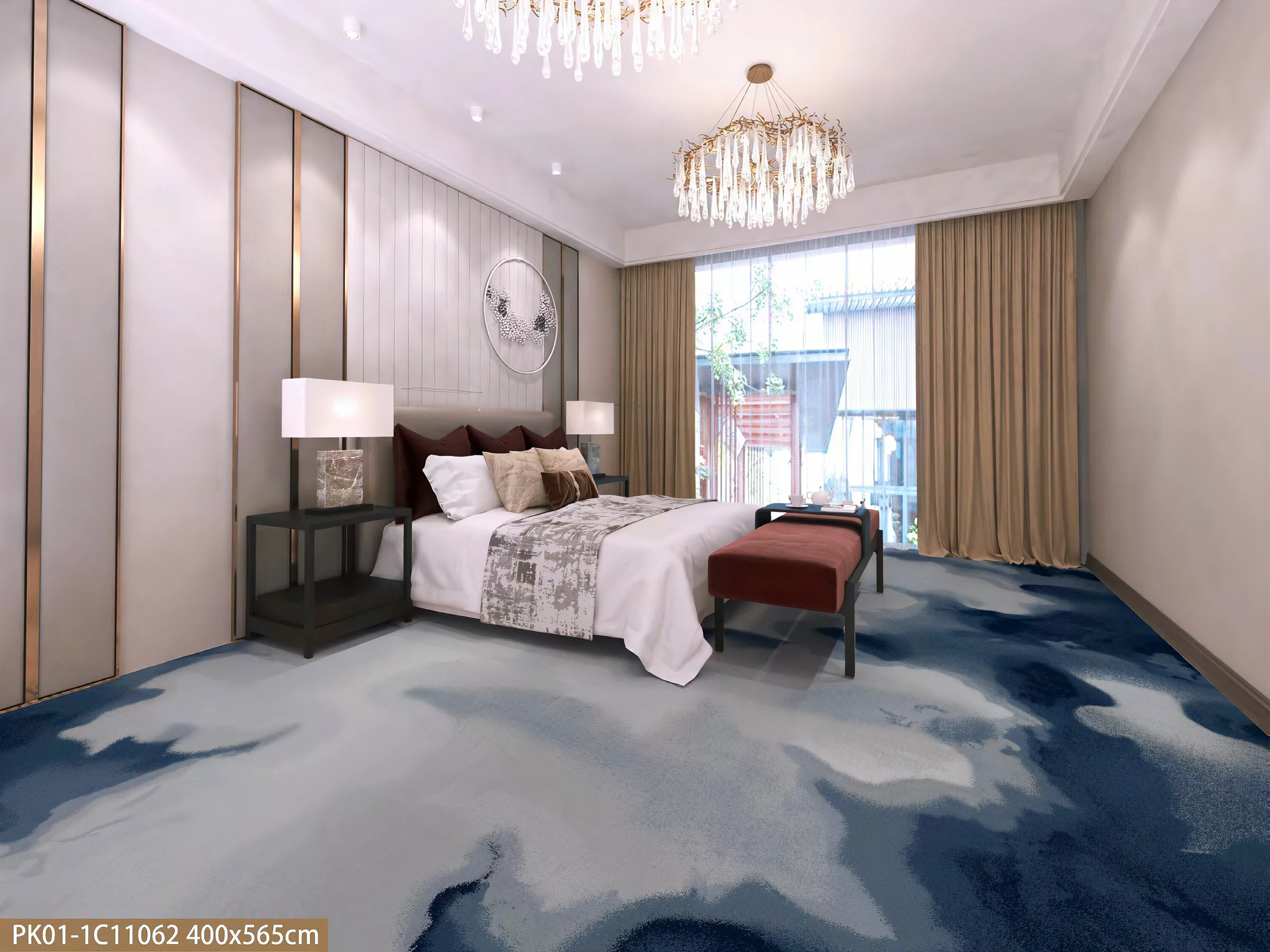
A blue-grey ink-wash carpet is an easy decision on a mood board and a difficult one on site. The palette reads calm and upscale in a rendering, then has to survive housekeeping cycles, luggage wheels, sunlight through guest-room curtains and a villa owner's expectation that the floor still looks new three years after handover. Before a purchase order goes out, procurement teams should work through six risk areas that decide whether an ink-wash patterned carpet performs or becomes a replacement cost.
1. Pattern scale and repeat are confirmed against the actual room, not a swatch
Ink-wash designs behave differently from small geometric repeats. A brushstroke motif that looks balanced on a 30 cm sample can be cropped by the bed base, split by a wardrobe line or disappear entirely under a desk chair in a standard guest room. Ask the supplier to place the pattern against your furniture layout and door setting before dyeing starts, and confirm where the repeat begins relative to the doorway.
In villas, the same issue reverses: an open-plan lounge may need a much larger scale than the sample suggests. Request a scaled printout or a digital mock-up of your room rather than approving from a catalogue image alone.
2. Colour matching across dye lots and batches
Blue-grey is unforgiving. Two adjacent rolls from different dye lots can show as a visible band under window light, and the grey component shifts warmer or cooler depending on the fibre blend and backing. For phased work — a hotel block handed over in two tranches, or a villa where guest rooms and corridors are carpeted months apart — batch consistency becomes a contractual matter, not a preference.
Practical controls: order the full quantity for each phase in one production run; keep the approved physical sample signed and dated on both sides; specify which reference (the supplier's card or your own submitted colour standard) governs acceptance. Where an area is likely to need a future repair, hold back spare material from the same batch.
3. Fibre and construction chosen for the traffic, not the finish
Guest rooms and private villas have opposite failure modes. Hotel rooms are cleaned on a fixed cycle with extraction machines and detergents; villa floors see bare feet, pets and infrequent deep cleaning. A blend that tolerates one may not tolerate the other.
- Pile height and density. Lower, denser pile hides caster marks and vacuum tracking; tall plush shows every wheel path within months.
- Fibre blend. Wool-rich blends recover from compression and resist visible traffic lanes; synthetic blends clean predictably and hold colour consistently between batches. Blends can be specified per project.
- Backing and edge stability. Wall-to-wall installation in a room with radiant flooring or heavy drapery needs a backing that will not telegraph through the pile or creep at the skirting.
Because size, colour, pattern and fibre blend are all configurable on made-to-order work, this is the decision to lock down in writing. The customizable commercial carpet range at SANTERSON is produced to project specification rather than stocked to a fixed format, so the specification sheet — not a product code — becomes the reference document for acceptance.
4. Sampling before production, and what the sample must prove
Samples are standard on bespoke carpet work, but many teams approve them too early in the process. A useful sample review tests four things at once: colour under the room's actual lighting (warm LEDs in a guest room read very differently from daylight in a villa lounge); pattern scale at the intended size; pile behaviour under a chair leg and under foot traffic; and how the edge finishes against your skirting profile. Approving a sample that only answers "do we like this design" leaves all four risks unresolved.
5. Quantity take-off, cutting waste and pattern matching
Directional patterns cannot be rotated to save material. A guest-room floor cut from a roll running one way may need a second roll aligned to the same motif, which raises the wastage allowance well above what a plain carpet would consume. Compare take-offs on the same basis: net floor area, plus the pattern repeat allowance, plus off-cuts for wardrobes and niches. Under-ordering mid-project is where batch-matching risk in point 2 becomes unavoidable.
For villa work with irregular geometry — curved bays, stair landings, a dressing room reached through an opening — supply the measured drawings rather than a room list, and confirm who signs off the cutting layout.
6. Delivery, storage and installation sequence
Made-to-order carpet arrives on a production schedule, and it needs conditions on site that match: dry storage, acclimatisation before fitting, and an installation slot after wet trades, painting and joinery are complete but before loose furniture lands. When one of those steps slips, the carpet is either laid damp or stacked in a corridor for weeks — both show up later as seams, odour or edge damage.
If the same supplier also handles your freight and fitting, this becomes a coordination question inside one scope instead of an argument between three contractors. That is one reason project buyers group carpet with other finishes under turnkey furnishing and building materials delivery rather than sourcing each finish separately.
Pre-order checklist
Confirm before the purchase order is released
- Pattern placement drawing for each room type, approved by the designer or client.
- One production run per phase, with batch numbers recorded on the packing list.
- Signed colour and pile sample retained as the acceptance reference; spare material held back.
- Fibre blend and pile height written into the order against the cleaning regime you will actually use.
- Take-off with pattern repeat allowance included, reviewed by both buyer and installer.
- Agreed delivery window, storage conditions and installation sequence on site.
Where the risk usually lands
In practice, most disputes over a decorative carpet are not about taste. They are about an unrecorded approval, a second batch that nobody flagged, or a wastage figure agreed verbally at quotation stage. Every item above costs nothing to settle on paper before production and becomes expensive after dyeing has started.
If you are specifying carpet for guest rooms, suites or villa floors and want the pattern, colour and blend confirmed against your drawings first, send through the room schedule and SANTERSON will confirm what can be produced to it.
Send your floor plans, room quantities and target cleaning regime to request a specification review and sample before you commit to a production run.