
A single arc floor lamp rarely decides a hospitality or villa project on its own, but it is exactly the kind of item that exposes how well a package has been coordinated. It stands on the finished floor, sits under the ceiling detail, reads against the dining table and sofa, and arrives in the same container as everything else. When one of those relationships is wrong, the lamp looks like an afterthought no matter how well specified it was on paper.
The Modern Semicircle Arc Floor Lamp, Silver Dome Standing Lamp for Living Room & Dining Room is a good worked example, because its geometry does most of the work. A curved arch pole carries a reflective dome shade across an opening, so the piece has to be judged against furniture and circulation at the same time as it is judged as a light source. The notes below follow the order a procurement team actually uses when reviewing that kind of item for a Furniture and Building Materials Project Procurement: what the product page establishes, what it does not, and which questions close the gap before an order is placed.
1. Read the form before the finish
The published copy describes three elements: an elegant curved arch pole, a reflective silver dome shade and a sturdy square base, with a sculptural form that spans gracefully over furniture. That combination is what separates a semicircle arc lamp from a straight-standing reading lamp. The arch creates a covered zone beneath the shade, which is useful in an open-plan living room where the seating group has no wall to lean against, and useful beside a dining table where a pendant would compete with the table height.
It also creates the first evaluation problem. A piece that spans furniture must be dimensioned against the furniture. Arch reach, overall height and base footprint are not decorative details in a proposal; they decide whether the shade clears the sofa back, whether the base fits between the rug edge and the traffic line, and whether the lamp can be placed at all without blocking a door swing. If a drawing shows the lamp next to a sofa rather than over it, the intent is different from the product's stated use, and that difference should be settled at specification stage instead of on site.
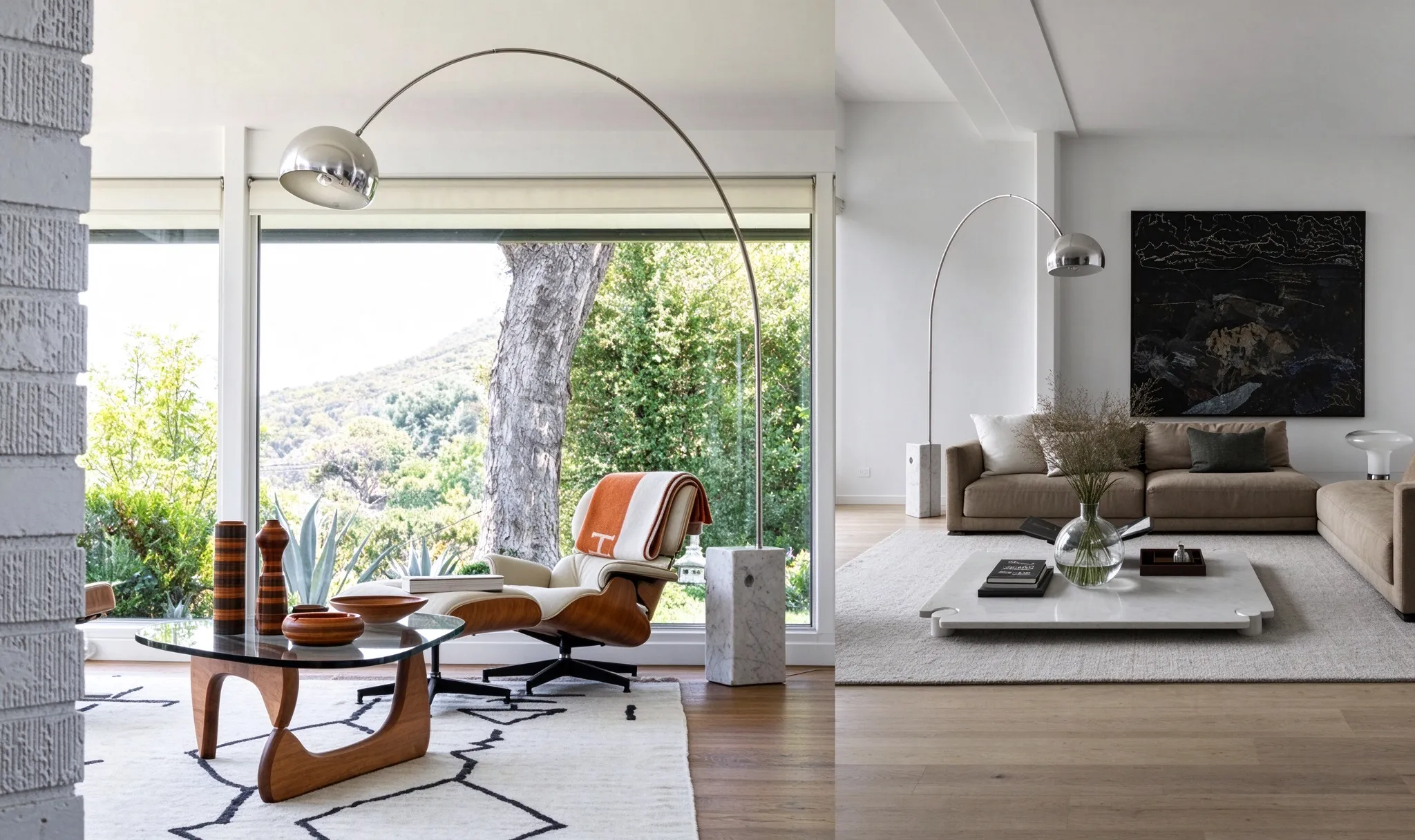
Semicircle arc floor lamp: curved arch pole, reflective silver dome shade and square base, as published on the product page.
2. Separate what the page states from what must be confirmed
The captured product copy is a design description, not a technical schedule. It establishes the visual and material character of the piece; it does not carry output or electrical data. The source note on the record is explicit that lumens, wattage, colour temperature, IP rating and electrical compliance were not present in the captured copy and need confirmation before publication. For a commercial proposal, that gap is normal at catalogue stage — and it is the part of the evaluation that has to be closed in writing.
| Evaluation point | Established by the product page | To confirm with the supplier before ordering |
|---|---|---|
| Form and composition | Curved arch pole, reflective silver dome shade, square base, sculptural spanning form | Overall height, arch reach, base footprint and total weight for floor loading and rug selection |
| Stated application | Living rooms, dining areas and premium interiors | Whether the same finish and dimension are offered for the room sizes in your drawings |
| Light output | Described as soft ambient light | Lamp type, whether an LED module is integrated or a lamp is supplied separately, and switching or dimming arrangement |
| Colour temperature and finish consistency | Reflective silver dome shade | Shade finish sample, and colour temperature consistency across every unit in a multi-room order |
| Electrical preparation | Not specified in the captured copy | Voltage and plug or hardwiring arrangement for the destination country, and cable route to the floor outlet |
| Durability and use class | Not specified in the captured copy | Suitable use class for public-area hotel settings, and spare-part availability for the shade and driver |
A practical rule: if a figure is not on the page, do not let it survive into your bill of quantities as an assumption. Specification sheets that quietly inherit catalogue adjectives are where project lighting packages go wrong.
3. Judge the lamp against the two rooms in its title
Living room
In a living room the arch is usually doing one of two jobs: lighting a seating group from above without a ceiling alteration, or anchoring an open edge where the lounge meets a passage or a dining zone. Both work with this form, because the dome shade throws light downward into the seating area while the arch keeps the base outside the seating cluster. Check the throw direction against the actual layout — a reflective dome aimed at a wall produces glare and wasted output, while one aimed across the seating group reads as designed lighting.
Dining room
Beside a dining table the lamp becomes part of the table's composition rather than a corner accent. Height relative to the tabletop, and where the base stands against chairs that pull out, both matter. A spanning arc can complement a pendant over the table, but two light sources at similar heights in one small room tend to fight each other. Decide first which fixture owns the table, then position the arc lamp clear of chair movement.
Hotel and public-area use
In guest rooms and lobbies the same piece is judged by maintenance as much as appearance: how the shade is dusted, whether the base can be moved for cleaning without marking the floor, and whether a damaged dome shade can be replaced years later. For these settings, ask about spare parts at quotation stage rather than after handover.
4. Evaluate the lamp inside the package, not alone
For villa and hospitality work, a floor lamp is one line among dozens of finishes and products that have to agree with each other. Metal tone is the most visible agreement: a reflective silver dome sits next to window frames, ironmongery, ceiling profiles and table bases, so its finish should be reviewed against the actual samples in the room rather than against a photograph. Flooring, wall panels and rugs shift how much the silver reads as warm or cool.
Coordination also affects logistics and programme. lighting ordered together with furniture, joinery and finishes, one supplier sequence covers production, packing and container loading, and the lamp arrives with the pieces it has to be placed beside. That is why many teams specify lighting through the same channel as their other building materials and fixtures — fewer handovers between trades, and fewer surprises at installation.
5. Where customisation enters the evaluation
Standard catalogue dimensions do not always match a project's room sizes, and that is where custom and OEM service becomes part of the assessment rather than an optional extra. For a spanning arc lamp the sensible customisation questions are dimensional and material: arch reach and overall height adjusted to the seating group or table, base mass and footprint adjusted for stability on the chosen floor covering, and shade finish matched to metals already specified. Material options described by the manufacturer include wood, metals, engineered stone and laminates, with branding and finishing such as engraving and logos where required.
Treat customisation as a schedule item. Prototyping and 3D modelling take time, and an altered dimension changes packing and container loading. Confirm what is genuinely adjustable on this family of lamps, what the minimum order is for a modified finish, and how an approved prototype is signed off before the full quantity is produced.
6. A pre-order checklist
Confirm in writing before release
- Dimensioned drawing: overall height, arch reach, base footprint, weight.
- Electrical data for the destination market: voltage, wiring or plug arrangement, driver details, dimming method.
- Lamp source arrangement: integrated LED module or separate lamp, plus replacement route.
- Physical sample of shade finish and base finish, checked against metals already on site.
- Placement drawing showing the lamp over or beside the actual furniture, with clearances to traffic routes.
- Spare-part terms for dome shade and driver, stated in the quotation.
- Packing list and container plan confirming how the arch pole and base ship — knocked down or assembled.
7. How a single lamp becomes part of a project workflow
The reason this evaluation style is worth the effort is that projects in Australia and elsewhere are usually sourced as a package. The service model described on the site runs through consultation, design and planning, production, logistics, installation and after-sales, with door-to-door freight by sea, air or rail, customs paperwork and shipment tracking handled alongside manufacturing. For buyers, that means an arc floor lamp can be reviewed at the same table as cabinetry, flooring, wall panels and ceramics — which is how you keep a silver dome consistent across ten rooms instead of discovering three different silvers at handover.
Published project references include villa work in Willoughby, Perth, North Turramurra, Melbourne and Sydney, alongside hospitality and office projects. Those references show the type of work handled; they do not by themselves prove scope, dates or performance for any new enquiry, so ask for comparable case detail when you evaluate a supplier for your own project.
Conclusion
A semicircle arc floor lamp with a reflective silver dome is evaluated in three passes. First the form: does the arch genuinely span the furniture it is proposed for. Second the data: dimensions, light source and electrical preparation confirmed in writing, since the catalogue page carries design language rather than figures. Third the package: finish consistency, customisation limits, spares and logistics reviewed together with the rest of the order. Complete those three passes and a decorative item stops being a risk line in the bill of quantities — it becomes one more coordinated element of the fit-out.
SANTERSON is a China-based manufacturer and one-stop supplier of furniture and building materials for villa, hospitality and office projects, operating since 2008 with custom/OEM production, door-to-door logistics, installation support and after-sales service. Product enquiries: Contact.